10 Moisture and Exterior Walls
Due to requirements for thermal conductivity, currently exterior walls typically comprise several layers, each with a separate function. Several of these walls are constructed as two-stage solutions where the outer part acts as a rainscreen and the inner part of the wall provides the required airtightness, vapour tightness, and insulation power (more details to follow below).
Beyond functioning as a weather screen by shielding against rain, cold, and heat, exterior walls should meet several performance requirements, including strength, fire performance, and acoustic performance.
10.1 Moisture Exposure
Exterior walls are typically exposed to moisture when precipitation strikes the facade. The impact is greatest in areas with heavy rainfall and/or wind load as this will result in driving rain. Wind load (and hence the impact of driving rain) is greater for tall buildings than for short buildings.
Furthermore, moisture exposure may derive from humid indoor air infiltrating the wall from the inside. If moisture transport is prevented (e.g., due to vapour-impermeable layers placed in cold spots in the construction) condensation may occur.
In old buildings without moisture barriers, there may also be rising damp, which may result in the lower part of the exterior wall becoming damp.
Finally, in some types of exterior walls, construction-related moisture may occur.
10.2 General Measures to Prevent Humidification
As far as possible, precipitation should be diverted at facade level. However, the infiltration of small amounts of water into the outermost layers in the construction is often unavoidable. Steps must be taken to ensure that any moisture infiltrating the construction can be effectively drained away.
The exterior wall should be constructed so that moisture infiltrating the wall from the inside as water vapour can pass without the risk of humidification occurring. In exterior walls with a vapour barrier, the barrier must be airtight, partly to prevent energy waste and partly to prevent humid indoor air from flowing into the construction. To prevent the risk of condensation, wind barriers, sheeting, and other materials further out in the wall should normally be min. 10 times more open to water vapour diffusion than the vapour barrier.
Exterior walls should be protected against rising damp using an effective moisture barrier/damp proof course between the foundations and the exterior walls. Capillary breaks, such as a damp proof course, should be continued through the construction. Foundation rendering must not be continued across the damp proof course, as the rendering may cause the wicking of moisture.
Finally, steps should be taken to ensure that, as far as possible, the distribution of rainwater occurs evenly across the surface to avoid uneven humidification and soiling. Windowsills should therefore project out at least 30 mm from the facade.
Regardless of the construction of the exterior wall, there are several general structural issues which should be considered to ensure correct short- and long-term moisture performance of the exterior wall. These issues are discussed further in the main section about a constructive moisture control.
The following sections discuss how these structural issues can be implemented for different types of exterior wall.
10.3 Two-Stage Constructions in Exterior Walls – General Considerations
In two-stage constructions, the rain and wind proofing functions are divided between the outer and inner parts of the exterior wall.
10.3.1 Rainscreen
The outer part of a two-stage exterior wall consists of a rainscreen behind which is a cavity, vented by means of openings (see Figure 38). The task of a rain shield is to divert precipitation that strikes the building. Vent openings ensure pressure equalisation between the cavity and the open (i.e., there will be approximately the same pressure in front and behind the rainscreen). Thus, there is no wind load to drive rainwater across the cavity to the inner wall and the inner wall will not be exposed to water load. Furthermore, ventilation in the cavity behind the rainscreen removes water vapour which diffuses through the wall.
The rainscreen could consist of sheet cladding with open joints but could also feature cladding which is itself air-permeable, such as board-on-board timber cladding.
The required pressure equalisation (and thus resistance to rain) can be achieved if the openings in the rainscreen total 0.25–0.5 % of the rainscreen area.
The distance between the rainscreen and the wind barrier should normally be min. 20 mm. However, in areas level with spacer battens a min. distance of 12 mm is acceptable.
The accumulation of water at the bottom of the vented cavity must be avoided (e.g., by installing a drain hole). If the cavity is above foundation level, a 50-mm flashed moisture barrier should be installed against the inner wall (the windproof layer).
If possible, the moisture barrier should be continued on the outside of the flashing profile. The flashing should slope outwards at a gradient of min. 1:5 (see Figure 84).

Figure 84. Flashing of horizontal vent opening with metal profile. The profile is continued min. 50 mm up the reverse side of the slit and (if possible) the wind barrier is continued down and overlaps the flashing. The flashing profile should slope outwards at a gradient of 1:5.
Openings or Slits in the Rainscreen
The openings in the rainscreen are intended in part to ensure pressure equalisation, and in part, to prevent large amounts of driving rain from entering with pressure-compensation airflow. The width of the slit should therefore be 5–6 mm.
Vertical slits (joints) are designed to prevent driving rain from entering the joint directly, striking the wind barrier as shown in Figure 85.

Figure 85. Ann example of flashing over a vertical joint to prevent driving rain from entering the joint and reaching the wind barrier.
Rainscreen and Fire
The rainscreen in a single-storey building can be built as a K1 10 D-s2,d2 (class 2 cladding) (e.g., timber cladding). In taller buildings it may be necessary to use a B-s1,d0 (class A material) (e.g. metal, facade tiles, cement-bound sheeting, or glass). Class 2 cladding could be used in up to 20 % of the facade area in buildings where the floor of the top storey is less than 22 m above grade.
10.3.2 Windproof Layer
The inner part of a two-stage exterior wall must absorb the wind load. It is therefore usually constructed with a windproof layer to protect the thermal insulation against air passage, thus preventing unnecessary heat loss (see section 4.8 Wind Barriers). The windproof layer can be omitted if the thermal insulation material and the joints themselves provide the required airtightness.
It is important that the windproof layer has a suitably small diffusion resistance in relation to the diffusion resistance of a vapour barrier (if used), and in relation to other layers on the warm side of the windproof layer.
Examples of commonly used wind barriers are shown in Table 5, which also indicates the typical fire classification of the products.
For tall or very weather-exposed buildings, there is a significant risk of driving rain penetrating the rainscreen to the windproof layer. The rainscreen should therefore be able to resist moisture load, including mould growth. Consequently, using moisture-sensitive materials such as carton-coated wind barrier plasterboard is not recommended for tall buildings and/or buildings with severe weather exposure.
When using moisture-sensitive materials, it is important that details are finished carefully to prevent water from affecting the inner wall. The windproof layer could be protected by a 50-mm mineral wool layer for example. This places the moisture-sensitive windproof layer in a warmer and drier environment, thereby reducing the risk of mould growth. Furthermore, the mineral wool helps improve the thermal insulation properties of the wall and breaks any thermal bridges in the wall.
Fire-Related Issues
In addition to the primary performance requirements (preventing moisture accumulation and air passage in the thermal insulation material) the windproof layer should also meet fire performance requirements. For example, multistorey buildings are subject to requirements that surface materials meet B-s1,d0 (class A material). This means that the three first and the last material examples in Table 5 apply solely to single-storey buildings.
If the insulation material is a class A material (e.g., mineral wool), the windproof layer is not subject to fire-performance requirements in single-storey buildings. By contrast, multistorey buildings are subject to fire-performance requirements which are tightened proportionally with the height of the building. These requirements may include the use of windproof layers classified as K1 10 D-s2,d2 or K1 10 B-s1,d0 (class 2 or class 1 cladding) and requirements stipulating D-s2,d2 or B-s1,d0 (class B and class A material). For detailed requirements, see BR08 and SBi Guidelines 230 (Hansen, 2013). If insulation materials are used which cannot be classified as class A material, a windproof layer in the form of class 1 cladding is required. This would be the case when using cellulose insulation.
10.4 Brick Walls
To meet applicable energy requirements, even when using energy performance framework calculations, it is usually advisable to build a 410 mm insulated cavity wall with 190 mm thermal insulation in the cavity, rather than a 350 mm cavity wall with only 130 mm thermal insulation as was previously customary. Low temperatures in certain spots on the inside of the walls are prevented by avoiding a full brick seam between the inner and outer halves of walls around windows and doors, which would otherwise act as a thermal bridge. Instead, the halves are joined using wall ties, preferably made of corrosion-resistant material such as steel or copper-tin alloy to minimise the impact of thermal bridging. The seam is filled with 30–50 mm hydrophobic insulation material to break the thermal bridge.
It is common knowledge that water can penetrate half-brick walls while full-brick walls are normally considered waterproof. The degree to which brick walls are rainproof depends on the extent to which the pointing fills out the joints. In practice, cracks and gaps between mortar and brick are virtually unavoidable. Under normal circumstances, the degree of waterproofness is dependent on bricks being able to quickly sorb water. This prevents any significant amounts of water from infiltrating these cracks and gaps.
The water sorbed will later evaporate back into the atmosphere. In building parts that are especially vulnerable to driving rain (such as corners in high buildings), this might occur in amounts that outstrip the water-storage capability of the bricks. A sizeable overhang would reduce this problem. A small overhang will not always be adequate, since the wind can drive the rain far beneath an overhang when the wind and rain is deflected below the roof.
Free parapets should always be securely flashed. Brick-on-edge copings should be designed so that water will not penetrate the underlying brickwork.
At worst, only the actual brick-on-edge course will need replacing if mortar joints and brickwork are damaged by frost.
Although brick walls will normally be able to sorb driving rain, it is unavoidable that some water will penetrate a half-brick outer wall, as perpends are not always sufficiently tight. Therefore, steps should be taken to ensure that water running down the inside of the outer wall is kept away from the inner wall by installing a damp proof course at the foot of the wall. Moisture must be drained to the outer wall where it is sorbed and transported by capillary action to the front where it will evaporate. Only in cases when a heavy load from driving rain is envisaged would it be necessary to drain incoming driving rain via perpends at the foot of the wall. A drain could be made by scraping out every third perpend to make a weep hole.
Furthermore, damp proof courses should be fitted over structural openings and parapets, draining any water towards the outer wall (see Figure 86). Above windows and doors in facades less exposed to driving rain, a trench can be integrated into the brickwork on the inside of the outer wall instead of a damp proof course, so that any incoming water runs to the sides where it is drained off. If so, the apertures should not be too wide. The trenches should be fitted carefully and kept clean while building the wall so as not to block them. If water from these trenches is drained to the front of the facade via hoses, these should be cleaned regularly for them to continue draining well. To ensure that water is drained away, hose draining should only be used at one end of the trench.
The windproof function in a double brick wall should be relegated to the inner wall, which assumes that the inner wall facing the room behind is either rendered, rough-cast, or built with compressed mortar joints. Joints in the outer wall should also be compressed to proof the mortar against frost damage and to make the joint tighter.
10.5 Brick-Faced Concrete and Aerated Concrete Walls
In theory, brick-faced concrete and aerated concrete walls are constructed in the same way as a double brick wall. This means that the cavity between the two wall parts is filled with insulation material. The same protective measures against water intrusion are implemented in the outer wall (which is designated the face wall in this context).
If the inner wall consists of concrete poured on-site, windproof requirements are considered met. If the inner wall consists of slabs, it is essential that the joints are adequately concreted over or pointed to ensure that they are airtight.
In this type of wall, the moisture barrier or damp proof course for diverting water at the foot of the wall is bonded to the outside of the inner wall.
Wall ties must be made of stainless steel with dimensions as small as possible to minimise the risk of thermal bridging and the resulting risk of condensation.
10.6 Timber and Steel-Framed Walls with Brick Facing
Brick-faced timber and steel-framed walls should be built to avoid 'mortar bridges' between the brick-facing and inner wall (e.g., with a 20 mm wide cavity to avoid mortar spillage). These walls are often fitted with a wind barrier of moisture-sensitive material. This can also be prevented by bricking against soft insulation material, fitted in tandem with the brick-laying. It is advisable to install a mineral wool sheet on the outside of the wind barrier, as mineral wool is hydrophobic and will thus block moisture from getting to the inner wall itself. Moreover, this will raise the temperature of the wind barrier sufficiently to avoid formation of a damp environment.
The ideal solution is to build the wall in a two-stage construction (i.e., by pressure-aligning the cavity behind the brick facing). Wind-proofing, thermal insulation, and a vapour barrier are incorporated into the inner wall.
The brick facing must be held in place by wall ties capable of absorbing movement in the brickwork in both vertical and horizontal directions.
In areas exposed to heavy water and/or wind load, it may be necessary to drain incoming water away (e.g., by omitting the mortar in every third perpend at the foot of the brick facing to form a so-called weep hole). To avoid mice or insect ingress, the open perpends should be fitted with an insect mesh.
Moisture insulation in the form of a moisture barrier or damp proof course is fitted above windows and doors and at the foot of the brick facing. It is bonded to the inner wall (e.g., see Figures 62 and 86). To supplement the damp proof course above doors and windows, trenches can be integrated into the brickwork on the inside of the outer wall, so that any incoming water is drained to the sides and away. Instead of a moisture barrier, facades with only minor exposure to driving rain can be fitted with trenches on the inside of the outer wall.
If so, the apertures should not be too wide. The trenches should be fitted carefully and kept clean while the wall is being built so as not to block them. If water from these trenches is drained to the front of the facade via hoses, these should be cleaned regularly to ensure that the drain continues to work. To ensure that water is drained away, hose draining should only be used at one end of the trench.
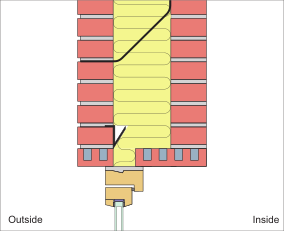
Figure 86. An example of a moisture barrier above a window, in the form of bitumen felt or plastic foil. The moisture barrier should slope outwards so that water is drained to the outer wall. The moisture barrier is placed above the functional part of the lintel (reinforced brick masonry and the necessary brick courses above this to absorb pressure). It may be necessary to supplement the moisture barrier with a trench to remove infiltrating water from the lintel. The moisture barrier must overlap the trench at both ends so that water from the moisture barrier is not drained into the trench.
Special attention must be given to making the vapour barrier tight to mitigate the risk of condensation and to comply with requirements for airtightness. All joints and connections in the vapour barrier must be airtight (i.e., bonded or taped, and preferably also pinched). This will ensure airtightness in the long term. The vapour barrier is best placed a small depth into the wall (e.g., 45–50 mm in from the warm side of the wall). However, the vapour barrier should be placed no more than 1/3 into the insulation from the warm side. In this way, electrical and other installations can be installed without having to penetrate the vapour barrier (cf. Section 4.6 Vapour Barriers, and SBi Guidelines 214, Klimaskærmens lufttæthed (Airtightness of the Weather Screen) (Rasmussen & Nicolajsen, 2007)).
It is essential that an airtight seal is made against the loft construction and against the wall plate by filling or pointing with caulking compound.
10.7 Concrete Walls
Exterior concrete slab walls are made of two reinforced concrete discs separated by a layer of insulation of either mineral wool or cellular plastic (in a sandwich construction). The inside concrete disc acts as a vapour barrier as it is both vapour-impermeable and airtight (after the joints are made tight by concreting or pointing them).
Joints between slabs should be executed as two-stage joints with a rainscreen function in the outer part and a wind screen function in the inner part. To comply with applicable insulation requirements, a 200–250 mm insulation thickness should be used depending on the size of the rib.
The outside concrete disc functions as a rainscreen and is normally min. 70 mm thick to protect the reinforcement against corrosion. The thickness of the inside concrete disc is determined based on static considerations.
Exterior walls can also be made of concrete poured on site with insulation on the outside protected by a rainscreen of sheeting, facade tiles, or rendering, for example.
10.8 Panelled and Profiled Structural Walls
These wall types are constructed as two-stage solutions (i.e., with a cavity behind the facade cladding helping to achieve pressure equalisation above the outer part of the wall (the rainscreen)). The joints in the rainscreen should therefore be open during wind loads. Pressure equalisation can be achieved if openings in the rainscreen total 0.25–0.5 % of the rainscreen area.
The wind proofing function is incorporated into the inner wall and is usually satisfied by the vapour barrier and the interior cladding. Special attention must be given to ensuring that the vapour barrier is tight to mitigate the risk of condensation and to comply with requirements for airtightness. All joints and connections in the vapour barrier must be airtight (i.e., bonded or taped, and preferably also pinched). This will ensure airtightness in the long term (cf. Section 4.6 on Vapour Barriers generally).
Therefore, the vapour barrier and the inside cladding are the elements that experience wind load. In stormy weather, this could exceed 500 Pa (~ 50 kg/m2).
The wind barrier is primarily used to prevent air from entering, or wrapping behind the insulation, but will also help ensure airtightness.
For steel-framed walls, a grid system of slotted profiles should be used to avoid thermal bridging. Beyond needless heat loss, thermal bridging can lead to dark discolorations (dust figures) on the insides of walls (see Section 5.5.1 on calculating thermal bridging). In timber-framed walls, cross-battening can be omitted because of the enhanced thermal insulation capacity of wood (which is still significantly poorer than that of insulation materials).
Horizontal Battens
Horizontal battens on the back of a rainscreen should not be able to intercept water and carry it to the inner wall. The battens are spaced 12 mm away from the wall using spacer bars, which will ensure free air passage via the vent slit (see Figure 84).
10.9 Glass Walls
In terms of moisture performance, glass walls should be viewed holistically, as they would normally constitute a total solution.
Glass facades may result in very high temperatures in direct sunlight, which must be considered when selecting the underlying materials. Plaster-based materials will tolerate a temperature of max. 60 °C before beginning to deteriorate. Instead, fibre-cement sheets could be used.
10.10 Completely Hydrophobic Facades
If completely hydrophobic cladding materials such as steel and glass are used for multistorey buildings, a ‘dense’ film of water may form during intense driving rain which will prevent pressure equalisation over open joints (weep holes) in two-stage rainscreen sealant systems. Therefore, it is best to use flashing at every other (normal) storey to break the water flow across the facade and drain the water away.
10.11 Re-insulating Exterior Walls
Significant savings can usually be made by re-insulating the exterior walls of a building because the area is relatively large. Moreover, it will result in greater comfort.
The required U-value for renovation is 0.20 W/m2K. However, it is possible to deviate from the requirement if it proves unviable.
Re-insulation is discussed in more detail in SBi Guidelines 221, Efterisolering af etageboliger (Re-Insulating Multistorey Buildings) (Munch-Andersen, 2008a).
10.11.1 Exterior Re-Insulation
As a rule, exterior re-insulation will be the best solution from a moisture control perspective. The existing wall will become warmer, and in turn, this will enhance its damp control performance. Thermal bridging level with storey partitions and interior walls is reduced, which furthermore reduces the likelihood that dust figures will form.
As a result, a new exterior rainscreen could improve dampness and energy conditions and, if carefully designed, could add fine water-control details to the building.
Above all, exterior re-insulation is financially viable if the existing exterior wall is due for reparation/renovation (e.g., when replacing the rendering of a worn facade cladding).
For architectural reasons as well as to optimise energy use, windows should be installed as close to the exterior wall surface as possible, making them flush with the exterior surface as before. From an energy point of view, the windowpane should be flush with the centre of the insulation in the wall.
Exterior re-insulation could be a vented sheet, profile cladding, or facade tiles where the insulation material is placed between battens and uprights in the original wall.
The method is described in Section 10.8, Panelled and Profiled Structural Walls.
Finally, for bricked and rendered surfaces, rigid insulation sheets can be installed. These can then be rendered with special types of hydrophobic and vapour-permeable rendering.
When re-insulating light-weight facades, vented façade claddings are used and are installed according to the guidelines in the section on stud walls clad with sheeting and profiles.
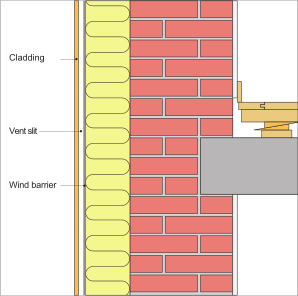
Figure 87. An example of an exterior re-insulation of an existing brick wall with a stud wall built as a two-stage construction with a vented light-weight rainscreen. When installing exterior insulation, thermal bridging is eliminated at deck level and in interior walls.
10.11.2 Interior Re-Insulation
In terms of both moisture control and energy, interior re-insulation is significantly more demanding than exterior re-insulation. Furthermore, the dehumidification conditions for the existing wall will not be as good as before because the heat flow (and hence the opportunity for materials to dry out) will be reduced. In other words, interior re-insulation is risky and should only be performed where no other solutions are viable.
The particular challenges are to prevent moist indoor air from infiltrating the construction and to avoid thermal bridging at adjacent interior walls and storey partitions. The risk of humid indoor air infiltrating the construction is the most significant disadvantage associated with interior re-insulation because it always involves a risk of condensation and hence mould growth on the original interior wall surface. Therefore, a requirement for successful interior re-insulation is that the vapour barrier must be installed with great care, to ensure that it is impossible for humid indoor air to infiltrate the original wall surface. Unavoidable thermal bridges will reduce the efficiency of the re-insulation. Furthermore, they may result in temperature differences on the interior surface which, in turn, may lead to colour differences in surface treatments applied to the wall.
In brick facades, interior re-insulation requires that the facade wall is watertight, as moisture might otherwise infiltrate the construction. Furthermore, the original wall should be in a reasonable state of repair, as there could otherwise be a risk of frost damage on porous brickwork or facade rendering. Finally, very porous brickwork is hydrophilic and may potentially sorb enough water to pose a risk of ‘summer condensation’ on the reverse side of the vapour barrier on south-facing walls.
Implementation
To minimise the risk of mould growth, all existing wallpaper and residual adhesive should be removed from the old wall before re-insulating. In brick walls, this will also improve the chances of sorbing minor amounts of condensate that may exist in the old rendering.
If heavy walls are re-insulated on the inside, a timber-framed stud wall is usually erected (an additional wall) with insulation material between the battens. The stud wall construction is kept clear of the exterior wall to prevent inaccuracies in the exterior wall from affecting the additional wall (spacing it from the wall also facilitates installation). Fill the space between the stud and the exterior wall plus the one between the uprights in the stud wall with insulation material.
Cladding and a vapour barrier complying with fire standards (typically gypsum plaster or reinforced gypsum sheets) are installed on the inside.
The timber stud could be 70 mm or 95 mm deep. The overall insulation thickness depends on the gap from stud to the exterior wall.
The only means available to preventing dampness issues is a tight vapour barrier. On south-facing surfaces, one could install a moisture-adaptive vapour barrier (see Section 4.6.5), which will allow any moisture from 'summer condensation' to dry out.
A prefabricated rigid insulation sheet could also be used with a vapour barrier bonded under one or two layers of plasterboard. However, the load-bearing capacity relative to objects hung on the wall will be less than for an insulated timber-framed stud.
Near to storey partitions consisting of wooden beams, the insulation should not be continued past the floor surface because this might result in the beam ends becoming damp. The occurrence of a 'thermal bridge’ in line with the storey partition results in the beams being heated. This means that the relative humidity will drop sufficiently and the risk of moisture accumulation will be reduced. In turn, this reduces the risk of decay or dry rot.
It is important that the vapour barrier fits tightly against adjacent walls, the ceiling, and the storey partition to prevent airflow through gaps and cracks. Near ceilings and storey partitions, this would mean that a plastered ceiling should be intact (i.e., it should have no cracks), tight against adjacent building parts and penetrations, and that the joisting vapour barrier is fixed to the inner side of the existing exterior wall.
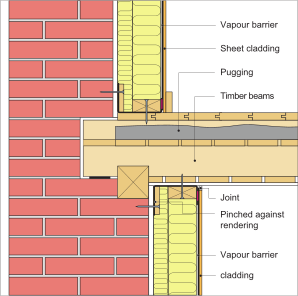
Figure 88. A diagram of the inside insulation of a supporting exterior brick wall. If applicable, the skirting, stucco, wallpaper, and other wall coverings are removed. At floor level, a length of vapour barrier material is pinched against the wall, making it airtight (e.g., using butyl tape and a board). The vapour barrier is continued up the inside of the bottom wall plate in the stud. The solution used at ceiling level is identical to the one used at floor level. Now, uprights and insulation are installed. If 70 mm uprights are used, each upright must be fixed to the exterior wall at min. one point. If the storey height exceeds 2.8 m, a 70 mm stud should be fixed at two points, and a 95 mm stud should be fixed at min. one point. The vapour barrier is joined at floor level and is pinched against top and bottom wall plates and uprights on interior walls with the interior sheet cladding.
When re-insulating light-weight walls, any existing vapour barrier should be removed and replaced by a new vapour barrier directly beneath the new cladding sheets, or, ideally 50 mm into the insulation. On rare occasions, a new vapour barrier can be fitted without removing the old one for normal moisture conditions (humidity exposure classes 1, 2, and 3), namely if the thermal insulance factor of the new insulation is max. half of the existing one (e.g., if 100 mm insulation has already been fitted and this is supplemented by 50 mm of re-insulation).
Finally, in humidity exposure classes 1, 2, and 3, it is possible to use a material with high insulating and good capillary properties such as calcium silicate, which is then bonded to the brickwork by ‘back-buttering’ it with special adhesive to ensure full adhesion. To avoid excessive amounts of condensate on the surface between the existing brickwork and the re-insulation material, the thickness should not usually exceed 80 mm (corresponding to the insulation power of 50 mm mineral wool). Smaller amounts of interstitial condensate forming in the interface between the two materials will be drawn back towards the room by capillary suction. This will create equilibrium, resulting in a dry surface. The insulating power achieved with this method is inferior to installing a well-insulated additional wall, but the construction is less sensitive to infiltrating moisture. This moisture which will be sorbed by the material and evaporate from the inside. Moreover, there will be no thermal bridges from the timber-framed stud. The inside of the wall, therefore, should have a vapour-permeable surface (e.g., wallpaper or vapour-permeable paint). Although the insulation power is inferior to that of an insulated stud wall, the inner surface will normally be sufficiently warm to prevent mould growth.
10.11.3 Cavity Wall Insulation
A widespread and financially attractive re-insulation method is insulation blown into hollow brick walls. Experience shows that if the outer wall is in good condition with intact pointing and without frost-damaged bricks, or loose rendering inside or outside, blown-in insulation in cavity walls is considered safe.
However, some care is advisable in the case of rendered and/or painted walls. Here, the drying-out processes is further reduced, which increases the risk of moisture or frost damage. Rain intrusion to the inner wall will not usually occur when using hydrophobic insulation materials (commonly mineral wool).
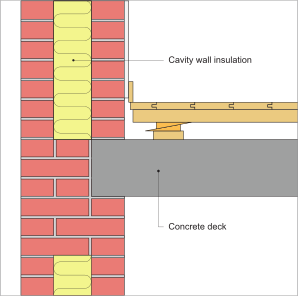
Figure 89. Insulated cavity wall with blown-in insulation in existing cavity. Bricking up the seam at storey partition level results in considerable heat loss along the edge of the deck.