7 Moisture and Ground Floor Slabs
Ground floor slab is the term used for floor constructions laid directly on the ground after having removed the topsoil. A ground floor slab is a compact construction without outdoor ventilation and should only be built on suitable ground (i.e., where there is no risk of the water table being so high as to allow water intrusion into the capillary break).
Active rat control measures for the building must be implemented at ground floor slab level (cf. the Environmental Protection Agency’s guidelines on rats) (Danish EPA, 2005). In foundations cast to frost-proof depth, attention should primarily be directed at penetrations. For lightweight peripheral foundations with EPS insulation not taken to frost-proof depth, it is necessary to take special measures to comply with requirements for active rat protection to a depth of 600 mm below grade.
In principle, basement floors are constructed as ground floor slabs.
7.1 Moisture Exposure
Ground floor slabs are exposed to moisture in the following ways:
- Construction-related moisture (i.e., water added in the construction phase, which may cause problems if not removed)
- Surface water on the ground around the building which, in unfortunate circumstances, may percolate into the ground floor slab
- Soil moisture, including groundwater, percolating rainwater run-off, and bound water
- Water vapour in indoor air.
In addition, there may be exposure to moisture from leaky installations or structures (e.g., moisture infiltration via leaky bathroom or utility room floors).
Heating pipes or heating ducts constitute a special risk, as the heat can cause moisture to infiltrate colder areas in the floor and condense.
7.2 General Measures to Prevent Humidification
7.2.1 Construction-related Moisture
As a rule, ground floor slabs are made with a concrete slab poured on site. After pouring, the moisture content of the concrete will be significant. Before laying the floor or starting other activities sensitive to high relative humidity, it will be necessary to either remove the excess moisture or install a moisture barrier to separate the moisture-sensitive parts from the concrete slab.
If the concrete slab is intended as the only radon protection, a min. of 100 mm concrete with a grade strength of min. 15 MPa (concrete 15), that is vibrated on pouring is normally used. To reduce the water content in the concrete, so-called ‘self-desiccating’ concrete can be used. This is stronger and its water-cement ratio is less (v/c ≤ 0.4) than traditional concrete used for this purpose. The enhanced strength means that the thickness can be reduced, but should not be below 80 mm.
To counter cracks formed by shrinkage and settling, which may cause radon infiltration, suitable shrinkage reinforcement should be incorporated into the deck (e.g., Ø 5 mm rod steel per 150 mm at the centre of the slab in both directions).
After pouring, the concrete slab should be protected against drying out for approx. 8 days.
Construction-related moisture is normally removed by thorough airing, with the potential addition of heating. This is a very time-consuming process (cf. Figure 56 and Section 2.4.2.).
Using a moisture barrier (e.g., 0.2 mm plastic foil with at least 150 mm taped overlaps laid on top of the concrete slab) will generally protect against humidification in layers further up the construction. Moreover, a well-installed tight moisture barrier will provide airtightness and protect against the radon infiltration from the ground.
To ensure properly tight joints, the moisture barrier should always be laid before installing pipework, cables, etc. The moisture barrier should be made of robust material (e.g., 0.2 mm plastic foil or suitable bituminous sheets) to allow for traffic. The moisture barrier should be installed late in the construction process, thus minimising the exposure to damage. Where heavy traffic on the moisture barrier is expected after installation, extra protection from excessive load can be provided (e.g., by laying floor felt). Potential damage or areas of weakness should be repaired before the floor is laid.
7.2.2 Moisture from Surface Water
The ground around the building should slope away at a gradient of 1:40 (1:50 for permanently paved ground), so that rainwater will drain away from the building (see Section 4.12). A plinth with a min. height of 150 mm is constructed alongside the building. This prevents water (including meltwater) from infiltrating the ground floor slab. Substructures should be watertight and airtight (see SBi Guidelines 214, Klimaskærmens lufttæthed (Airtight Weather Screen) (Rasmussen & Nicolajsen, 2007)).
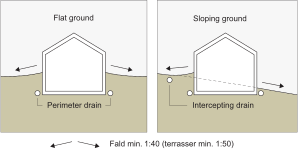
Figure 56. The ground around a building must slope away from it to ensure that excess surface water (as well as that derived from thaw and intense rain) is drained away. The gradient must be min. 1:40 while it should be min. 1:50 for patios and similar areas with a permanent paved surface. The plinth must be watertight and be at least 150 mm high. A perimeter drain is installed to ensure that surface water is drained away. This will prevent water pressure on the foundations. On sloping ground, the ground on the side of the building where the original grade level was highest must be levelled and an intercepting drain should be established at the transition from the original ground to the newly levelled one. When establishing a slope away from the building, potential settlement of the ground must be anticipated and planned around.
7.2.3 Soil Moisture
Ground floor slabs are affected from below by soil moisture. This moisture includes both water wicking from the groundwater by capillary action and rainwater percolating through the soil.
Soil moisture must be prevented from being drawn up to the actual deck structure. This is achieved by installing a capillary break which should be min. 150 mm deep.
A capillary break can be made from coarsely-grained pebbles with a min. grain size of 4 mm, such as gravel or shingle. A layer of gravel this thick will normally prevent wicking, assuming that the gravel has been washed. Also specially coated, expanded clay aggregate can be used as a combined capillary break and thermally insulating layer.
Finally, insulation material in the form of rigid mineral wool or cellular plastic could be incorporated into the construction as a capillary break. Insulation material is laid on top of a screed layer. The best result is achieved by placing the insulation in 2 layers with staggered joints.
We recommend establishing a perimeter drain, especially where there is considerable water impact on the outside of the ground floor slab, which could be the case with low-lying ground floor slabs.
Moisture transport can also occur by convection (airflows) via cracks and gaps. The deck structure should therefore be made as airtight as possible. Furthermore, the conditions can be improved by establishing pressure equalisation of the capillary break to the open (e.g., via a pipe above roof level). This will also help to prevent radon infiltration from the ground.
7.2.4 Water Vapour in the Indoor Air
Ground floor slabs are affected by vapour pressure coming from above and below due to the water vapour content in the air on the two sides of the construction. The difference in vapour pressure on the underside of the ground floor slab is vital for the moisture transport through the deck by diffusion. Although the relative humidity in the soil is almost 100 %, in most cases the vapour pressure is higher inside the building than below it. This is because the temperature inside the building is normally higher than below the building (see Figures 57 and 58).
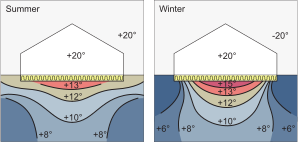
Figure 57. A schematic of temperature conditions below a building with a ground floor slab. The temperature below the ground floor slab is lower than inside the house. Moisture transport will therefore normally occur from the building downward into the ground. At great depth, the soil temperature can be considered almost constant.
In holiday homes and large buildings, there may periodically be moisture transport from the ground to the building and special measures might therefore be necessary (e.g., using a moisture barrier).
In holiday homes and large buildings, there may periodically be moisture transport from the ground to the building and special measures might therefore be necessary (e.g., using a moisture barrier).
Moisture is therefore transported by diffusion out of the building, so that moisture evaporates from the underside of the concrete and condenses in the ground. A membrane/moisture barrier should not normally be placed underneath the concrete, as this will prevent the downward drying process and introduces a risk of condensate forming on the membrane.
If the vapour pressure inside the building is higher than below the ground floor slab, which is normally the case when the building is heated, water vapour from the ground will never be able to condense on the concrete or the flooring. For example, if the concrete is 20 °C and the ground is 15 °C, there will be equilibrium moisture content when the moisture content of the concrete corresponds to approx. 75 % RH (see Figure 58).
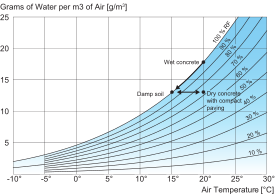
Figure 58. In wet concrete and damp soil, the relative humidity is 100 %, but as the temperature of the soil is lower than that of the concrete, the water vapour pressure in the concrete is greater than in the soil. This is why water evaporates from the underside of the concrete slab, slowly drying out the concrete over time. The arrow along the 100 % isotherm on the diagram indicates the direction of the diffusion. The horizontal arrows indicate that equilibrium is reached at 15 °C and 100 % RH in the ground and at 20 °C and 73 % RH in the concrete.
In buildings which are only heated periodically (such as holiday homes) a moisture barrier should always be installed if any layers in the construction are sensitive to moisture. This is because there will be moisture transport from the ground into the building during cold periods and thus a risk of condensation on the underside of a potentially vapour-impermeable layer. The moisture barrier is normally placed directly on the concrete to prevent condensation and humidification of moisture-sensitive layers further up in the construction.
In very large buildings, the soil layers below the centre of the building will gradually be heated to near room temperature and an effective temperature difference between the concrete slab and the soil beneath the centre of the floor cannot be relied upon. During periods with low temperatures in the building, there is a risk of moisture transport from the ground into the building. Therefore, it is recommended that a moisture barrier always be used.
In buildings with ground floor slabs, vapour-impermeable flooring should not be used if the building is unheated or only heated periodically (see Figure 59). This should especially be avoided in old buildings where one cannot be sure that capillary breaks and an efficient moisture barrier have been installed.
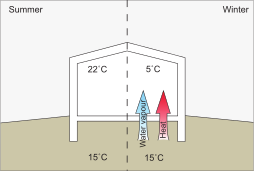
Figure 59. Moisture transport in a ground floor slab normally moves downwards. This is because the vapour pressure in the house is higher than in the ground, due to the higher temperature. In an unheated building, the ground below the ground floor slab is warmer in winter (and the relative humidity is higher) than the indoor air in the house. Therefore, the moisture transport through the ground floor slab moves upwards. The water vapour driven upwards by the heat flow will condense on any cold layer that stops it. This is why a moisture barrier is used to prevent humidification of layers sensitive to moisture higher up in the construction. Vapour-impermeable flooring should only be used in buildings that are not permanently heated, if one is certain that capillary breaks and an efficient moisture barrier have been established.
In heated buildings, condensation of water vapour in indoor air on the upper side of a moisture barrier should be prevented because it can result in the entire floor construction becoming damp. This is achieved by placing the insulation material so that at least 2/3 of the thermal conductivity is below the concrete. In this way, the concrete slab will become warm enough to avoid condensation. Alternatively, calculations can be made to discover if there is a risk of condensation. Furthermore, thermal bridges at substructure level should be reduced as much as possible (cf. recent requirements concerning linear thermal transmittance) to avoid condensation forming on the inside of the substructure. For example, this can be achieved by installing slab-edge insulation between the concrete slab and the foundation, combined with the construction of the upper part of the foundations with expanded clay aggregate bricks sandwiching insulation.
When renovating old uninsulated ground floor slabs, max. 75 mm insulation material should be placed above the moisture barrier to prevent condensation from forming on the upper side of the moisture barrier. If the substructure has not been insulated (e.g., with bricks of expanded clay aggregate), the thickness of the insulation layer should be reduced to 50 mm on the outermost 1–1.5 m facing exterior walls.
7.2.5 Placing the Moisture Barrier
There is often doubt as to whether a moisture barrier ought to be installed in a ground floor slab and, if so, where it should be placed. The primary reason for installing a moisture barrier is to protect against construction-related moisture. It can, therefore, be omitted if it can be ascertained that there will be no issues with construction-related moisture (e.g., relative to renovation or the laying of floors insensitive to moisture). Note, that omitting the moisture barrier could have implications for radon protection.
In theory, very few solutions are available. They are shown in Figure 60.
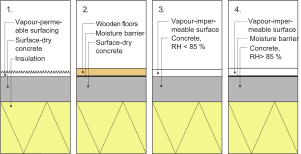
Figure 60. Constructing a ground floor slab with a concrete deck in heated buildings.
- Vapour-permeable surfacing (e.g., tiling or carpeting without tight rubber backing). Given that the flooring is vapour-permeable, construction-related moisture can dissipate up through it. A moisture barrier is unnecessary, and the concrete need only be surface-dry before the flooring is laid.
- Wooden floors are sensitive to moisture and should not be used if the relative humidity in the concrete (absorbed water) exceeds 65 % RH. This means that wooden floors on ground floor slabs are only possible when a moisture barrier has been installed on top of the concrete. Conversely, a wooden floor can be installed if the concrete is dry (e.g., on a dried-out storey partition).
- A vapour-impermeable flooring (such as PVC or linoleum) can be laid directly on dry concrete. Construction-related moisture must be dried out before laying, to achieve equilibrium between the concrete and the highest RH tolerated by the flooring and the adhesive (which is normally 85 or 90 % RH) (see Section 5.2).
- Vapour-impermeable flooring such as PVC or linoleum laid on a moisture barrier on the upper side of the concrete slab. The moisture barrier is necessary if the floor needs to be laid before the concrete has dried out sufficiently for the adhesive and the flooring to be effective.
7.3 Examples of Ground Floor Slab Constructions
The following show some examples of ground floor slab constructions allowing for the conditions outlined above
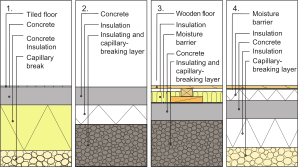
Figure 61. Ground floor slab constructions.
- Ground floor slab with concrete deck without floor finish. The construction comprises a capillary break (e.g., 150 mm shingle) and pressure-resistant insulation as substrate for the concrete. No moisture barrier is needed.
- Ground floor slab with concrete deck without floor finish. The construction comprises combined insulating and capillary-breaking layer at least 150 mm thick made of loose (coated) expanded clay aggregate. Due to the thermal insulating property of the capillary break, the thickness of the pressure-resistant insulation can be reduced compared to Figure 61.1.
- Concrete deck with wooden flooring on joists. This construction also comprises a min. 150 mm thick layer of combined insulation and capillary break of loose (coated) expanded clay aggregate under the concrete. Moreover, 75 mm mineral wool has been laid between the joists. A moisture barrier has been laid on the concrete slab, preventing construction-related moisture from the concrete slab from reaching the wooden flooring via evaporation or wicking. The indoor air will not condense on the upper side of the moisture barrier because the thermal insulation chiefly is below the concrete slab. Heating pipes running below the floor must be insulated separately (cf. DS 452+Ret.1+Till.1:2020 DS 452: Thermal insulation of technical service and supply systems (Danish Standards, 2013)). This will also prevent the floorboards from drying out.
- Ground floor slab with a 150-mm thick capillary break of shingle with pressure-resistant insulation laid on top as a substrate for the concrete slab. Furthermore, pressure-resistant insulation, a moisture barrier, and a floating wooden floor are laid on top of the concrete slab. When placing the moisture barrier on the warm side of the insulation, there will be no risk of condensation on the upper side.
7.3.1 Lightweight Grade-Deck Constructions
For moderate loads (such as dwellings), it is possible to construct a more untraditional ground floor slab. For example, the construction could comprise a gravel screed layer on top of which is laid a combined capillary break and insulating layer of cellular plastic. The cellular plastic should be laid according to manufacturer’s instructions, including strength of the sheeting, and laying pattern. The moisture barrier, subfloor, and flooring are laid directly on top of the cellular plastic layer. There are strict requirements for the planeness of the screed layer, as any unevenness or misalignment will spill over to the finished floor construction.
The advantage of a lightweight construction is the fact that it does not add construction-related moisture and does not require hardening or drying. However, a disadvantage is the lack, as in traditional constructions, of a concrete layer, which can be used as a floor for subsequent work procedures.
Foundations should be erected underneath all exterior and partition walls, so that they can be secured properly and, if possible, contribute to the wind bracing of the building. Furthermore, the construction requires special measures to protect against radon infiltration and rats.
7.3.2 Construction Details
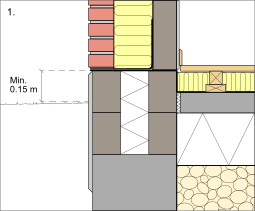
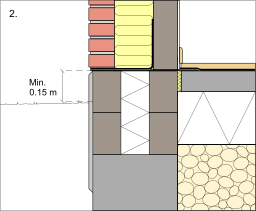
Figure 62. An example of wall construction details. Concrete blocks with central insulation are used on the concrete foundations. The ground floor slab is constructed with a combined layer of insulation and capillary break of coated expanded clay aggregate, a layer of insulation, and a poured concrete deck. A 20 mm insulation strip is inserted between the concrete deck and foundations to break the thermal bridge. The bituminous foundation waterproofing is continued into, and bonded to, the concrete deck. A moisture barrier has been laid on the upper side of the deck and bonded to the foundation waterproofing. The moisture barrier will also add a degree of protection against the radon infiltration.
- A wooden floor on battens has been installed and supplemented by insulation material between the battens.
- A floating wooden floor has been installed, laid on top of the moisture barrier on the concrete deck, meaning that the required insulation material should be installed underneath the concrete slab (the construction could also be built as shown in Figure 61.4).
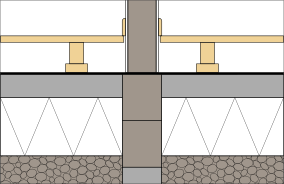
Figure 63. Example of foundations below an interior wall built to enhance load-bearing capacity and shear-wall action, if applicable. An unbroken radon protection layer and/or moisture barrier is installed underneath the partition wall.
7.4 Other Issues
7.4.1 Step-Free Access
Requirements for step-free access to buildings often result in ground floor slab constructions being placed as low down as possible. Facades should still be protected against exposure to moisture, including splashback from rainwater. As always, the height of the substructure should be min. 150 mm. Furthermore, the floor plane should be min. 150 mm above grade.
A ramp or similar levelling structure provides access to the entrance door. Generally, the slope of ramps and levelling structures should be max. 1:20 (50 mm per m). With a plinth height of 150 mm, therefore, the length of the ramp will be min. 3 m.
For detached single-family dwellings built for personal use, there are similar requirements for step-free access, but there are no requirements as to the gradient of ramps. This means that the slope can be increased, reducing the length of the ramp. However, the slope should be max. 1:14 (approx. 70 mm per m). Levelling corresponding to a single step permits a slope of up to 1:10 (100 mm per m).
Ramps should finish with a horizontal plane (a platform) of at least 1.5 × 1.5 m. Further information on ramp and ledge design, installing balustrades, and similar constructions is available in SBi Guidelines 230 (Hansen, 2013) and 222 (Sigbrand & Jensen, 2008).
To retain the height of the plinth where ramps or levelling structures are built along the exterior wall, a trench drain should be dug to ensure that water is drained away from the facade. If possible, the width of the trench should be 300 mm and not less than 100 mm. The surface of the concrete deck should be min. 50 mm above grade to protect the parts of the ground floor slab which are sensitive to moisture against humidification via the substructure.
The link between platform and building should incorporate a metal grid, which will allow the passage of water and reduce splashback. Ready-made elements for this purpose are available on the market. The width of the grid mesh should not exceed 10 mm at the shortest end.
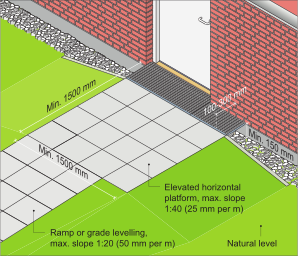
Figure 64. An example of access to a house with ground floor slab and ramp with a platform of min. 1.5 × 1.,5 m. A grate-covered trench drain is dug to ensure that water will drain away from the upper part of the substructure. The trench drain in this example is 300 mm wide, providing adequate protection against humidification.
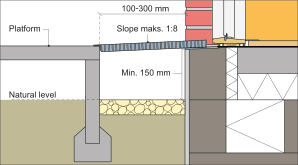
Figure 65. An example of step-free access to a building with a ground floor slab. A trench drain is built facing the entrance and a grid is fitted between the ramp and the building. The trench drain must be min. 150 mm deep and can be constructed with a bottom comprising fist-sized stones to reduce splashback. The grate could, for example, be placed at a slight incline to facilitate passage across the doorstep. If so, the grate must be max. 300 mm wide with an incline of max. 1:8.
As an alternative solution, a ‘moat’ could be constructed all around the building. However, this solution is less efficient in terms of moisture performance than one involving a ramp because there is a bigger risk of the foundation being exposed to water pressure. The solution should therefore only be used where the risk of water pressure on the foundation is considered negligible (e.g., where the building is located on high ground or on a slope).
The ‘moat’ should be sufficiently deep to maintain a plinth height of 150 mm and it should, if possible, be 300 mm wide. Water from this ‘moat’ must be drained off to a gully so that large amounts of water from snowmelt or heavy downpours do not cause damming in the trench. A grate will have to be installed to link ground level with door openings. The ‘moat’ could be filled with fist-sized stones to reduce splashback. If so, regular cleaning between the stones will be necessary. The floor can be installed level with the ground. However, the upper side of the concrete deck should be at least 50 mm higher than the top of the ‘moat’ to reduce the risk of water getting into the floor construction, should water dam in the ‘moat’.
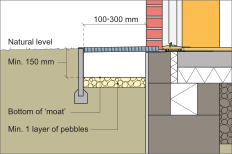
Figure 66. Example of a trench drain design (‘moat’) along an exterior wall. The trench drain ensures that a plinth height of min. 150 mm is maintained to avoid water load on the upper part of the foundations. If possible, the width of this trench drain should be 300 mm and not less than 100 mm. The ground should have a definite slope (min. 1:40) for patios and similar paved surfaces, with a compact paved finish (min. 1:50). The water discharge system should be sized to accommodate the extra amounts of water from the ‘moat’.
Further examples of solutions with step-free access are available at www.sbi.dk/tilgaengelighed
7.4.2 Heating Pipes
Heating pipes in ground floor slabs introduce a special risk of damp damage. The heat from the pipes will make any moisture evaporate and the water vapour pressure can become so high as to form condensation (e.g., on the underside of wooden floors). Therefore, in a concrete deck with wooden flooring on joists, it is especially important that the moisture barrier is efficient underneath the heating pipes. A strong bituminous sheet placed underneath the pipes is perfect for this, as it is both vapour-impermeable and robust (and hence not as prone to damage during pipe installation as plastic foil) (see Figure 67). If vapour-impermeable flooring is installed, care should be taken to ensure that the subfloor has dried out sufficiently to avoid damage to either adhesive or flooring.
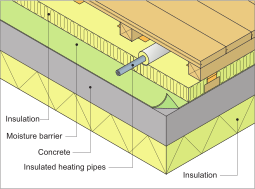
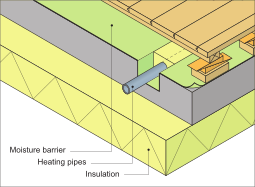
Figure 67. An example of the placement of heating pipes in ground floor slabs.
- Heating pipes in wooden floor above layer of concrete. The pipes must be thermally insulated separately and thoroughly. It is essential that the moisture barrier is effective to avoid construction moisture from evaporating from the concrete slab.
- Heating pipes in trenches. There should always be an effective moisture barrier between concrete deck and a moisture-sensitive floor such as a wooden floor. It is essential that the moisture barrier is effective to avoid construction moisture evaporating from the concrete slab.
7.4.3 Under-Floor Heating
The moisture exposure affecting flooring via newly-poured concrete subfloors with underfloor heating is different than for ordinary floors.
Flooring made of PVC, linoleum, and similar materials, can usually be laid when air-concrete equilibrium has been reached at a relative humidity of 85 %. Moisture measurements are made at a point approx. halfway through the thickness of the concrete slab to allow for redistribution of moisture after the floor has been laid. Following the redistribution, moisture content immediately below the flooring will correspond to that measured halfway through the thickness of the slab.
For concrete floors with embedded heating cables, requirements for moisture content have been tightened because the moisture will not redistribute in the same way after the floor has been laid. This is because the heat presses the moisture in the part of the concrete lying above the cables upward towards the flooring. Thus the moisture is concentrated immediately below the flooring. This can result in deterioration of adhesive and deformation of wooden floors.
These problems can be avoided by drying out at a deeper level than usual before laying the floor. Laying vapour-impermeable floors must be delayed until the concrete has reached equilibrium with air at 75–80 % RH (instead of the usual 85 % RH).
Laying wooden floors must be delayed until the concrete has reached equilibrium with air at 55–60 % RF (instead of the usual 65 % RH). If requirements for absorbed moisture cannot be met, an effective moisture barrier must be installed prior to the floor being laid.
Joints in the moisture barrier under wooden floors must be tight. This can be achieved by taping them. Overlap joints are not sufficient to prevent water vapour infiltration. The moisture barrier should overlap the wall behind the skirting, preventing dampness from the concrete slab from infiltrating the floor via the cavity under the skirting or via the wall. For a more detailed discussion of issues concerning underfloor heating, see Byg- Erfa info sheet on Gulvvarme og gulvtyper – isoleringsforhold skader og gener (Under-Floor Heating – Insulation Issues, Damage, and Problems) (Byg- Erfa, 2007b)
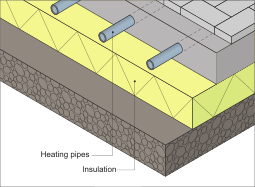
Figure 68. Example of ground floor slab (or other deck construction) with concrete deck and tiled flooring with embedded heating pipes. In tiled floors, there is no need for moisture barriers, as the construction does not contain materials that are sensitive to moisture.
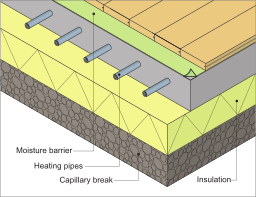
Figure 69. Example of grade-slab with concrete deck and a floating wooden floor with embedded heating pipes. An effective moisture barrier must be installed with tight joints and, at exterior walls, must be bonded to the moisture barrier. At interior walls, a moisture barrier must be overlapped with the wall behind the skirting. It is advantageous if the concrete layer has dried out well before the wooden floor is laid because the underfloor heating can result in quick moisture transport from the concrete into the adjacent walls.
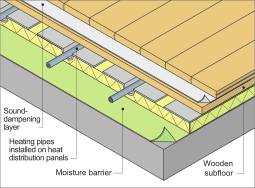
Figure 70. An example of grade-slab construction with underfloor heating. A moisture barrier has been laid on top of the concrete slab to prevent humidification of construction-related moisture from below. The heating cables are placed in heat distribution channels which, in this example, are placed in grooves milled into the insulation sheet. A wooden subfloor sheet is installed with a floating wooden floor on a substrate (e.g., of floor felt or felt).
7.4.4 Renovating and Re-Insulating
Ground floor slabs can normally only be re-insulated from above. If no insulation has been fitted underneath the ground floor slab, the moisture barrier (if applicable) should be placed with special care. Especially in the case of wooden floors (on joists), standard practice has been to lay the moisture barrier on the concrete slab and the insulation on top of that. This will not usually cause problems if a small insulation thickness is used (i.e., max. 50 mm as a rule). Up to 75 mm can be used if the foundation is insulated (e.g., with expanded clay aggregate bricks). Using more insulation than specified involves a risk of condensation on the upper side of the moisture barrier.
If thicker insulation is required, a floating floor construction can be used with pressure-resistant insulation underneath the subfloor. In this case, the moisture barrier is placed immediately below the subfloor. Note that an insulation thickness large enough to change the floor level may cause problems with doors, electrical installations, and other fittings.
Occasionally, during renovation, one might discover that a ground floor slab construction has no capillary break. To correct this one should always fit an effective moisture barrier which will double as a capillary break. However, this is a last-resort emergency solution because the concrete slab (and the adjacent building parts) are not protected against humidification from below.
Mould growth is another problem which might occur in connection with renovating a ground floor slab without a capillary break. To avoid mould growth after renovation, the concrete slab must be thoroughly cleaned before laying a (new) moisture barrier. The surface should be kept clean until the moisture barrier has been fitted. The safest solution is to bond or weld the moisture barrier to the concrete slab. A bituminous membrane could be welded to the slab or a liquid epoxy coat could be applied. These measures prevent oxygen from meeting the upper side of the concrete slab. Without oxygen, mould cannot grow.