12 Moisture and Roof Constructions
This chapter covers roofs with small slopes (less than 10°/1:6) (normally designated as flat roofs) as well as roofs with larger slopes normally designated pitched roofs. Within each of these standard types, there exist several different variants, including cold roofs, warm roofs, vented roofs, and unvented roofs.
Roof constructions comprise the whole roof structure from the inside loft cladding to the finished roof covering, including vapour barrier, insulation, roof underlay, and spacer bars.
12.1 Moisture Exposure
The moisture exposure of roofs derives from:
- Precipitation, (driving) rain, and (driving) snow entering the construction from the outside
- Humidity in the outdoor air
- Humidity from indoor air infiltrating the construction due to diffusion through the materials or convection (airflow) through leakages
- Construction-related moisture (i.e., water deriving from the construction phase)
- Condensation of moisture in the outer parts of the construction due to emissions to the atmosphere
The risk of moisture absorption due to convection is greater for roofs than exterior walls because the thermal uplift in the air will always cause a slight, but continuous positive pressure below the ceiling. In winter, the positive pressure will result in indoor air trying to flow upwards into the roof construction. Even when a quality vapour barrier has been installed correctly, small amounts of moisture will manage to infiltrate the loft space in the same way that moisture will manage to infiltrate leakages around loft hatches and penetrations.
Wind on the exterior roof may considerably increase the moisture to which a roof is exposed. Wind may cause precipitation to act like driving rain or snow. Both can be blown upwards and may thus infiltrate constructions where weatherproofing uses lap joints (e.g., roof tiles).
Furthermore, wind may cause both positive and negative pressure in roofs. However, over roofs with small slopes the pressure will usually be negative. Negative pressure over flat roofs will propagate into the vent slit and may reinforce the convection of indoor air into the loft unless a completely airtight layer is incorporated into the construction.
12.2 General Measures to Prevent Humidification
Rain and meltwater must be prevented from infiltrating the roof construction, which should therefore be waterproof. However, in roof constructions with roof underlay small amounts of precipitation are allowed through the primary roof covering before being stopped. The water must be drained off the roof or the underlay as quickly as possible to prevent the underlying constructions from being damaged. Roofs (roof covering and roof underlay) must therefore always be installed with an effective slope towards an outlet or gutter (roof edge). The slope on flat roofs should be min. 1:40.
However, slopes in valleys may be reduced to 1:100 and in cricket intersections be reduced to 1:165. Slopes as small as this require a rigid substrate (i.e., one corresponding to a deflection of max. 1:400 of the effective span for snow load).
Humid indoor air must be prevented from causing dampness in the roof construction. For this reason, vapour barriers are normally installed in roofs. The vapour barriers must be:
- made from robust material which will tolerate handling on the building site
- made from vapour-impermeable material which will prevent moisture transport in connection with water diffusion
- made airtight because moisture infiltrating the roof construction via convection (airflow) cannot usually be removed fast enough. Given that the thermal uplift means a greater risk of convection in roofs than in exterior walls, it is particularly important that the vapour barrier is tight. Electrical and other installations in loft spaces should therefore be run below the vapour barrier to avoid perforating it (e.g., by installing the vapour barrier 50 mm inside the insulation layer).
The incorporation of moisture into the roof construction during the building process should be avoided. The work should therefore be performed in dry weather and work in progress should be covered at the end of each working day. Alternatively, the whole building site should be covered, which is best achieved with a total covering. Roof components supplied with base felt must have sealant strips fitted across the joints immediately after installation. This can be achieved by welding on a strip of bituminous felt.
12.3 Roof Coverings
Many different types of roof coverings exist, and their waterproofing qualities vary.
12.3.1 Continuous Roof Coverings – Roll Material
Roof coverings supplied in roll form and welded together on the building site can be made fully waterproof even for small roof slopes. Such roof coverings include bituminous felt and roofing foil (e.g., PVC or EPDM). Roofs with this type of roof covering can be constructed with only a slight slope. However, it is imperative that water is drained away. On these roofs, one can design with a min. slope of 1:40, which can be reduced to 1:100 in valleys, and to 1:165 in intersections.
12.3.2 Roof Tiles – Clay, Concrete, Slate
This type of roof is primarily made waterproof with overlap/lap joints between individual tiles. The roof tiles are laid out on battens and are only suitable for pitched roofs.
The roof slope should normally be min. 25° to ensure that the roof is waterproof and frost resistant. Smaller slopes should only be used subject to agreement with the manufacturer and when special measures are in place to ensure that the construction is waterproof (e.g., by installing a firm underlay with two layers of bituminous felt). The lap joints may vary in size and geometric design. Generally, a greater slope and wider lap joints will enhance waterproofing properties. Similarly, interlocking tiles will provide tighter joints than roof tiles with simple overlaps such as pantiles.
These roof coverings are always used in conjunction with roof underlay. To some extent, the roof underlay can compensate for any open roof coverings and it must be selected relative to the desired type of tile and slope. Note that, for this roof type, the minimum slope is normally found at the base of the roof, and it is this slope that determines the specific type of underlay to be used.
Roof tiles are available with interlocking ribs as well as special (tightly jointed) interlocking tiles which are themselves weatherproof down to a certain slope.
In the past, mortar bedding, bitumen-based sealing agents, or foam-moulding was used but these are no longer considered capable of providing the required waterproofing in the long term. On roof surfaces inaccessible from the inside (e.g., couple roofs and sloping walls in utilised loft spaces), this kind of sealing should therefore not be used.
12.3.3 Roofing Sheets – Fibre-Cement
Roofing sheets are normally available as corrugated, cement-based sheeting. These are waterproofed by overlapping them and may be combined with sealant tape in the joints. This type of roof can be used for slopes as low as approx. 15°. For slopes below approx. 25°, sealant tape is used to keep the roof waterproof.
12.3.4 Metal Sheets
Depending on type and make, a metal sheet roofing may be installed on roofs with relatively modest slopes. The slope for corrugated steel sheets will often be 10–15° while seamed zinc roofs with seam sealant can be used for slopes as low as 3–7°.
Mechanical joints for metal sheet roofing made on the building site are not impervious to water pressure and the min. slope for such roofs is therefore somewhat larger than for bituminous sheets and roofing foils.
There will often be condensate on the underside of metal roofs due to strong cooling of the roof surface caused by emissions to the atmosphere. Metal roofs should therefore be installed with roof underlay capable of collecting condensate. Moreover, extra protection against water infiltration should be provided with sheet joints. Many roofing sheets are available with condensate absorbers on the underside in the form of an absorbent coat of paint. Absorbent paint can absorb condensate of up to approx. 0.5 kg/m2, which makes it possible to use the sheets without underlay in humidity exposure classes 1 and 2 (i.e., above relatively dry rooms). Note that if the underlying rooms are used for other purposes, absorbent coats will usually be unable to prevent dripping condensate.
12.3.5 Roof Underlay
Besides the primary roof covering, many cold roofs have roof underlay. The purpose of the roof underlay (for clay-tiled roofs, slate roofs, etc.), is to trap any water infiltrating the primary roof covering. In vapour-impermeable roof coverings such as metal roofs, the roof underlay is used to collect condensate (see Section 12.4.3, Roof Underlay – Purpose and Types).
12.4 Warm and Cold Roofs
Roofs can be divided into two types, according to moisture performance:
- Warm roofs. The insulation lies wholly or partly above the supporting structure, which is therefore kept warm. The roof construction in unvented.
- Cold roofs. The insulation lies inside the construction, so that part of the supporting structure gets cold during winter. The roof construction is normally vented but can also be unvented.
12.4.1 Warm Roofs
For most applications, a warm roof is a safe construction in terms of moisture performance. In warm roofs, supporting structures are insulated on the outside. Their temperature is thus higher than the dew point in the actual location in the construction and there will be no risk of condensation and moisture accumulation. The roof covering is normally bituminous felt or roofing foil such as PVC but can also be metal. The coverings are all vapour-impermeable. The insulation material constitutes the substrate for the roof covering.
Table 18. Overview of application areas for different roof types, relative to humidity exposure class. Refrigerated rooms and cold stores are not included in the application classes and must always be assessed based on existing conditions. In cold stores, the roof covering itself acts as vapour barrier, as the moisture transport always moves in an inward direction while, in refrigerated rooms, there may be moisture transport both inwards and outwards.
Humidity Exposure Class | Unvented with Moisture-Adaptive Vapour Barrier | Unvented with Vapour-Permeable Roof Underlay | Vented with Firm Underlay | Vented Bituminous Felt Roof | Warm Unvented Roof |
|---|---|---|---|---|---|
1 | + | + | + | + | + |
2 | + | + | + | + | + |
3 | (+) | + | + | + | + |
4 | + In application classes 4 and 5, a moisture risk calculation must be made for moisture accumulation. | ||||
5 | + In application classes 4 and 5, a moisture risk calculation must be made for moisture accumulation. |
Both roof covering and vapour barrier are thus vapour-impermeable. This means that if moisture gets into the insulation, it is unable to dry out. Therefore, it is a condition that the construction is kept dry during both construction and use. The incorporation of moisture into the exterior insulation layer can be avoided by using dry materials and protecting the roof against rain in the construction phase. The finished roof must be protected against damage and maintained regularly to avoid subsequent leakages.
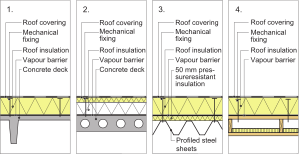
Figure 99. Constructing a warm roof.
1 and 2. Principled construction of warm roof on concrete slabs. In moist (i.e., newly-poured) concrete, a vapour barrier is placed over the concrete.
- Principled construction of warm roof on steel sheets. An efficient vapour barrier must be installed, and this is best placed between the two layers of insulation.
- Warm roof constructed on a timber deck. The vapour barrier must be effective (i.e., both airtight and with a high diffusion resistance (high Z-value), such as existing bituminous felt).
Warm roofs include:
- Roofs with exterior insulation on a concrete, steel, or timber substrate
- Formerly cold roofs provided with exterior re-insulation
- Inverted roofs (i.e., roofs where the roof covering lies below the insulation)
- Duo-roofs (i.e., roofs where insulation layers are placed both below and above the roof covering)
Concrete Deck as Insulation Substrate
Concrete decks are usually damp when the roof insulation is installed. When the building is heated, moisture from the concrete is driven up into the roof insulation unless a vapour barrier has been fitted. Therefore, normally a vapour barrier should be used which can also double as temporary weather protection.
Concrete decks with a thickness of min. 50 mm can normally be regarded as sufficiently vapour-impermeable to act as vapour barriers in humidity exposure classes 1–2. If the concrete deck is dry when the roof insulation is installed (which is usually only applicable to renovation work), the vapour barrier can be omitted. However, concrete cannot act as vapour barrier in humidity exposure classes 3, 4, and 5 where a real vapour barrier must be used (e.g., bituminous felt in humidity exposure class 3 and bituminous felt with inlaid aluminium foil in classes 4 and 5). For slab solutions, it is a precondition that joints and connections are carefully taped by welding on strips of bituminous felt to avoid leakages and hence any risk of convection.
Profiled Steel Sheets as Insulation Substrate
Profiled steel sheets are vapour-impermeable, but joints and connections are not airtight. A vapour barrier should therefore always be installed.
To achieve a planar substrate and to protect the vapour barrier against fire, the vapour barrier is normally placed 50 mm into the insulation. This can be done without further ado in humidity exposure classes 1–3 while documentation in support of the moisture calculation is required for classes 4 and 5.
Normally, a vapour barrier of bituminous felt or roofing foil is used to ensure that intersections with edges, roof lights and other elements are tight.
Mechanical fixtures will perforate the vapour barrier in steel-sheet roofs, but if a strong vapour barrier is used, such as bituminous felt or roofing foil installed 50 mm up into the insulation, the perforation can be considered sufficiently tight in humidity exposure classes 1–3. In humidity exposure classes 4 and 5, special steps must be taken to ensure tightness (e.g., using foamed glass in the lower part of the insulation or installing a steel sheet as substrate for the vapour barrier (on top of the profiled steel sheets)).
Wood as Substrate for Insulation
Bituminous felt is laid on top of wooden decks or wood-based sheeting which partly protects against humidification during the construction phase and partly acts as an efficient vapour barrier. For reasons of acoustics and fire performance, there will often be approx. 50 mm or insulation inside the wooden deck. This is not problematic in humidity exposure classes 1–3 while documentation in support of the moisture calculation is required for humidity exposure classes 4 and 5.
12.4.2 Cold Roofs
In cold roofs, there is a risk of condensation inside the construction if humid air strikes cold surfaces. This is because the insulation lies inside the construction, and parts of the supporting structure are exposed to low temperatures in winter.
Roof constructions are normally vented but can also be unvented. Cold roofs are typically wooden constructions but can also be made of steel. Warm roofs include:
- Lattice trusses with vented loft space
- Couple roofs with vent slits (both flat and pitched)
- Tie-beam roofs
- Vented timber or steel roofing elements
- Unvented timber or steel roofing elements.
Roof coverings include several different products such as roof tiles, roofing sheets, bituminous felt, and roofing foil. This means that roof coverings can be both vapour-permeable and vapour-impermeable.
The substrate for roof coverings can be battens, purlins, boards, or sheeting.
Ventilation
Cold roofs are usually installed as vented constructions where the moist indoor air which unavoidably infiltrates the roof construction is removed by venting the cold side of the insulation. Note that if the vapour barrier leaks, even powerful ventilation below the roof underlay is not always able to remove moisture infiltrating the roof construction.
Ventilation is achieved via vent openings made at eaves, ridges, gable ends, etc. Inside the roof construction, air flows through air gaps or slits (in loft spaces, apexes, and crawl spaces). Differences in wind pressure and temperature (the so-called stack effect) cause air to flow through the construction, thereby eliminating moisture.
Ventilation must include:
- Unutilised loft spaces
- Vent slits under vapour-impermeable underlays in couple roofs
- Slits between insulation and roof covering when no underlay is used
- Cavities between roof covering and underlay (regardless of whether this is vapour-permeable or vapour-impermeable).
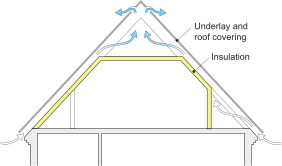
Figure 100. A schematic of a vented roof. The ventilation includes crawl spaces, gaps between insulation and roof underlay, and apex. Ventilation usually occurs between the eaves and ridge as shown here where thermal uplift (the stack effect) contributes to driving vent air through the roof construction. In order for this to function, the vapour barrier must be tight. Besides ventilation below the roof underlay, the space between roof underlay and roof covering should also be vented.
It is unrealistic to expect vapour-permeable underlay (i.e., underlay with Z-values of max. 3 GPa m2 s/kg) to be capable of removing sufficient moisture from loft spaces, apexes, and largish crawl spaces (floor spaces of > 1 m). Unless the vapour barrier has been correctly installed, ‘modest’ ventilation must be set up in vapour-permeable roof underlays (e.g., via roof vents or vent slits in every second pair of roof trusses in loft spaces, and crawl spaces).
Gangways in loft spaces (made of impermeable materials such as plywood) are raised 20–30 mm above the insulation to enable air to circulate underneath and to remove any humidity infiltrating from below. If it forms part of the building’s stabilising system, this should be done with care.
Moisture from outdoor air is periodically carried into vented roof constructions (e.g., when the constructions are colder than the outdoor dew point). This moisture will be vented away when the outdoor air, once again, becomes drier than the air inside the roof construction.
In roof coverings with low thermal capacity and low, or non-existent moisture absorption (such as steel sheets), the added moisture may result in considerable amounts of condensate which must be drained off by the roof underlay.
In overlapping roof coverings such as roof tiles, small amounts of rainwater may infiltrate the roof surface from the outside and may cause humidification. Ventilation below the roof covering should ensure fast drying, thus protecting spacer bars, roof battens, and roof covering. The need for ventilation is greater in winter when the moisture content in the roof construction peaks.
To avoid moisture problems, the ventilation must be effective. This can be ensured by complying with the following specifications:
- The cavity/loft space in pitched roofs is normally vented via openings at eaves and at the ridge level. This is the best way to ensure that ventilation occurs between two openings subjected to positive and negative pressure respectively, due to wind load on the building. In pitched roofs, thermal uplift will also help ventilate the roof, especially when the sun shines on it. Note that if the roof surface is covered (e.g., by solar panels), the contribution to the thermal uplift from solar heating will be diminished.
- Ventilation air should be evenly distributed. Ventilation openings should therefore be placed to avoid unvented areas.
Consequently, ventilation must be established in the parts of the roof where hips, valleys, roof lights, chimneys, and similar features block the primary ventilation (e.g., using roof vents (perhaps combined with vent tiles)). - Normally, a mesh would be installed in the vent openings to prevent the ingress of birds, insects, or driving snow. When using insect meshes, the size of the vent opening should be increased (normally doubled compared to unmeshed openings).
- In buildings shorter than 16 metres, the vent openings in unutilised loft spaces and apexes can be substituted for (or supplemented by) openings at the top of gable ends, thus allowing gable-to-gable ventilation.
- Eave ventilation usually occurs via slits distributed along the base of the roof. Only where this proves impossible should roof vents be used.
- Ridge ventilation usually occurs through slits or roof vents placed high enough on the roof to be able to exploit the stack effect. Note that ventilation through vents in an interlocking clay-tile roof may require vent tiles. In mono-pitch roofs and gable roofs with slopes of less than 10° and buildings with a depth of less than 16 m, ventilation occurs solely via openings at the base of the roof. The size and number of the ventilation openings is relative to the size of the roof and its geometric design (see Table 19).
- For roof types not covered by the tables, the formerly ventilation requirement of 1/500 of the built area is a safe heuristic to determine the size of vent openings.
- If no roof underlay is used in the roof construction, the vent slit must be min. 70 mm (i.e., 70 mm distance between the insulation and the lower edge of the roof tiles).
- In vented roof underlay, the space between the insulation and underlay must be min. 45 mm if firm underlay is used, or 70 mm if underlay of roll material or thin sheeting such as wood-fibre sheets is used.
- In roofs with roof underlay, ventilation must be set up between roof underlay and roof covering to avoid moisture accumulation and the resulting risk of damage due to frost and decay. The need for ventilation depends on the type of roof covering used.
- Finishes at eaves and the intersection of horizontal and sloping roof surfaces should be fitted with wind barriers made of plywood or wind-resistant plasterboard. The wind barriers act as a backstop for the insulation at all terminations/edges without reducing vent openings. The wind barrier is sealed to prevent wind from getting under the insulation.
- For renovation tasks where poor airtightness is suspected and the risk of convection is therefore high, it is advisable to increase ventilation compared to buildings with a higher degree of tightness. In this case, unvented roof underlays should not be considered.
- Eave gutters should be placed to ensure a free passage of air to the vent opening with a min. 15 mm free passage between the gutter and the opening/wall.
- Note that no ventilation cowls are allowed in flat-roof ventilation (i.e., roofs sloping less than 10 °). This is because the negative pressure over the roof propagates to the vent space via the cowls, which may result in humid indoor air being sucked up into the roof construction.
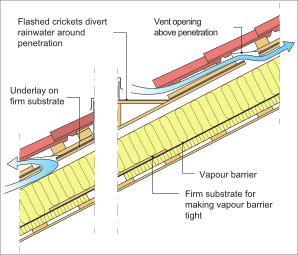
Figure 101. Where the hip, valley, and chimney block the normal eave-to-ridge ventilation, alternative ventilation must be established (e.g., using roof vents, potentially combined with vent tiles). Penetrations are executed on a firm substrate where it joins the underlay. The cricket shown here diverts rainwater around the penetration, thereby reducing the water load. The height of the flashing around the penetration must be min. 100 mm.
For building depths above 16 m, the ventilation must be designed based on a moisture assessment. It is usually an advantage to establish cross-ventilation (i.e., also venting alongside the building).
The TOR Guidelines 30, Fugt og tage (Dampness and Roofs) (Bunch-Nielsen, 2010) gives a detailed description of how to ventilate cold roofs with a cladding of vapour-impermeable roofing materials such as bituminous felt.
Table 19. Required vent opening sizes or no. of roof vents per roof truss in underlays in the roof of buildings with a depth (width) of up to 16 m. The table applies to rafter distances of up to 1.2 m.
The figures are expressed as net areas. If vent slits or roof vents are fitted with insect mesh, the vent opening area should normally be doubled. The roof vent/insect mesh manufacturer must state by how much the mesh reduces the through flow if this is reduced to less than half of the through flow in an opening/roof vent without a mesh. There must always be vent openings at the base of the roof. For low roof slopes (i.e., ≤10 °) ridge ventilation should be avoided to mitigate negative pressure in the roof construction.
The figures are expressed as net areas. If vent slits or roof vents are fitted with insect mesh, the vent opening area should normally be doubled. The roof vent/insect mesh manufacturer must state by how much the mesh reduces the through flow if this is reduced to less than half of the through flow in an opening/roof vent without a mesh. There must always be vent openings at the base of the roof. For low roof slopes (i.e., ≤10 °) ridge ventilation should be avoided to mitigate negative pressure in the roof construction.
Building Depth Opening at Total Opening at Ridge
Each Rafter Base | Roof Vents | Slit | ||
|---|---|---|---|---|
Roof Type | m | Width (mm) | cm2 | Width (mm) |
Gable Roof ≥10 ° Slope | ≤ 16 | 15 | 100 | 10 |
Mono-Pitch Roof or Lean-to | ≤ 8 | 15 | 50 | 10 |
≥10 ° Slope | ≤ 16 | 15 | 100 | 10 |
Flat Roof ≤10 ° Slope | ≤ 16 | 15 | No openings at ridge | |
Table 20. The height of a vent slit between underlay and insulation in a vented underlay.
Building Depth Height of Vent Slit (mm) | ||
|---|---|---|
Firm underlay | Roll material or flexible sheets | |
Up to 16 | 45 | 70 |
above 16 m | Determined after moisture assessment | Determined after moisture assessment |
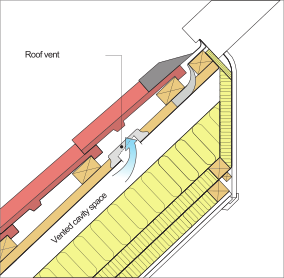
Figure 102. Position of roof vent in underlay below roof light to ensure ventilation which is otherwise blocked by the roof light.
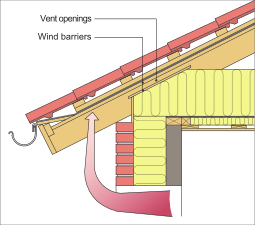
Figure 103. Underlay at eaves and gable ends in multistorey buildings must be protected against fire-spread. To ensure that the roof construction complies with fire requirements and is adequately vented, the vent opening should be made so that the gap between the wind barriers will be min. 300 mm long and max. 30 mm high.
12.4.3 Underlay – Purpose and Types
Most tiled or slated roofs will allow rainwater to infiltrate the covering to some extent.
Traditionally, these roof coverings were installed using roof putty, or similar adhesives, to waterproof the roof against precipitation. This is still a workable (albeit not very practical) solution if the underside of the roof is freely accessible.
If the loft space is utilised or the house is built with a utilised top floor or couple roof, roof underlay is often the only option because it is impossible to maintain the mortar bedding/weatherproofing in the traditional way.
Under thin, vapour-impermeable roof coverings, such as metal roofs, there is usually no water infiltration, but there may be condensate on the underside instead. The condensate may drip onto the insulation and, at worst, may migrate into or right through the construction.
Roof underlays serve two purposes:
- Collecting and diverting small amounts of rainwater which might penetrate the roof covering (and/or condensate)
- Allowing humidity inside to dissipate, thus avoiding harmful moisture accumulation, which may cause mould growth, decay, and dry rot in the construction. Humidity from the inside can be removed by ventilation below the underlay or by diffusion through the roof underlay material (see below).
Run-off from the roof surface must be drained to the gutter.
The underlay could be a membrane on a substrate of boards, plywood, or OSB sheets, a free-hanging membrane, or sheeting.
Beyond moisture-related properties (such as water vapour resistance factor for unvented roof underlays) and beyond being waterproof, the underlay must possess other qualities relative to airtightness, ‘tent effect’, strength, durability, and fire resistance. Further information on these properties is available on the DUKO website www.duko.dk (DUKO is a Danish roof underlay classification scheme). Information on buildability and choice of roof underlay relative to roof covering, roof slope, etc. is also available. For further information, see TRÆ 54, Undertage (Underlay): Træfiber- og faste undertage (Wood-Fibre and Firm Underlays) (Brandt, 2007) and (Byg-Erfa, 1997a), (Byg-Erfa, 1997b), (Byg-Erfa, 2007c), (Byg-Erfa, 2008b).
12.4.4 Roof Underlay – Moisture Performance
Regardless of the structure, small amounts of humidity from the inside will infiltrate the construction. To avoid moisture accumulation, moisture from the inside must be removed at the same rate as it appears.
A distinction is made between two types of roof underlay constructions: vented and unvented.
- In a vented roof underlay moisture is removed via ventilation below the roof underlay.
- In an unvented roof underlay a vapour-permeable roof underlay is used (i.e., products sufficiently vapour-permeable for moisture to be able to dissipate through the material).
Vented and unvented roof underlays will only function properly if humid indoor air is effectively prevented from infiltrating the roof construction. This is normally achieved using a vapour barrier, which will prevent moisture infiltration via both convection and diffusion. Furthermore, loft constructions must be airtight (i.e., plaster must be intact and without cracks, existing vapour barriers must be installed with tight joints and penetrations, loft hatches must be tight, and there must be no openings in joints between ceiling and walls). When renovating and re-insulating roofs, plastered ceilings can no longer be regarded as sufficiently tight to prevent moisture transport into the construction. Consequently, renovation should always involve the installation of a vapour barrier if the insulation used is thicker than 150 mm. If a vapour barrier already exists, its tightness must be checked.
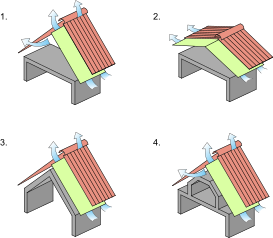
Figure 104. All roofs fitted with roof underlay must be vented between the roof underlay and the roof covering. In addition, vapour-impermeable roof underlays must be vented between the underlay and the insulation.
- Open loft spaces are aired most efficiently via eave-to-ridge ventilation. For short buildings (i.e., 16 m or less), ridge ventilation can be substituted by, or supplemented with, ventilation at the tops of gable ends.
- Eave-to-eave ventilation must only be used for roof slopes below 10° and building depths of max. 16 m.
- In couple roofs, eave-to-ridge ventilation is used.
- In tie-beam constructions, eave-to-ridge ventilation is used. However, in short buildings (i.e., 16 m or less), ridge ventilation may be substituted by or supplemented with ventilation at the tops of the gable ends.
For vapour-permeable roof underlays, ‘modest’ ventilation must be set up in open loft spaces, apexes, and large crawl spaces (with floor areas wider than 1 m) (e.g., using roof vents placed at the top and bottom in every other roof truss) (see Section 12.4.2, Ventilation) because the driving thrust controlling the diffusion is poor here.
The vapour barrier must be made of durable and vapour-impermeable material with a Z-value of min. 50 GPa s m2/kg, unless it can be documented (e.g., through calculations) that a lower Z-value is safe.
If in doubt whether it is possible to install a tight vapour barrier, it is advisable to opt for a vented underlay construction.
Regardless of the roof underlay type, the underside of the roof covering must be vented to avoid condensation and frost damage to the roof covering. To ensure unimpeded ventilation and drainage of rainwater between battens and roof underlay, a spacer bar measuring min. 45 x 25 mm must be fitted on top of the rafters and the underlay. The spacer bar must be made of sharp-edged, pressure-impregnated timber (NTR AB or DS/EN 351-1(P8)). The spacer bars will also ensure free passage between the ventilation openings (e.g., at eaves and ridges) and will keep the underlay in place.
Vented Roof Underlay:
Traditionally, roof underlay has been installed in vented constructions (see Figure 105). Moisture infiltrating the construction from the inside is removed from below the roof underlay with fresh-air ventilation. Firm roof underlays (e.g., bituminous felt as well as many roll-materials) are vapour-impermeable and must therefore always be vented on their undersides.
Vent openings to the underside of the roof underlay must be established in compliance with general rules for ventilation in roof constructions (see Section 12.4.2, Ventilation). Fresh air will flow from the vent openings into the loft space or through a vent slit between the insulation and roof underlay.
In couple roofs, the height of the vent slit should average min. 45 mm. In firm underlays, it is sufficient to dimension the vent slit with this height.
In the case of roll material and flexible sheeting, such as wood-fibre sheets, the vent slit should be dimensioned with a height of min. 70 mm because the underlay will hang between the rafters (see Figure 105).
For roof surfaces on buildings with a depth of more than 16 m, a moisture assessment of the ventilation conditions must be made, focusing on both the size of the vent openings and the height of the vent space.
Note that some types of insulation materials may be supplied with an excess height of up to 5 %. This involves a risk of the effective vent space being reduced. When designing vented underlay constructions and determining the construction height, it is vital to consider the possible excess height of the insulation material. This can be done either by calculating with 5 % extra height or by securing the insulation material with nylon wire, or an Ø 2 mm steel wire per 300 mm.
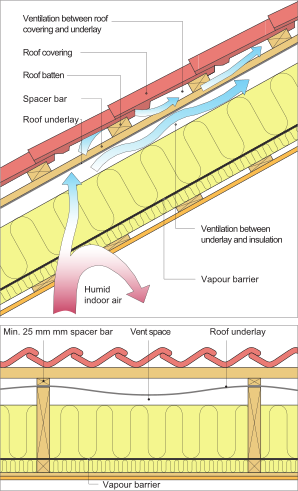
Figure 105. A vented underlay where moisture infiltrating the roof construction from the inside is removed by ventilation of the gap between the insulation and the roof underlay. When installing an airtight vapour barrier, both convection and diffusion of moisture into the construction is reduced. The vent slit must have an average height of 45 mm (i.e., for roll materials and pliable materials). A vent slit height of 70 mm must be dimensioned because these materials will hang between the rafters as shown on the lower figure.
The spacer bar must be pressure-impregnated.
The spacer bar must be pressure-impregnated.
Unvented Roof Underlays
In unvented underlays, there is no vent slit between the insulation and the roof underlay (see Figure 106) which requires less construction height.
In unvented constructions, moisture from the inside must be removed via the roof underlay material (i.e., water vapour should dissipate through the material). Moisture is then removed from the upper side of the underlay by venting between the roof covering and the roof underlay or via natural leakages in the roof covering.
Therefore, unvented roof underlays should be made of materials which are both waterproof to keep out rain and open to water vapour diffusion, so that moisture from the inside is able to migrate through the material by diffusion.
To ensure adequate water vapour diffusion, the vapour diffusion resistance factor (the Z-value) for roof underlay material should be less than 3 GPa s m2/kg. The Z-value is determined by performing a wet-cup test (i.e., determining the diffusibility by examining the moisture transport through the material when inserted as a barrier between two relatively humid environments).
Although vapour-permeable, the roof underlay is only capable of removing small amounts of moisture. For proper functioning, it is necessary to install an (air)tight vapour barrier.
Note that unvented underlays should not be used in conjunction with plastered ceilings because these do not protect sufficiently against moisture transport. This is partly because plaster will often crack and thus allow humid air through. Furthermore, the vapour diffusion resistance of plastered ceilings is like that of the roof underlay materials. Therefore, one cannot be certain that infiltrating moisture from the outside can be removed fast enough.
In unutilised loft spaces, apexes in tie-beam constructions, or in large cold crawl spaces (floor width > 1 m), thermal uplift may cause an accumulation of moisture at ridge level. In such cases, it is particularly important that the vapour barrier is tight, so that the humidification occurring from the inside can be reduced as far as possible. As a minimum, ‘modest’ ventilation should be established (e.g., via 50 cm2 roof vents or vent spaces in every second pair of roof trusses in loft spaces, apexes, and crawl spaces).
Note that some types of insulation materials may be supplied with an excess height of up to 5 %. This implies a risk of the flexible underlay being pressed up by the insulation material, resulting in the underlay sloping towards the rafters. When designing vented roof underlay constructions and determining the construction height, it is vital to allow for the possible excess height of the insulation material. This is done either by dimensioning 5 % in extra height or by securing the insulation material with nylon wire, glass wire, or an Ø 2 mm steel wire every 300 mm.
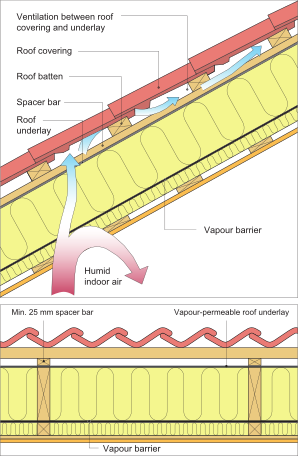
Figure 106. An unvented roof underlay where moisture from the inside is removed by diffusion through the roof underlay. An unvented roof underlay requires an airtight vapour barrier capable of reducing both convection and diffusion of moisture into the roof construction. An unvented roof underlay cannot be used when ceilings consist wholly of plaster because the vapour diffusion resistance of a plastered ceiling cannot adequately prevent diffusion and plastered ceilings are prone to damage, allowing the infiltration of moist air into the construction via convection through cracks and holes. The spacer bar must be pressure-impregnated.
12.4.5 Materials
Firm Underlay
A firm underlay is installed on a substrate strong enough to allow workers to walk on it. It is usually installed on a substrate of boards, plywood, or OSB sheets with a facing of bituminous felt or other strong roof-covering grade roll material (cf. TRÆ 54, Undertage (Underlay): Træfiber- og faste undertage (Wood-fibre and firm underlays) (Brandt, 2007)).
Besides functioning as an underlay, firm underlays of sheeting material can help absorb wind loads sustained by the building, as they will act as bracing due to shear-wall action.
Roll Materials
Underlays made of roll materials tend to be thin, free-hanging membranes mounted horizontally or perpendicular to the rafters. They have no bracing effect.
Some roll materials can be installed on a firm substrate of boards, plywood, or OSB sheets (which need not be roof covering grade). Using roll materials in this way should only be done on the following conditions:
- The wood-based substrate should not absorb moisture via the ‘tent effect’
- The installation should be carried out in compliance with the manufacturer’s instructions. One must obtain agreement from the manufacturer that the material can be installed on a firm substrate.
Sheeting
Underlays of flexible materials chiefly comprise wood-fibre sheets.
These are usually relatively thin sheets which will not tolerate being walked on.
12.4.6 Installation and Applications
Roofs with Vented Loft Space
Vented loft spaces are unutilised loft spaces between the ceiling and the roof.
This is a traditional, well-functioning roof construction known in lattice-truss constructions.
This roof type can be used for humidity exposure classes 1–3. The loft space must be vented in accordance with general rules for ventilation (see Section 12.4.2, Ventilation).
For roofs using underlays such as tiled or slated roofs, the instructions relative to the specific underlays must be followed. For unvented underlays of vapour-permeable materials, modest ventilation is established in the loft space (e.g., through slits and/or roof vents in every second pair of roof trusses). This also applies to apexes in tie-beam constructions (see Section 12.4.2, Ventilation and 12.4.4, Unvented Underlays).
Couple Roofs with Vapour-Permeable Roof Coverings
In couple roofs, the roof surface is parallel with the loft (and integrated in a compact construction without an intermediate loft space).
Moisture balance in this roof type is achieved using one of the following constructions:
- Vented construction, which usually includes an underlay
- A construction incorporating an unvented underlay
Vented Construction
The traditional solution with a tight vapour barrier and a vented cavity above the insulation functions well in terms of moisture control. This roof type can be used for humidity exposure classes 1–3.
To prevent rainwater infiltration, either an underlay or roof tiles with interlocking ribs should be used.
For roofs using underlays such as tiled or slated roofs, the instructions relative to the specific underlays must be followed.
Unvented Underlay
This roof type is highly dependent on the presence of an airtight vapour barrier to effectively prevent moist air from infiltrating the roof construction. The construction is the same as for an unvented underlay.
This roof type can be used for humidity exposure classes 1–3.
Couple Roof with Vapour-Impermeable Roof Covering
The moisture balance in couple roofs with a vapour-impermeable roof covering can be achieved using the following constructions:
- Vented couple roof with (vapour-impermeable) vapour barrier
- Unvented couple roof with moisture-adaptive vapour barrier
Vented Couple Roof
The traditional solution with a tight vapour barrier and a vented cavity above the insulation functions well in terms of moisture control (see Figures 108-111). This roof type can be used for humidity exposure classes 1–3. TOR Guidelines 30 (Bunch-Nielsen, 2010) gives a detailed description of ventilation conditions with a vapour-impermeable roof covering (e.g., of bituminous felt or roofing foil).
The vapour barrier must be airtight because ventilation will only remove the moisture infiltrating the construction via diffusion.
Indoor air infiltrating the roof construction is an especially pronounced problem during the six winter months when the outdoor air used for ventilation can absorb only small amounts of moisture.
It is important that the ventilation works with a balanced pressure (e.g., side-to-side ventilation). Vent cowls must not be used as they create negative pressure in the roof, thus increasing the risk of indoor air being drawn up. The height of the vent space must average min. 45 mm.
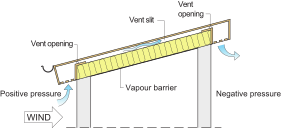
Figure 107. The ventilation principle for vented couple roofs. Wind pressure on the building drives ventilation air through the vent slit via vent openings at the eaves and ridge. Moreover, the stack effect in the vent slit contributes in a small way to driving the ventilation air.
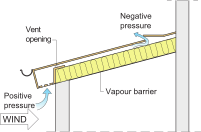
Figure 108. Ventilation from overhang to vent tile for changes in building level (should only be used for roof slopes above 10°). Wind pressure on the building drives ventilation air through the vent slit via vent openings at eaves and ridge vent tiles. Moreover, the stack effect in the vent slit contributes in a small way to driving the ventilation air. Ridge vent tiles should be positioned min. 500 mm from the adjacent wall.
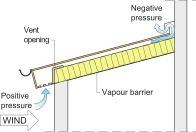
Figure 109. Ventilation from overhang to double flashing for changes in building level. Wind pressure on the building drives ventilation air through the vent slit via vent openings at the eaves and at flashing at ridges/changes in building level. Moreover, the stack effect in the vent slit contributes in a small way to driving the ventilation air.
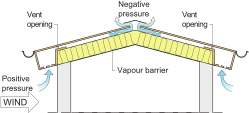
Figure 110. Ventilation from overhangs to a double ridge (should only be used for roof slopes above 10°). Wind pressure on the building drives ventilation air through the vent slit via vent openings at the eaves and ridge. Moreover, the stack effect in the vent slit contributes in a small way to driving the ventilation air.
For roofs with a small slope, the wind is the sole driver of the ventilation. Consequently, the wind must have free passage to the vent openings.
For flat roofs (i.e., with slopes below 10°) there will always be negative pressure above the roof. Hence no vent cowls should be used, as these create negative pressure in the vent slit, thus risking moist indoor air being drawn up through leakages in the vapour barrier.
For roofs with underlay installed (to intercept dripping condensate, especially in metal roofs) manufacturer’s instructions for the specific underlays must be followed.
Unvented Couple Roof with Moisture-Adaptive Vapour Barrier
Unvented couple roofs are based on the theory that the moisture which will unavoidably infiltrate the roof construction during winter is removed via a moisture-adaptive vapour barrier in summer (see Section 4.6.5 on Moisture-Adaptive Vapour Barriers). In winter, a moisture-adaptive vapour barrier works in the same way as an ordinary barrier (i.e., preventing or reducing moisture diffusion into the roof construction). In summer, the roof is heated by the sun, which will drive moisture down to the vapour barrier. This makes the relative humidity above the vapour barrier very high (condensate might even form on the vapour barrier) which will alter the properties of the vapour barrier, allowing moisture to escape via diffusion and/or capillary suction to the room below.
Unvented couple roofs are often constructed as prefabricated roofing slabs. The assumptions for use stated by the vapour barrier manufacturer must be followed carefully, including requirements for the roof surface being heated by the sun and the slabs being fully packed out.
Unvented couple roofs can normally be used in humidity exposure classes 1–2. Manufacturer's specifications for use should be carefully complied with. These should only be used for humidity exposure classes 3–5 in consultation with the manufacturer and/or a consultant with expertise in moisture control.
12.5 Roof Renovation and Re-Insulation
Renovation work should generally be planned and executed according to the same guidelines that apply to new builds. However, renovation tasks will often involve issues which are more complex than those encountered in new builds.
Roof renovation will often involve re-insulating the roof to comply with Building Regulation requirements. Beyond roof renovation, this might also apply to other major renovation tasks. It will often lead to more drastic work involving realigning rafters by furring (upwards or downwards), installing underlay, and re-insulating.
If no vapour barrier had been installed previously, this will normally have to be done during the renovation. If there is a vapour barrier in the construction already, it should be checked and any leakages should be repaired. If there is any doubt as to its quality, the best solution is to install a new vapour barrier.
Note that when renovation work involves re-insulation, plastered ceilings are no longer considered adequate protection against moisture infiltrating into the construction above. If the total insulation thickness is more than 150 mm, a vapour barrier must be installed.
Any leakages, around loft hatches or penetrations must be repaired.
12.5.1 Roofs with Underlay
When replacing clay-tiled or concrete-tiled roofs the Building Regulations stipulate that insulation be installed to meet applicable standards (if it is financially viable). For roof renovation work, it will usually be necessary to install underlay, particularly if the loft space is to be utilised. Prior to installing the underlay, rafters must be checked for potential damage and may require realigning. To facilitate nailing spacer bars and battens, furring planks with a min. thickness of 45 mm should be fixed to the side of rafters, if required. If the furring is fixed on top of the rafter, make sure that the pull-out strength of the nails is sufficient to absorb wind forces exerted on the roof.
The subsequent work procedure follows the general guidelines applicable to underlay discussed earlier (see Section 12.4.3).
12.5.2 Warm Roofs
Warm roofs are normally renovated by replacing the roof covering and possibly adding extra insulation by mechanical fixing. The existing insulation material must be dry, as there would otherwise be a risk of water from the insulation infiltrating the construction through the holes formed by the new mechanical fixtures. One can check that the roof insulation is possible by scanning the roof with a roof scanner supplemented by test cuttings and loss-on-drying tests to calibrate the scan. In small roofs, the check can be performed solely with test cuttings.
A small amount of moisture is acceptable (namely up to max. 2 kg water/m2 of roof area in the insulation). If this figure is exceeded, the insulation should be replaced.
Re-insulating on top of the existing insulation will always improve moisture conditions and hence there are no specific requirements for insulation thickness, except that Building Regulation requirements for the total construction must be complied with.
Old warm roofs do exist. However, where a wood-fibre sheet has been fitted over the mineral wool insulation to distribute pressure, the exterior added insulation must comply with the rules in the section named Converting a Cold Roof to a Warm Roof.
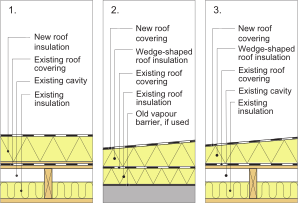
Figure 111. Examples of the renovation and re-insulating of existing roofs.
- Converting a cold roof to a warm roof. The old roof covering (which must be airtight and diffusion proof) will function as a vapour barrier in the roof after the renovation. Insulation with a thickness relative to the humidity exposure class in the building is installed (cf. Table 21). The vent openings in the old roof are closed after approx. one year when it has been ascertained that there is no moisture left in the construction.
- Renovating and re-insulating a warm roof. The old roof covering (which must be airtight and diffusion proof) will function as a vapour barrier in the roof after the renovation. Wedge-shaped insulation in the thickness stated in Table 21 is added and a new roof covering is installed. This will ensure that rainwater on the roof surface is able to drain off and that there will be no humidification due to moisture transport from within.
- Installing exterior additional insulation in a cold roof (with wedge-shaped insulation to improve the slope). The requirements in Table 21 must be met by the thickness at the thinnest place. Ventilation is closed off as for in the first example.
12.5.3 Converting a Cold Roof to a Warm Roof
During a renovation process, it is possible to convert cold roofs with a covering of bituminous felt or roofing foil into warm roofs by means of exterior re-insulation and a new roof covering.
The old roof covering will then act as a vapour barrier
in the new warm roof. Therefore, steps should be taken to ensure that the old roof covering is airtight around roof lights, penetrations, roof edges, and similar features.
To avoid humidification, the thermal insulance factor of the new exterior insulation must have a specific min. value relative to the existing one. This min. value depends on the humidity exposure class applicable to the building. In most cases, the thermal insulance factors correspond to the ratios between the thickness of the new insulation and the original one. If new insulation with a markedly lower λ-value than the original one is used, the thickness of the new exterior insulation can be reduced using the ratio between the thicknesses of the insulation layers. If the λ-value of the new insulation is only slightly lower than that of the original insulation, this means that it is safe to use the ratio between the thicknesses of the insulation layers.
Table 21 provides guidelines for the relationship between the thermal insulance factors of the original construction and the new insulation.
Table 21. The required thermal insulance factor of the new insulation in relation to that of the original construction when converting from a cold to a warm roof or for exterior re-insulation of a warm roof. The conditions stated are calculated based on the max. moisture content in the given class. If it can be ascertained that the moisture content is less (e.g., if climate control is used), calculations may indicate that the required thermal insulance factor of the new insulation can be reduced.
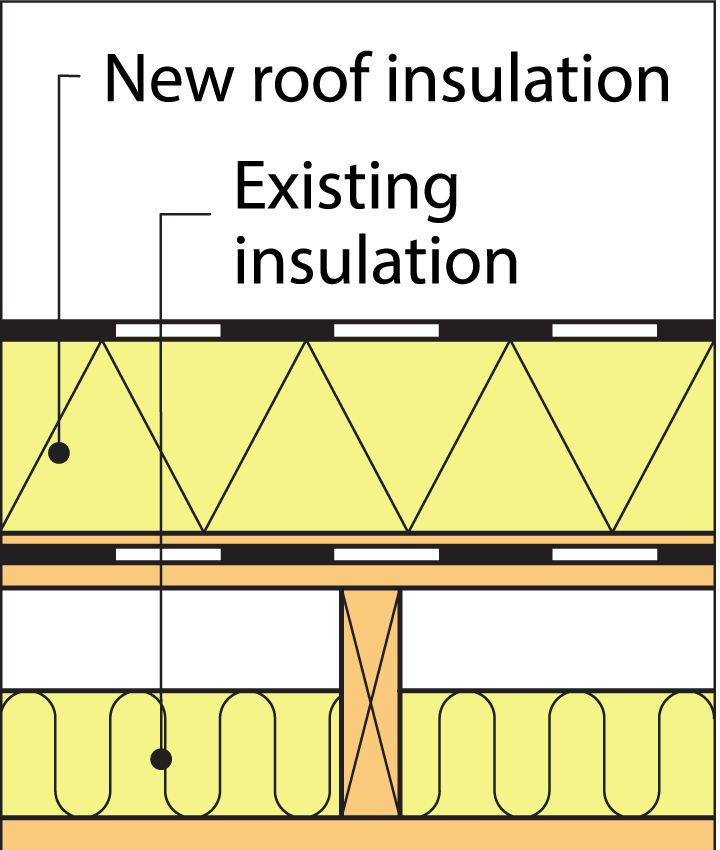 | Humidity Exposure Class | Ratio Between the New and Existing Thermal Insulance Factors |
|---|---|---|
1 | 1:1,5 | |
2 | 1,5:1 | |
3 | 3:1 | |
4 | 8:1 | |
5 | To be calculated |
Example
When re-insulating a traditional roof construction as shown in the figure in table 21, the minimum thickness of the re-insulation is determined with the humidity exposure class as follows:
Construction:
- Bituminous felt
- x mm re-insulation, λ-value = 0.036 W/mK
Existing bituminous felt on 22 mm plywood 50 mm cavity - 100 mm insulation, λ-value = 0.039 W/mK
- Spaced battens w. vapour barrier and 13 mm plasterboard
Calculating Thermal Insulance Factors (Ignoring the Bituminous Felt):
Material | Thickness | Thermal Conductivity | Thermal Insulance Factor |
|---|---|---|---|
d | λ | R=d/λ | |
m | W/m · K | m2K/W | |
Extern. transition Insulation | x | 0.036 | 0.04 x/0.036 |
Total thermal insulance, top | 0.04 + x/0.036 | ||
Plywood | 0.022 | 0.11 | 0.20 |
Cavity | 0.05 | 0.16 | |
Insulation | 0.1 | 0.039 | 2.56 |
Spaced battens Vapour barrier Plasterboard | 0.019 - 0.013 | 0.25 | 0.16 0.05 |
Intern. transition | 0.10 | ||
Total thermal insulance, bottom | 3.24 | ||
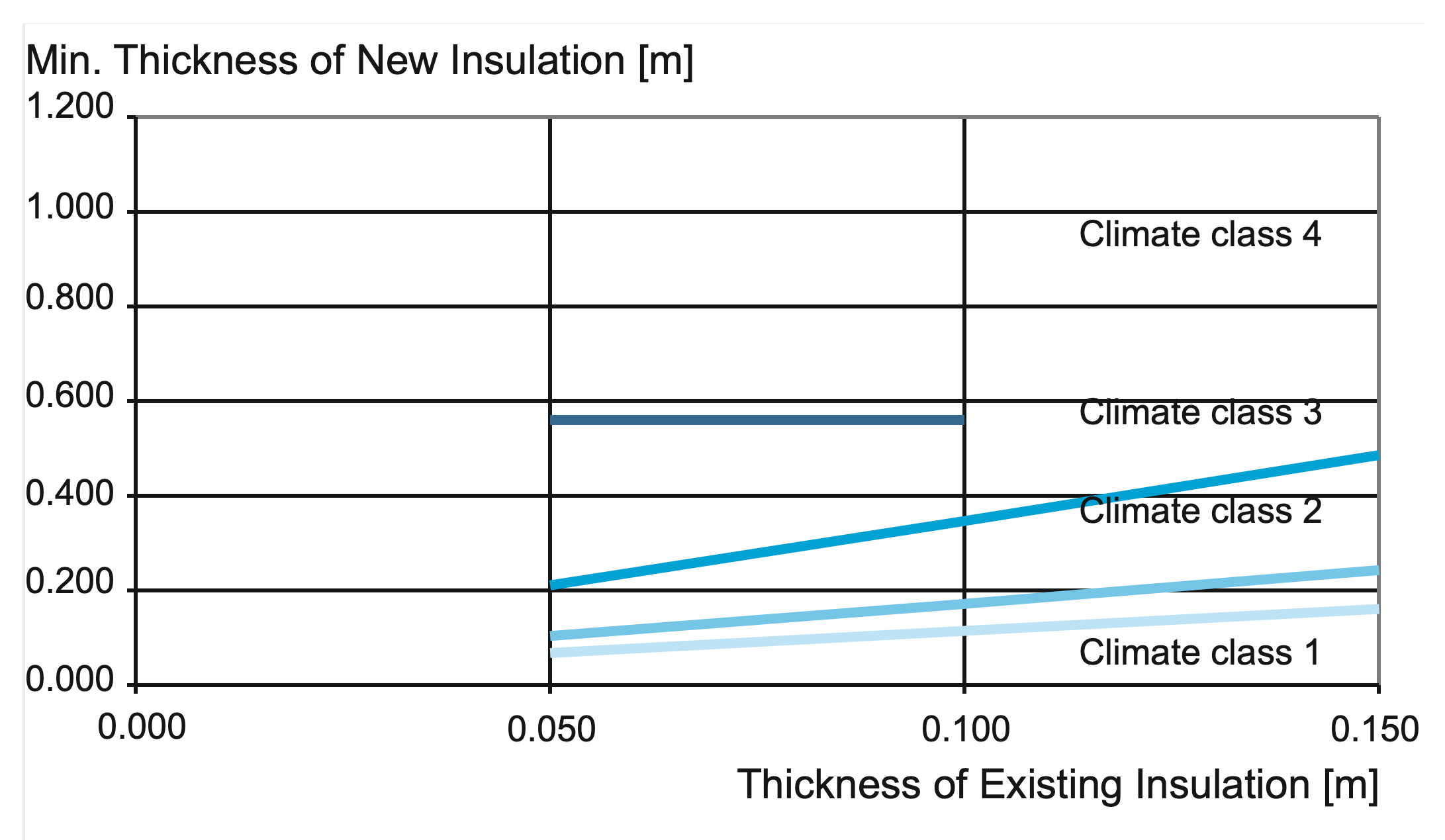
The insulation thickness can thus be calculated based on the thermal insulance factor Kinsulance outlined in Table 21 where 1:1.5 corresponds to the value 2/3:
If this is inserted into the above example, the result will be climate class 2 (Kinsulance = 1.5):
The above calculation can be expressed graphically for this construction as:
Normally, the ventilation is continued for about 1 year so that the roof will have an opportunity to dry out. If this proves impossible for structural reasons, the roof must be dry before closing the ventilation, which can be verified with scanning and sampling.
To improve the slope of the roof, the exterior insulation is typically executed using wedge-shaped insulation. In this case, the requirements in Table 21 must be met by the thickness at the thinnest place. Note that the old vapour barrier in the original cold roof will not usually be airtight. Therefore, in practice it can be disregarded.
12.6 Rooftop Terraces, Green Roofs, and Parking Decks
Using roof constructions as rooftop terraces, green roofs, and parking decks requires careful consideration of the load exerted on the roof as well as the special impact transmitted from the decking to the roof covering. Such load-bearing rooftop constructions should therefore be designed as inverted roofs (see Figure 112.1) or as duo-roofs (see Figure 112.2).
When designing the rooftop construction as a duo-roof or an inverted roof, the membrane can be kept frost-free. This prevents the decking from freezing onto the membrane, damaging it in the event of dimensional changes.
Inverted roofs work like warm roofs in terms of moisture because the load-bearing parts of the construction are on the warm side of the insulation.
An inverted roof only consists of one membrane, since in theory, the roof covering also acts as a vapour barrier. In duo-roofs, the insulation on the upper side of the vapour barrier should normally be at least half of the insulation mass to ensure that the membrane is kept frost-free.
Slopes in duo-roofs and inverted roofs can be reduced to 1:100. The thickness of the upper insulation layer must be dimensioned according to Table 21. If the ratio between the insulation above and below the roofing membrane in duo-roofs is less than 1:1, a vapour barrier should normally be fitted on the upper side of the roof deck.
The insulation in inverted roofs and the upper insulation layer in duo-roofs are placed above the membrane and should therefore be made of a closed-cell material. It will only sorb small amounts of water and will therefore, not be affected by frost damage (e.g., XPS insulation material, which is extruded polystyrene).
In duo-roofs, it is possible to use other materials underneath the membrane where they will not be exposed to water impact (e.g., EPS insulation material (expanded polystyrene) or foamed glass).
The compressive strength of the insulation material must be dimensioned relative to the load exerted on the decking. Materials with (short-term) compressive strength below 150 kN/m2 cannot normally be used.
The purpose of the insulation (beyond its thermal and moisture-related function) is to protect the roofing membrane against mechanical impact.
Rooftop terraces can also be designed as ordinary conventional warm roofs, assuming that the decking is laid on blocking, allowing rainwater a free run below the decking. In this case, the roofing membrane must have a slope of min. 1:40 (see Figure 112.3).
The decking could be comprised of concrete slabs on paving pedestals or timber decking on stickers.
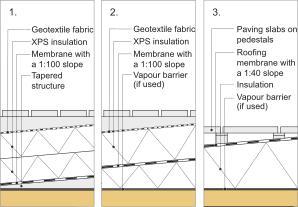
Figure 112. Examples of rooftop terrace construction.
- An inverted roof for rooftop terrace or green roof on a concrete deck. The membrane is placed underneath the insulation and doubles as a vapour barrier. Geotextile fabric has been placed between the insulation and decking to protect the insulation.
- A duo-roof used for a rooftop terrace or green roof. The membrane lies between the two insulation layers and doubles as a vapour barrier. The thickness of the upper insulation layer must be dimensioned according to Table 21. Geotextile fabric has been placed between the insulation and the decking to protect the insulation.
- A rooftop terrace designed as a conventional roof with tiling slabs on pedestals or blocked up to ensure water drainage. The slope should be min. 1:40.