9 Moisture and Basements
This section deals with basements not exposed to water pressure (i.e., basements above the water table or where the water table has been lowered). Basements below groundwater level should be built as properly watertight constructions, which is beyond the scope of this book.
9.1 Moisture Exposure
Basements are complex in terms of moisture control and there are vast differences in moisture and temperature conditions between parts of constructions lying above and below grade.
In theory, basement floors will function as ground floor slabs in terms of moisture performance. Similarly, basement walls above grade will function as exterior walls in terms of moisture performance. Basements below grade are exposed to moisture from both inside and outside and temperature conditions below grade differ from those above grade. These conditions may impact moisture conditions in the construction, including how, and in which direction, moisture is transported.
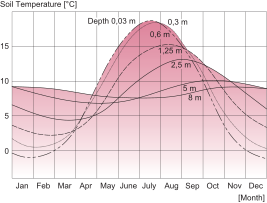
Figure 75. A graph showing variations in soil temperature over the course of a year at various depths. Fluctuations over a 24-hour period in air temperature only affect the soil temperature down to a depth of just under 0.5 m. By contrast, seasonal variations affect soil temperature to a depth of approx. 8 m. Temperature fluctuations in the ground are delayed compared to those of the air. This delay increases with depth and at a depth of 8 m it will be approx. six months. At greater depths, soil temperature remains constant at approx. 8 °C.
Basement walls may be exposed to moisture as follows:
- Construction-related moisture
- Water in the soil, including rainwater run-off percolating through the soil (infiltrated water) and bound water
- Water vapour from the indoor basement air
- Precipitation on the part of the wall which is above grade
In basements, exposure to moisture (sustained by exterior basement walls and floors), results in moisture being released from exterior walls into the indoor air. This excessive moisture must be removed. In newly built basements with thermally insulated walls, this will normally be achieved via ventilation combined with heating.
9.2 General Measures to Prevent Humidification
9.2.1 Construction-Related Moisture
Newly poured concrete basements will contain a considerable excess of moisture. If the basement is closed off, moisture from the concrete will be released to the indoor air, resulting in the relative humidity approaching 100 %. Therefore, it is necessary to remove excess moisture before starting activities sensitive to high relative humidity (such as laying a floor).
Construction-related moisture is usually removed through airing, potentially in combination with heating. Alternatively, one could use a dehumidifier until the basement has dried out. This is a very time-consuming process (cf. Sections 2.2.3 and 2.4.2).
9.2.2 Water Build-up on the Outside of the Basement
Water build-up on the outside of the basement may derive from groundwater, rainwater run-off percolating through the soil, or water from leaking discharge pipes and malfunctioning dry wells or drains.
To provide acceptable moisture conditions inside the basement, water build-up in both the floor and walls must be reduced to a minimum.
Ground Conditions
Rainwater run-off should be drained away from the building and the ground should therefore slope away from the building at a gradient of 1:40 over the first 3 m away from the building (see Section 4.12). For buildings on sloping ground, the ground needs to be levelled off to ensure that rainwater can drain away, or an intersecting drain will have to be constructed immediately below the ground surface at the transition between natural and levelled-off ground (see Figure 56).
Water Pressure and Drainage
The risk of humidification is especially great if water is allowed to stand along the perimeter of the basement, as this could create water pressure on basement walls and floors. This water will typically come from the surface percolating through the backfill along the perimeter of the outside of the basement walls. Therefore, it is important that water carried to the exterior walls of the basement is drained away as quickly as it enters.
9.2.3 Moisture Protection
Moisture build-up in exterior basement walls is normally prevented by implementing a combination of the following options:
- Insulation on the outside of the basement wall, either in the form of rigid mineral wool, cellular plastic insulation sheets with drainage grooves covered by geotextile fabric, or coated expanded clay aggregate pellets. This assumes that the outside water should be drained away before it reaches the outer basement wall.
- Fitting foundation wall plates (i.e., thin profiled plastic sheets allowing water to drain away from the outside of the basement walls).
- Waterproofing the outside of the basement wall, traditionally achieved by applying two layers of bitumen coating.
Insulation and Foundation Wall Plates
Basement wall insulation and foundation wall plates act as moisture barriers, but they are not watertight. These materials should therefore always be used on walls which are intrinsically watertight such as concrete or which, as a minimum, have a finish of waterproof rendering, or similar. Basement wall insulation and foundation wall plates should always be used in combination with a perimeter drain to avoid exposing the walls to water pressure.
Mineral wool can drain water through the insulation but is not designed to remove large amounts of water deriving from rainfall. Foundation wall plates can drain water away in the interspace between plate and basement wall. Foundation wall plates should be installed with good overlap. Both basement wall insulation and foundation wall plates must terminate as close to the ground as possible and should be flashed at the top, perhaps with a tile or profile to prevent precipitation (including meltwater) from entering the insulation or entering behind the plates. Basement wall insulation could be continued above grade and terminated with a suitable surface treatment such as rendering.
Bitumen Coating
Bitumen coating must be done on an even surface (e.g., a levelled or rough-plastered surface). The bitumen coating should be protected either by exterior thermal insulation, rough-plastering using cement mortar in a 1:3 ratio, or by installing drainage blocks of lightweight aggregate concrete, for example.
Wall Drainage System
To avoid rainwater percolating through the soil causing water pressure at certain spots, a subsurface drainage substrate should be fitted to the basement wall to drain The wall drainage system will intercept water originating on the surface and convey it to the perimeter drain (see Figure 76). The wall drainage system could consist of insulation materials with drainage properties or foundation wall plates as mentioned above. If insulation requirements are met in other ways, the wall can be drained by installing a 0.2 m layer of quick-draining sand or gravel sized d10 > 0.3 mm or a similar layer of coated expanded clay aggregate pellets.
Apart from the wall drainage system, no requirements exist for the material used as filling.
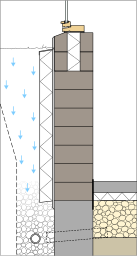
Figure 76. An example of a basement wall with wall drainage system ending at the perimeter drain to remove water percolating through the surface and avoid water pressure being exerted on the wall. To reduce moisture load, the ground slopes away at a rate of min. 1:40 over the first 3 m away from the building (including after potential settling). A plinth height of min. 150 mm is used to avoid humidification occurring in the moisture-sensitive lower parts of the exterior wall. To control radon infiltration, the wall is rendered on the outside and a tight membrane is fitted between the concrete floor and the foundation slab.
Perimeter Drain
Water heading for the outside of basement walls will be drained down to the bottom of this wall by the wall drainage system. From here, it will be drained off via a perimeter drain around the outer wall foundations (see Section 4.13.1). This drain will normally remove the water via a sewer system. The work must be carried out by an authorised sewer contractor. Only where the ground consists of self-draining material, such as coarse sand, can the perimeter drain be omitted. Drainage should be carried out according to DS 436, Code of Practice for the groundwater drainage of structures (Danish Standards, 1993).
Transfer Pipes
When the water table is high and one cannot be sure that the perimeter drain will prevent water intrusion underneath the building, it can sometimes be necessary to install a so-called transfer pipe below the basement floor. The need for this should be ascertained via a geotechnical examination of the soil conditions. If required, a drainage layer must be installed (e.g., a capillary break of coated expanded clay aggregate pellets or shingle connected to the perimeter drain by the transfer pipe). The bottom level of the drain should always be placed underneath the underside of the capillary break.
If transfer pipes are used, two pipes per building should be installed. If the capillary break is divided into foundation sections underneath internal walls, a transfer pipe should be installed for each section.
9.2.4 Moisture Content – Water Vapour from Inside and Outside
The relative humidity depends on whether the basement is heated or unheated. Note that basements intended for heating may not necessarily be heated in practice, even during winter. This can cause a damp indoor climate in the basement.
The floor and exterior walls will be affected by moisture from the inside in the form of water vapour deriving from activities in the room, adding moisture or from venting with warm moist outside air during summer. The constructions are affected on the outside by water vapour from moisture in the surrounding soil.
Wintry Conditions
In winter, the temperature in an unheated basement will be around 10 °C. At this time of the year, the outside air water content averages 4–5 g water per m3. When the outside air enters the basement, it is heated to 10 °C, whereby the relative humidity drops to 50–60 % (assuming that there is no moisture input from other sources in the basement).
Summery Conditions
In summer, the temperature in an unheated basement will be around 15 °C. At this time of the year, the outside air water content averages 10–12 g water per m3. When the outside air enters the basement, it is cooled and the relative humidity increases to 80–90 % (see Figure 77).
On especially warm and humid summer days, the moisture content of the outdoor air may rise to more than 15 g water per m3, which corresponds to a dew point temperature of 17 °C or more. This means that condensation may appear from time to time on uninsulated basement walls and floors in unheated basements. On such days, the basement should be kept tightly shut. By contrast, effective airing out should be performed during periods when the outdoor air is drier (i.e., if outdoor-air moisture content is 10 g/m3 or less, for example a temperature of 20 °C and an RH of 55 %).
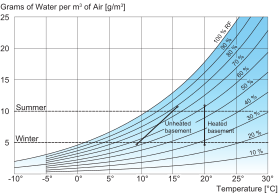
Figure 77. In an unheated basement, cold ventilation air will be heated in winter and the relative humidity (RH) will drop to 50–60 %. In summer, warm air is cooled, and the RH may rise to 80–90 %. If the basement is humidified by rising damp or from activities, the relative humidity will rise. The relative humidity is always lower in a heated basement than in an unheated basement because the same moisture content corresponds to a lower relative humidity at a higher temperature. Modest heating can therefore be used to keep the basement dry in summer.
Reducing the Relative Humidity by Heating
Even modest heating of a basement will tend to make it drier because the heating will cause the relative humidity to drop. For example, heating to 20 °C will reduce the relative humidity to around 60 % in summer and around 30 % in winter (see Figure 77).
9.3 Damp Basements
All the moisture conditions above only apply if no humidification of the basement occurs apart from what is contained in the outdoor air.
Basements with considerable human activity or ‘damp’ basements (i.e., where floors and walls are approximately saturated with soil moisture due to poor drainage and moisture insulation) will sustain moisture input. The moisture content will thus be higher than mentioned above and effective airing out (potentially coupled with heating) will be necessary to keep the basement dry.
Whether airing is sufficient to keep the basement dry depends on how quickly the moisture input occurs. In many basements, there is a delicate balance between the amount of moisture added and the amount removed by airing. If no airing occurs or the temperature is lowered, the balance will shift, and a previously dry basement can become damp and sustain damage. Consideration should therefore be given to whether changes to the basement could shift the equilibrium. For example, insulating the storey partition facing the basement, insulating a boiler placed in the basement, or mounting a new well-insulated heating system will reduce the temperature and cause the relative humidity in the basement to rise. Measures intended to enhance energy consumption and comfort can thus prove to be disadvantageous in terms of dampness (see the section of renovating basements).
9.3.1 Moisture Transport in Basement Walls and Floors
Moisture in exterior basement walls can evaporate from both the interior and exterior surfaces, as moisture can diffuse from the inside to the outside of the basement.
Normally, only small amounts of moisture will evaporate from the part of the exterior wall that is below grade. This is because the average water vapour pressure on the inside and outside of the construction, will only deviate slightly. Hence there will only be a minor driving thrust for moisture transport. The relative humidity on the basement exterior will always remain high, and although the temperature is low, the water vapour pressure (the so-called partial pressure) will also be relatively high. It will also be high in relation to the water vapour pressure on the interior of the basement.
Basement walls were traditionally waterproofed by asphalting or installing foundation wall plates for example. This waterproofing is usually vapour-impermeable, thus preventing diffusion through the surface. In these basements, evaporation will only occur from the inside. Experience shows that basements waterproofed from the outside function well in practice, assuming that they are constructed correctly.
In terms of moisture, it would be an advantage if evaporation could also occur from the outside of the construction. This is only possible when using vapour-permeable – but waterproof – facing on the exterior basement wall combined with vapour-permeable insulation on the exterior of the basement wall.
9.3.2 Rising Damp
Rising damp may occur in basements with floors or walls made of porous materials allowing capillary suction. This is because the porous materials may sorb moisture from surrounding wet materials such as groundwater or moist soil strata along the foundations or basement floor.
The problem of rising damp is especially pronounced in old basements with brick-built foundations where the capillary suction properties of both bricks and mortar can be considerable. Rising damp may also occur in constructions using porous or weak concrete or mortar-joint granite rock.
In recently built basements, foundation bases are usually made from good-quality concrete, in which case the capillary properties are negligible.
The capillary liquid rise is determined by:
- The prospective inflow of surface or groundwater
- The capillary suction properties of soil and materials in the basement wall
- The possibility of rising damp which could evaporate into the basement and outward to the ground
Rising damp is also a problem in old basement floors installed without capillary breaks.
9.4 Constructing Basement Floors
In theory, basement floors are constructed like ground floor slabs (i.e., with capillary breaks to prevent moisture wicking from wet soil strata). The capillary break could consist of a min. 150 mm layer of coarse gravel, coated expanded clay aggregate pellets, or pressure-resistant insulation (cf. Section 7 Ground Floor Slabs, and the example in Section 7.3).
To meet energy requirements, the basement floor must be insulated, and sheets of rigid mineral wool or cellular plastic can be incorporated into the structure as capillary breaks. These materials should always be installed on a level drainage or gravel layer.
If the concrete slab is intended as the only radon protection, a min. of 100 mm concrete with a grade strength of min. 15 MPa (concrete 15), vibrated on pouring, is normally used. To reduce the water content in the concrete, so-called ‘self-desiccating’ concrete can be used. This is stronger and its water-cement ratio is lower (v/c ≤ 0.4) than traditional concrete used for this purpose. The enhanced strength means that the thickness can be reduced, but it should not be thinner than 80 mm.
To counteract cracks formed during shrinkage and settling, which may cause radon infiltration, a suitable shrinkage reinforcement should be incorporated into the deck (e.g., Ø 5 mm ribbed steel per 150 mm at the centre of the slab in both directions). After pouring, the concrete slab should be protected against drying out for approx. 8 days.
The thermal insulation ensures that the soil temperature below the basement floor is kept low and hence the water vapour pressure under the basement floor is equally low. Any moisture transported up through the basement floor is therefore negligible and can be removed via a modest air exchange rate. In a dry heated basement (constantly heated to a min. of 20 °C) the floor can be laid in a manner typical for an ordinary ground floor slab. Moisture-sensitive floors, including wooden floors, should always be laid on top of a heavy-grade moisture barrier (e.g., 0.2 mm plastic foil).
9.4.1 Radon
When the barometer reading drops, air from the soil is pressed up through the floor. In addition to the deck itself being tight, it is imperative that interfaces with basement walls are also tight, as well as any penetrations (e.g., using caulking compound).
Radon infiltration can be further prevented/reduced by balancing the pressure of the underside of the deck construction with that in the open. This could be achieved by placing an air-permeable layer under the deck such as a capillary break of shingle or coated expanded clay aggregate pellets. The pressure can be balanced using a pipe to above roof level (see Figure 46).
9.5 Constructing Exterior Basement Walls
Exterior basement walls were traditionally made of concrete poured on site or built with concrete blocks (e.g., of lightweight aggregate concrete on a poured foundation slab). Stringent requirements for linear thermal transmittance have meant that concrete basement walls in heated basements are unlikely to be built in the future. As mentioned earlier, foundation wall plates, rigid mineral wool, or cellular plastic sheets covered with geotextile fabric can be fitted to the outside of the wall and/or traditional rough-casting and a double coat of bitumen can be used.
9.5.1 Exterior Thermal Insulation
Thermal insulation of exterior basement walls should preferably be performed on the outside. This will ensure a warm outside wall with a dry inner surface and will eliminate the risk of condensation. Special thermal insulation materials are required for example rigid mineral wool, coated expanded clay aggregate pellets, or polystyrene drainage mats with drainage grooves protected by geotextile fabric on the side facing the soil. The insulation can be continued above grade where it could be given a facing in the form of rendering or sheeting.
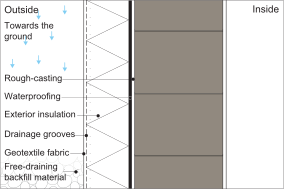
Figure 78. An example of outside thermal insulation of an exterior basement wall using aerated concrete blocks. The basement wall is waterproofed on the outside. Insulating polystyrene drainage mats with vertical drainage grooves on the outside are mounted to the exterior basement wall. The drainage grooves are covered by geotextile fabric to prevent the grooves from being blocked by soil. The drainage mats could be bonded in place. Drainage mats are usually supplied with ready-fitted geotextile fabric with flaps for overlapping joints. The upper edge should be covered to avoid water intrusion between the basement wall and drainage mats.
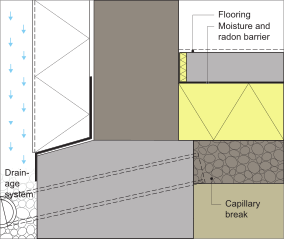
Figure 79. Detail showing a basement floor with a capillary break and insulation. The basement wall is made of aerated concrete with exterior polystyrene insulating drainage mats and vertical drainage grooves on the outside covered with geotextile fabric. The transition between foundations and exterior basement wall must be waterproofed with flashing. The concrete floor slab is usually min. 100 mm thick with reinforcement (e.g., Ø 5 mm per 150 mm in both directions). The capillary break is connected to the perimeter drain via transfer pipes.
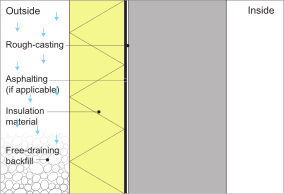
Figure 80. An example of a poured concrete exterior basement wall. The wall is treated on the outside with rough-casting and given a double asphalt coating (if applicable). If evaporation to the outside is required, the asphalting should be omitted. The exterior thermal rigid mineral wool insulation sheets are installed using ‘spot-bonding’, strip-bonding, or asphalt binder. Backfill is free-draining (e.g., gravel or coated expanded clay aggregate).
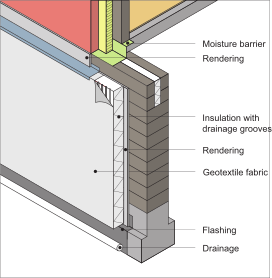
Figure 81. An example of an exterior basement wall made of blocks which is rough-cast and asphalted on the side facing the soil. Exterior thermal insulation of polystyrene insulation with drainage grooves covered by geotextile fabric. Backfill is free-draining (e.g., gravel or coated expanded clay aggregate). The insulation should terminate as close to grade as possible and have a 200 mm overlap of the insulation in the top blocks of the exterior basement wall. The insulation is flashed at the top (e.g., with a metal profile). The transition between foundations and exterior basement wall is waterproofed with flashing.
Interior thermal insulation is generally not recommended, as it can lead to humidification of the interior wall surface by water intrusion from the outside and/or through the condensation of humid indoor air on the original surface (which will be cold after completing the work of insulation).
9.6 Renovating Old Damp Basements
Old basements are usually renovated to solve moisture problems or to make them drier and warmer.
The rules for basement renovation are almost the same as those for building new basements. Nevertheless, conditions are usually more complex because the constructions do not normally meet applicable requirements (e.g., those for insulation and capillary breaks).
In many old properties, rising damp may occur in both floors and walls (particularly in those built with brick walls and floors without capillary breaks). In these cases, moisture conditions are linked to:
- Ventilation
- Heating
- Evaporation inwards to the basement
- Evaporation outwards to the soil
- The presence or absence of a moisture barrier in basement walls
- Interior and exterior insulation
Often, moisture conditions in old basements can be improved with relatively simple interventions. It is very difficult – not to say impossible – to renovate an old basement and achieve the moisture conditions of a new one. Given that total renovation is very costly, one would usually implement the simplest and cheapest measures and accept a degree of dampness in the basement climate. If this is the case, the usage of the basement will typically be limited to secondary purposes.
In an unheated basement with poor airing and damp floors and walls, the relative humidity might be close to 100 % all year round. If the moisture in walls cannot evaporate, it could rise to a level where the joisting in the basement floor can deteriorate due to wood-decaying fungi.
9.6.1 Ventilation and Heating
Sensible ventilation/airing and heating can reduce humidity levels in a basement to acceptable levels (see Figure 77) (see Reduction of Relative Humidity by Heating, in Section 9.2.4).
Ventilation and heating will reduce the relative humidity in the basement.
This will enable more moisture to evaporate from the basement floor and walls and thus limit the extent of rising damp in the walls.
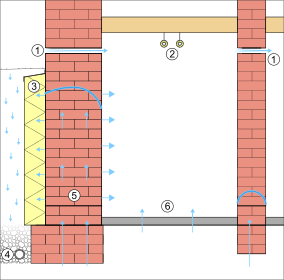
Figure 82. In old basements, the walls and floors will often be damp. This may be due to rising damp or because the exterior basement wall is exposed to moisture. The capillary rise (shown as blue curves) depends on several conditions. The capillary height can be reduced by:
- Ventilation which will reduce the RH in indoor air and increase evaporation from the walls by removing humid air. The surface treatment of the interior walls should be vapour-permeable to allow evaporation. Note that special conditions apply in summer.
- Heat supply in connection with ventilation will reduce RH in the indoor air and increase evaporation from the walls.
- Insulating the outside wall will raise the wall temperature and hence evaporation form the inner wall. Moreover, using vapour-permeable insulation will allow evaporation to the outside.
- Setting up a drain to reduce moisture load from the outside and hence the amount of moisture intrusion into the construction.
- Horizontal moisture control of the (outside) basement wall.
- Moisture control of the floor, which will reduce the amount of rising damp through the basement floor and hence RH in the indoor air, and which will increase evaporation form the walls.
9.6.2 Evaporation into the Cellars
To achieve the best possible conditions for evaporation into cellars, vapour-permeable surfaces/coats are used on the inside basement walls. Coating is best done by whitewashing or applying vapour-permeable coats such as silicate paint or oil emulsion paint.
Vapour-impermeable surfaces, on the other hand, prevent water from being transported to the surface, hence reducing evaporation. Instead, there might be a risk of moisture wicking higher up into the walls. Using vapour-impermeable facings such as sheets, ordinary waterproofing plaster, or waterproofing membranes on basement walls should therefore be avoided.
Furthermore, exterior walls (also interior walls affected by rising damp) should be free of cupboards and other large objects which might impede evaporation.
Salt in Basement Walls
Due to evaporation, over time, salts from either the soil or the construction can accumulate in basement walls. Salt deposited in old basement walls through wicking cannot be removed and will often lead to recurrent problems of peeling rendering and paint.
Salt is hygroscopic and although moisture sources (such as water wicking from the soil) may have been eliminated, a high moisture content in the walls should be expected.
Continuous problems with peeling due to salt content can be reduced to some degree by applying special patching compound capable of holding more salt than ordinary rendering before being damaged.
9.6.3 Evaporation from Outer Basement Walls
Moisture conditions in basements can be improved to some extent by allowing outward evaporation to the soil. This requires the outer wall to be vapour-permeable while remaining waterproof. This means that asphalting or other vapour-impermeable coatings will have to be removed. If the water vapour pressure in the basement is higher than in the soil outside, wall moisture will evaporate through the insulation and condense in the soil. The walls are protected against water pressure (soil moisture) by a capillary break, which drains (percolating) water to the perimeter drain (see Figure 82).
9.6.4 Moisture Barriers in Basement Walls
Humidification of basement walls can be reduced or blocked by installing a horizontal moisture barrier in the walls.
There are usually three options for the execution of horizontal moisture barriers:
- Inserting stainless steel sheets
- Installing a moisture barrier after cutting or sawing through the structure
- Injecting hydrophobic agents.
It is problematic that, for practical reasons, these moisture barriers will often have to be placed some way above grade or the floor, and a combination of these options is often necessary.
Inserting corrugated stainless steel sheets can only be used in brick basement walls with continuous horizontal joints. The steel sheets are knocked or vibrated right through the wall and installed with overlap to achieve an unbroken moisture barrier. It is difficult to ensure an unbroken moisture barrier in corners and similar areas.
A moisture barrier can be installed by cutting or sawing through areas with a chainsaw with diamond-studded teeth. This method can be used for all materials. The work should be divided into sections.
Full-scale studies of sawing through basement walls have been performed and information has been documented from practical experience. Further information is available at www.gi.dk.
Full-scale studies have also been conducted with hydrophobic agents. Results indicate that there is no guaranteed effect from injecting hydrophobic agents. The effect will also be highly dependent on local conditions. Further information on practical experience with the injection of hydrophobic agents is available at www.gi.dk.
9.6.5 Waterproofing a Basement Floor
A basement floor can be waterproofed by breaking up concrete floors and installing replacement floors onto a capillary break (see Figure 83). However, this is an expensive solution.
Therefore, in most cases, other methods are used to control rising damp. These include; installing a plastic moisture barrier, applying a coating of mastic asphalt or waterproof rendering (see Section 9.6.7, Interior Re-Insulation/Moisture Control). It can be difficult to meet demands from suppliers for a max. humidity level in the substrate when applying a liquid moisture barrier, as concrete floors without capillary breaks will normally have a high moisture content.
9.6.6 Exterior Re-Insulation/Moisture Control
Insulation or moisture control of old basements is best done from the outside. This will prevent moisture from the outside from infiltrating the basement wall, making the wall warmer. In turn this increases evaporation from the inside.
Thermal insulation can be achieved using insulation materials with draining properties such as coated expanded clay aggregate pellets or cellular plastic sheets with drainage grooves protected by geotextile fabric on the side facing the soil. Insulation materials without drainage properties can also be used, including mineral wool combined with free-draining backfill on the outside. Draining is necessary to avoid percolating surface water exerting pressure on the basement wall.
The insulation can be continued above grade where it can be rendered or covered with sheeting.
9.6.7 Interior Re-Insulation or Moisture Control
Interior thermal insulation of outer basement walls is generally not recommended, as it may result in the original wall surface becoming damp. However, in old basements this may be the only option. A thorough investigation should always be undertaken to ascertain whether it is technically and financially viable to install insulation and moisture insulation from the outside. If the majority of an outer basement wall is above grade, it might be necessary to thermally insulate the inner side for structural and aesthetic reasons.
For inside insulation to work, the basement must be dry and heated to min. 20 °C in winter. If insulation is installed on the inside, all residual organic material must be removed to eliminate the risk of mould growth or deterioration.
In practice, insulating the inside will often take the form of an insulated additional wall in front of the actual exterior basement wall. The insulation will result in the temperature of the original exterior basement wall being lowered. There is a risk, therefore, that humid indoor air will condense on the surface of the original wall unless the additional insulating wall is vapour-tight. If the additional wall is not airtight, this introduces a risk of convection in the wall, resulting in condensation. Furthermore, the part of the outer wall which is below grade will be in hydrostatic equilibrium with the surrounding soil, which could lead to the additional wall becoming damp due to its exposure to moisture from the outside. If so, only inorganic materials should be used without a vapour barrier in the part that is below grade, so that any incoming moisture can evaporate into the basement.
An example of this type of construction is an additional wall of aerated concrete, without a vapour barrier, with 50 mm of insulation facing the actual outer basement wall. However, it is disadvantageous that this type of wall takes up a lot of space.
It would be preferable if at least some of the insulation could be placed on the outer side of the basement wall. This would increase the wall temperature, thus speeding up drying and reducing the risk of condensation.
Inorganic sheeting with modest thermal insulating properties and high capillarity is available on the market. Such sheets can be used to break thermal bridges in basement walls without a vapour barrier when installed by bonding them. The moisture transported through the sheets via diffusion (condensing on the surface of the original wall) will wick back to the inner surface where it will evaporate. This application requires special adhesive and vapour-permeable surface coatings.
9.6.8 Re-Insulating Basement Floors
In theory, basement floors can be thermally insulated from the inside using the same methods as for re-insulating ground floor slabs. However, if there is a risk of flooding in the basement, only floors that will tolerate humidity should be used. A safe solution in terms of moisture performance would be a floor tiled directly onto concrete. Here there is no need for a moisture barrier.
Room height permitting, a layer of pressure-resistant insulation can be laid, and a new concrete floor poured directly onto that. The use of moisture barriers when laying floors must follow the guidelines for ground floor slabs.
For lower room heights, a floating floor could be laid by adding a layer of insulation on the concrete deck, followed by a moisture barrier, and finally a subfloor sheet. The moisture barrier must be joined tightly to all surrounding walls and, if possible, should be continued upward behind the skirting (finishing at the upper edge).
Finally, the whole basement floor can be replaced in connection with sectional cementing of the foundations all the way round. This is, however, expensive and is usually only an option if the basement is due for renovation for other reasons.
In connection with renovating a basement floor, radon control should be incorporated by making the deck construction completely tight – if necessary, by using flashing against the walls.
9.6.9 General Issues
Following a renovation, some measure of heating and ventilation will be necessary to keep the basement dry.
After renovation, it will take a very long time (up to several years) before the walls have achieved a new hydrostatic equilibrium. Note that if the constructions (such as the brickwork) contain salts, the moisture content in these may still be high and the peeling of rendering and other coatings is unavoidable.
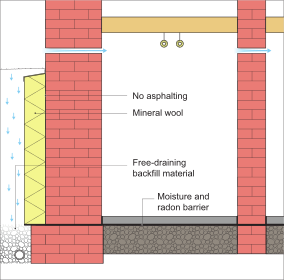
Figure 83. The complete renovation of a damp basement involves breaking up the basement floor, ensuring moisture control of all walls below floor level, installing a capillary break, a radon barrier, and a new concrete floor. Basement walls are insulated on the outside (e.g., with a vapour-permeable layer of insulation) to enable them to dry out by evaporation outwards through the outer basement walls. They are coated on the inside with vapour-permeable paint, or a similar coating. A perimeter drain is established and free-draining backfill material is added next to the insulation.
A measure of heating and ventilation will be necessary to keep the basement dry. Note that if the constructions (such as the brickwork) contain salts, the moisture content in these may still be high and the peeling of rendering and other coatings is unavoidable. Radon control should be incorporated into the renovation by ensuring that the deck construction is completely tight. If necessary, one could use flashing against the walls.
A measure of heating and ventilation will be necessary to keep the basement dry. Note that if the constructions (such as the brickwork) contain salts, the moisture content in these may still be high and the peeling of rendering and other coatings is unavoidable. Radon control should be incorporated into the renovation by ensuring that the deck construction is completely tight. If necessary, one could use flashing against the walls.