8 Moisture and Crawl Spaces
Vented deck constructions facing soil are normally termed crawl spaces.
They are usually constructed with strip foundations and a vented cavity between the floor construction (crawl space deck) and the underlying ground (bottom deck). The term crawl space also includes spaces that are inaccessible.
In recent years, there have been marked changes in the physical conditions of crawl spaces. The changes are due to better insulation of crawl space decks and installations. The insulation has ‘robbed’ the crawl space of considerable heat input, which has resulted in lower temperature and consequently higher relative humidity in crawl spaces. Traditional vented (cold) crawl spaces with a ventilation area of 1/500 of the ground area and a U-value corresponding to current insulation requirements are therefore only an option if the materials facing the crawl space are solely inorganic. If so, they must be vented in accordance with the guidelines stated in Figure 74. Using organic materials in the construction of crawl spaces is not advisable.
To utilise vented floor constructions as proper accessible crawl spaces, they should be constructed with access and a min. 600 mm headroom to allow for inspection and repairs (cf. Branchevejledning om arbejde i eksisterende krybekældre (Trade Guidelines for Working in Existing Crawl Spaces) (Branchearbejdsmiljørådet for Bygge & Anlæg, 2004).
For the above reasons and for reasons of accessibility (step-free access), crawl spaces will normally only be used in new builds where ground floor slabs are considered unsuitable or where it is considered advantageous (e.g., for pipe layout in a service corridor below terraced houses). In these cases, crawl space construction should be executed quite differently, as described below.
8.1 Moisture Exposure
Crawl spaces can be exposed to moisture in the form of:
- Soil moisture intruding through the walls of the crawl space or up through the bottom deck
- Moisture from above-lying rooms
- Construction-related moisture
- Moisture from the outside air (possibly ventilation air).
Additionally, there is a risk of moisture seeping in from surface water or groundwater, especially if there are cracks in the walls or floor, or low-lying grids.
8.2 General Measures to Prevent Humidification
8.2.1 Construction-Related Moisture
Construction-related moisture is normally removed by thorough airing and potentially combined with heating. This is a very time-consuming process (cf. Section 2.4.2). In unvented (warm) crawl spaces, the concrete bottom deck should be allowed to dry out for at least a month after being poured. If no large amounts of moisture require removal, the residual moisture in a crawl space can usually be removed via ordinary ventilation. To aid the drying process, enforced mechanical ventilation could be set up for a period.
In powerfully vented crawl spaces for pavilion structures, concrete bottom decks are not normally used, and construction-related moisture is therefore rarely a problem.
8.2.2 Soil Moisture
Ground floor slabs are affected from below by moisture from the soil.
The ground around the building should slope away, so that rainwater will drain away from the building (see Section 4.12).
This moisture includes both water wicking from the groundwater by capillary action and rainwater percolating through the soil.
Soil moisture must be prevented from being drawn up into the reinforced concrete layer at the bottom of the crawl space. This is done by installing a capillary break (see Section 2.2.3).
Unless the soil is self-draining, a perimeter drain should always be installed alongside foundations.
Soil moisture results in a relative humidity that is almost always 100 % in the soil pore system. The high relative humidity in the pores means vapour pressure is exerted on the underside of the bottom deck which is solely dependent on the temperature at the specific place in question (see Sections 3.2.4 and 7.3). The implications of this depend on conditions inside the crawl space (see the Section Water Vapour in Indoor Air, below).
Moisture transport can also occur by convection (airflow) through cracks and gaps. For this reason, as well as to prevent radon infiltration, it is important to make the deck in cold crawl spaces as airtight as possible. In warm crawl spaces (which will be covered in greater depth later in the Guidelines) it is the bottom deck that must be airtight.
8.2.3 Water Vapour in Indoor Air
Materials in crawl spaces may be heavily exposed to moisture due to the moisture content of the air in crawl spaces.
If outside air enters a traditionally vented crawl space, temperature conditions will usually change the relative humidity. In winter, the temperature in a traditional crawl space is slightly higher than the outside temperature due to additional heat input from the building above.
Ventilation air will therefore be heated, leading to a drop in RH. In summer, the surface area in a crawl space is colder than the outside air, resulting in a drop in ventilation air temperature and a rise in RH (see Figure 71).
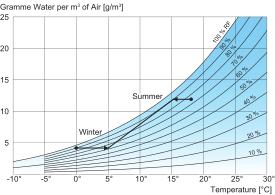
Figure 71. Moisture conditions in a traditional cold crawl space without added moisture input from the ground. In winter, the temperature is around 5 °C, which is higher than outside due to additional heat input from the building. The ventilation air will be heated slightly and the relative humidity will drop to around 60 % as a result. In summer, the temperature in a crawl space is around 15 °C because the surface areas (especially the reinforced concrete bottom) are cold. Thus, the ventilation air is cooled, and the relative humidity rises to approx. 90 % (sometimes even more).
8.3 Traditional Cold Crawl Spaces
The effect of the above combinations of moisture exposure was formerly counteracted using vented crawl spaces. This was generally considered a sound technical solution for moisture as well.
Crawl spaces could be kept dry thanks to a degree of heat input to the ventilation air from the rooms above. Moreover, ventilation meant that any radon infiltration from the subsoil would be removed by the ventilation air. A further advantage of the new crawl space height (of 60–80 cm) was that installations could be run there.
These advantages are no longer considered as significant as they once were. The current energy requirements and the related requirements for thermally insulating a traditionally vented crawl space means that the ventilation air no
longer gets the same amount of heat input from the rooms above to maintain a sufficiently high temperature. The effect of this is that the relative humidity in the crawl space becomes higher than before with a considerable risk of mould growth if organic materials have been used there.
Furthermore, the Danish Working Environment Authority has tightened requirements governing prolonged work in crawl spaces (cf. Section 8.6.1, Installations in Crawl Spaces).
8.4 Warm Crawl Spaces
If constructing a crawl space, it is best executed as a warm crawl space in a design that is radically different from previous practices.
The following subsections provides guidelines for designing a warm crawl space.
A warm crawl space is vented by indoor air and its temperature is therefore very close to that in the rooms above.
Deck Construction
The deck is constructed without insulation. The crawl space walls should be thermally insulated and damp-proofed as one would exterior basement walls. At the bottom of the crawl space, a bottom deck is cast on top of a capillary break and insulation material with a thickness corresponding to the insulation for a ground floor slab/basement floor. To protect against radon, the deck must be reinforced or, if not, a membrane must be laid underneath the bottom deck. The membrane should be fitted tightly to the crawl space walls. This will also improve airtightness and reduce moisture encroachment.
Ventilation
Mechanical ventilation hooked up to the property’s ventilation system creates negative pressure in the crawl space, enabling heat recovery. The air exchange rate should correspond to the one in the building, which is generally configured to a rate of 0.5 times per hour. The air supply comes from the rooms above via natural leakage paths at skirting board levels, and similar locations. Slits or grids in the floor could also be made intentionally (however not from the kitchen and bathroom). The mechanical ventilation system must generally be adjusted to avoid any nuisance. The crawl space should be designed to allow the air free passage to the exhaust area from all rooms in the crawl space (i.e., there must be openings between all rooms in the crawl space allowing passage for inspection).
Airtightness
The airtight enclosure of the building (cf. SBi Guidelines 214, Klimaskærmens luft- tæthed (Airtightness in the Weather Screen) (Rasmussen & Nicolajsen, 2007)) must include the bottom deck and the crawl space walls which should consequently be made airtight.
Drainage Systems
A perimeter drain is often set up, unless the soil surrounding a crawl space is self-draining (see Section 4.13.1 Drainage Systems).
The optimal sound transmission conditions from one room to the next are achieved using heavy materials (concrete, aerated concrete) in the crawl space deck.
Access
Headroom in the crawl space should be at least 800 mm, providing a passage underneath pipework of at least 600 mm.
There should be an access hatch sufficiently large to accommodate people and to enable pumping and dehumidifying equipment to be brought down and set up in the crawl space. In anticipation of possible water intrusion, the bottom of the crawl space should be horizontal with a slight slope towards a sump from where a pump can remove the water. For example, the sump could be sized at 0.5 × 0.5 m with a depth of 5–10 cm. The sump is placed near the access hatch.
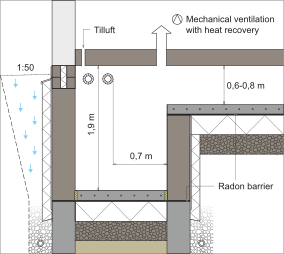
Figure 72. An example of a warm crawl space (insulated at the bottom and walls) with a service corridor in one side. The service corridor is constructed according to applicable requirements for height and width and facilitates supplying and servicing installations in the crawl space. In this example, the heated crawl space is mechanically ventilated by indoor air supplied via leakage paths in the deck structure. These openings could be supplemented by slits or grids.
To protect against radon, the walls are coated on the outside (e.g., by rendering or a coat of bitumen).
8.5 Powerfully Ventilated (Cold) Crawl Spaces
In the past, powerfully ventilated crawl spaces were commonly used in pavilion structures placed on high ground. High-powered ventilation is achieved using a ventilation area in the substructure of min. 1/50 of the built area (i.e., 10 times what was formerly used in a traditionally designed vented (cold) crawl spaces).
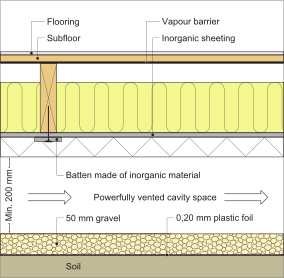
Figure 73. An example of a powerfully ventilated crawl space built within the context of a pavilion of prefab slabs. There must be access for the joints to be made from above. The ventilation area must be min. 1/50 of the built area. Rising damp from below is prevented by a plastic foil membrane held in place by a layer of gravel.
A min. height of 600 mm is required for the crawl space to be accessible for inspection and maintenance in the cavity. For lower heights, no installations should be run within the cavity.
A min. height of 600 mm is required for the crawl space to be accessible for inspection and maintenance in the cavity. For lower heights, no installations should be run within the cavity.
To protect against soil moisture, a min. 0.2 mm PE foil is laid, covered by approx. 50 mm of sand or gravel to keep the membrane securely in place.
The distance between the ground and crawl space deck should be min. 600 mm, to enable inspection and repairs of the construction. Often, the distance between the bottom and sand/gravel layer is only approx. 200 mm. This renders the space inaccessible. No installations should be run in constructions with cavities this low because maintenance is virtually impossible.
Radon protection is achieved by a combination of high-powered ventilation and an airtight deck construction.
Any load-bearing wooden parts in the deck construction can be protected against moisture exposure by placing 100 mm insulation underneath such parts. Wood exposed to the open should be pressure-impregnated and any sheeting used to cover the insulation should be made of inorganic materials.
Vent openings should be protected against vermin intrusion, for example by installing metal grids (cf. Vejledning om rotter (Guidelines on rats) issued by the Danish Environmental Protection Agency (Danish EPA, 2005)).
Other variants of cold crawl spaces can only be used if it can be proven (via moisture calculations) that sound moisture and temperature conditions can be maintained in the crawl space.
Powerfully ventilated crawl spaces are not particularly energy efficient. They generally increase heat losses as it is impossible to exploit the insulation properties of the underlying soil layers.
8.6 Special Issues
8.6.1 Installations in Crawl Spaces
In terraced and chain housing, district heating pipes, and other installations, are often required to run below a deck construction. If so, the work must be carried out in accordance with the Danish Working Environment Authority’s stringent requirements for prolonged work in crawl spaces (cf. Branchevejledning om arbejde i eksisterende krybekældre (Sector Guidelines on Working in Existing Crawl Spaces) (Branchearbejdsmiljørådet for Bygge & Anlæg, 2004)). This stipulates a min headroom of 1.9 m and a free working width, level with the installations, of min. 0.7 m (see an example in Figure 72).
To avoid working in crawl spaces, consider whether it might instead be possible to design the deck construction so that the installations can be installed and serviced from above (e.g., via detachable floor hatches). This would eliminate the requirement for free headroom to perform work.
8.6.2 Crawl Space Decks Below Wet Rooms
Below wet rooms (such as bathrooms, toilets with floor drains, and similar areas), the crawl space deck should be made of concrete or aerated concrete. As far as possible, joisting should be avoided, but if used it should be installed in accordance with the guidelines in By og Byg Anvisning 200, Vådrum (Wet Rooms) (Brandt, 2001). No organic materials (such as wood) must be used in inaccessible crawl spaces in the crawl space deck.
8.6.3 Renovation/Re-Insulation of Crawl Spaces
A crawl space which has functioned well for years should not be changed at any cost (including re-insulating underneath the deck construction), as there would seem to be a correct balance between moisture release, additional heat input, and ventilation.
If a vented (cold) crawl space is renovated (e.g., to achieve energy savings), this is best done by converting it into a ground floor slab (if ground conditions or existing installation duct work in the crawl space does not prevent this). When converting a crawl space into a ground floor slab, radon control measures must be implemented (e.g., by fitting an airtight moisture barrier, and possibly combining it with pressure equalisation of the capillary break). Alternatively, the crawl space can be converted into a warm one (see Section 8.4 on Warm Crawl Spaces).
The Danish Working Environment Authority stipulates that work must only be carried out in low-ceilinged rooms for short periods (see the above Section Installations in Crawl Spaces). It is therefore best, to remove the floor, so that the work can be done from above. This is also commonly the only alternative when renovating.
If there is a bad smell in a crawl space, it might be due to inadequate ventilation. The ventilation should at minimum, meet the previous requirements for size and position of the requisite vent openings (see Figure 74).
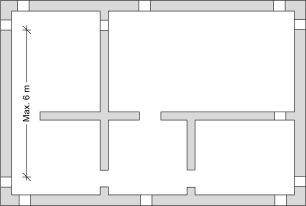
Figure 74. In a cold crawl space, there should be at least one vent opening for every 6 metres of exterior wall and each opening should be min. 150 cm2. The openings should be positioned to avoid ‘pockets’ of stagnant air. The underside of vent openings in a crawl space must be min. 100 mm above grade. With a horizontal channel, the upper side of the living room floor could conceivably end up considerably above grade. The floor height can be lowered if the vent openings are ‘broken’, but the cross section or number of openings should then be increased by min. 50 %. To enable inspection of the crawl space, the height should be min. 600 mm and the openings in the interior walls should allow a person to pass through.
The ventilation can be improved by installing a ventilation duct from the crawl space and up above roof level as shown in Figure 46.
The ventilation duct should be uninsulated inside the building for reasons of thermal uplift but insulated in the loft space and above roof level. In this way, the effective wind driving thrust is supplemented by a thermal wind thrust (through the stack effect). This results in negative pressure in the crawl space. The existing foundation vent openings are retained and function as intake vents for the ventilation air.