3 Sources of Moisture
Buildings are affected by moisture from both inside and outside. The moisture exposure sustained by buildings depends largely on the type, position, and use of the building. There is a considerable difference in the exposure to moisture sustained by a dry storage hall and that sustained by a printing works with humidifiers.
The requisite in-depth knowledge of moisture exposure depends on the nature of the task. Unfortunately, moisture exposure data are limited and the degree of impact varies considerably.
To measure moisture content, it is necessary, to know the potential sources of moisture and to be able to assess or calculate whether potential exposure to moisture will lead to humidification, etc.
Moisture exposure issues typically handled in a structural context include:
- Precipitation
- Soil moisture
- Surface water
- Air humidity (water vapour)
- Construction-related moisture
- Utility water
Exposure to moisture from utility water occurs frequently in wet rooms or occasionally when washing floors. Moisture in wet rooms is discussed in more detail in By og Byg Anvisning 200, Vådrum (Wet Rooms) (Brandt, 2001).
Exposure to moisture may also occur in connection with damage and natural disasters (e.g., pipe bursts, fire, or flooding). These are generally accidental and therefore cannot be considered in normal moisture control assessments.
3.1 Precipitation
Precipitation in the form of rain, snow, or hail that falls vertically (i.e., without wind impact), will only affect roofs, balconies, and other horizontal or sloping surface areas. The structures must be watertight and sloping for the water to drain off. The required size of the gradient depends on the structure and is min. 1:40 for roofs, whereas for window constructions it is min. 1:8–1:4. Moreover, the construction must be dimensioned to absorb snow load. Beyond this, the intensity of the precipitation is normally only relevant when dimensioning outlets.
When there is simultaneous exposure to wind and precipitation, the latter is deflected and will also potentially affect vertical surface areas such as exterior walls. In the case of rain, this is termed driving rain.
The amount of driving rain which impacts a surface depends not only on wind velocity, but also on the local topography, the location of the building relative to its surroundings, the direction and gradient of the surface, geometry of the building, and the size of raindrops. In Denmark, surfaces facing south-west are most heavily exposed to driving rain. There is considerable variation in the amount of driving rain: on the island of Fanø the amount is twice that of Copenhagen.
The variation in driving rain is random and the amounts will vary significantly from one year to the next.
Wind leads to pressure around a building, pressing the wind upwards near the roof and sideways at the corners. The exposure to driving rain is therefore especially great in these parts of the building and may be even greater than from unobstructed driving rain (i.e., driving rain on an unobstructed surface facing the same way and not affected by the building design).
In poorly built constructions, wind pressure differences on the sides of the building may press water into these, especially at the corners and horizontal edges of the building.
After having struck the facade, the water will run down. Facade material such as brick will absorb a large part of the water whereas glass will not absorb anything. Therefore, near the lower storeys, there could be significant amounts of water settling as a continuous water film over the surface. Water film in combination with wind load may result in the facade sustaining actual water pressure.
Precipitation in the form of small dense snow crystals that is simultaneously driven by wind is called driving snow. In strong winds, driving snow can move in all directions, including upwards. Driving snow can infiltrate roof tiles, vent openings, and other areas.
Data on moisture exposure from the outdoor climate can be obtained from the Danish Meteorological Institute (DMI) (www.dmi.dk). Moreover, historical data are available from individual meteorological stations. Note that the conditions relative to a specific building may deviate a great deal from the conditions of other meteorological measuring stations, even those nearby.
Data used to simulate moisture transport are often derived from the Danish year of reference TRY (Andersen et al., 1982) or from the more recent year of reference DRY (Jensen & Lund, 1995).
In concrete cases concerning existing buildings, relevant data can sometimes be obtained by measuring directly inside or on the building (see Section 13).
3.2 Soil Moisture
Building parts in contact with soil may be exposed to impact from both water and water vapour.
Soil moisture occurs in the form of:
- Ground water
- Water drawn by capillary action
- Percolating surface water
- Water vapour.
3.2.1 Groundwater
At a specific subterranean leveI, the ground is saturated with water. The groundwater table/level is the level where (pore water) pressure equals atmospheric pressure. Below the groundwater table, the water pressure rises proportionally with the depth.
Building parts below the groundwater table are therefore subjected to water pressure.
Groundwater levels vary naturally over a year and are normally highest around April and lowest around October. The variations from year to year from differences in precipitation may be considerable.
Variations in groundwater levels are greater in highly water-permeable soils than in soils with low water permeability.
Groundwater levels can be determined by digging or drilling a hole in the ground. The hole is fitted with a filter (e.g., a pipe with holes or slits allowing the passage of water but retaining particles). Groundwater will flow to the hole, and, after a while, the hole will fill with water to become level with the ground-water table.
In soils with little permeability, it may take a long time to attain equilibrium due to the slow flow velocity.
Sometimes, in addition to the primary groundwater table, a secondary water table may occur, which is the water table of a limited ground-water store.
In some cases, humidification from groundwater can be avoided by lowering the ground-water level around the building. However, permission to lower the groundwater is subject to environmental restrictions or restrictions concerning neighbouring buildings and plants. In other cases, it may not be possible to lower the groundwater (e.g., in areas with highly permeable soils). These issues should be investigated before taking steps to lower the groundwater table.
Water pockets alongside buildings due to percolating surface water can result in a secondary water table and hence pressure on basement walls and other structural effects.
This kind of moisture exposure can normally be avoided by draining the building (see Section 9.2.3; and DS 436, Code of Practice for the groundwater drainage of structures.
(Danish Standards, 1993)).
3.2.4 Water Drawn by Capillary Suction
Water can be drawn from the ground by capillary suction (for information on capillary suction see Section 2.2.3). In finely-grained soils, the capillary rise can be considerable (more than 10 m for the most finely-grained soils). Water from the soil is drawn into foundations, basement walls, and ground floor slabs by capillary action if their capillary suction properties are greater than those of the soil.
Moisture damage caused by capillary suction is normally prevented by installing a capillary break (see Section 2.2.3).
3.2.3 Surface Water
Surface water derives from precipitation and can cause considerable water intrusion in buildings, both at grade level and by percolating down through the soil along the building.
Generally, the building can be protected against water damage from surface water by constructing slopes away from the building for the first 3 m (see Section 4.12).
Protection against water intrusion from percolating surface water can be achieved with a combination of drainage and making the building exterior watertight (see Section 4.13.1).
3.2.4 Water Vapour
The soil around a building always contains water vapour and the RH in soil pores is normally assumed to be close to 100 % (for a definition of relative humidity see Section 2.1.3). This means that the soil’s water vapour pressure corresponds to the saturation vapour pressure at the actual temperature. The temperature varies over the year depending on the thermal conductivity of the soil, the distance to the building, the depth below grade, the insulation and heating of the building, and other qualities of the site.
Under normal circumstances, the vapour pressure will be greater inside the building than outside, and vapour will thus be transported out of the building (cf. Section 2.4.1). In buildings only heated occasionally (such as holiday homes) the moisture flow may reverse into the building in winter because at this time of the year vapour pressure may be greater in the soil than in the building.
Below large buildings and at greater depths, the temperature will be practically constant. Below large buildings, in time the temperature will approximate the average temperature inside the building and this will minimise moisture transport. Reducing the temperature in the building could therefore result in moisture being transported into the building (see Figure 59).
In the two cases mentioned above, moisture transport can be prevented by a correctly installed moisture barrier (see Section 4.7).
3.2 Air Humidity
Air always contains a certain amount of moisture with seasonal variations. Moist air will lead to water vapour pressure, the extent of which depends on the moisture content and temperature. There is normally a difference in the moisture content of outdoor and indoor air. This difference in moisture content will result in moisture transport from places with high water vapour content/water vapour pressure to places of lower content. This is discussed in more detail in Section 2.4.1.
In unfortunate circumstances, when moisture is transported through building constructions, the moisture content can be so high as to cause mould growth or decay in materials. A very low temperature inside the construction may lead to condensation.
3.3.1 Outdoor Climate
In summer, the outside air will normally contain around 10 g of water vapour per m3, corresponding to an average relative humidity of approx. 75 %. In winter, the absolute water vapour content is low at only about 5 g per m3, but the relative humidity is high, averaging 90 %.
Figure 26 shows the area within which the outdoor climate normally varies over a year. The average variations within a 24-hour period in each month of the year are also indicated.
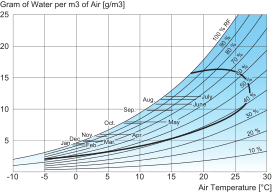
Figure 26. Outdoor temperature, water vapour content, and relative humidity (RH) vary over the year within the area delimited by the top curve in the water vapour chart and the one in bold. The chart was prepared using meteorological observations made every hour around the clock for a period of 15 years. 99 % of the measured hourly values occur in the area shown. The horizontal lines express the average variations in the outdoor temperature and RH over a 24-hour period in each month of the year (see Figure 27).
Mean figures for a year or a month contain considerable daily variations. When the temperature rises during the day, the relative humidity drops. In summer, the relative humidity often drops to around 50 % at noon.
When the temperature drops at night, the relative humidity rises, often reaching 100 %, forming dew and potentially fog. This frequently occurs in clear weather without cloud cover to hamper thermal emissions from the earth’s surface to the atmosphere. Figure 27 shows how much outdoor temperature and relative humidity can vary over a cloudless 24-hour period in summer.
In warm and humid summer weather, air moisture content can be up to 15 g/m3, but after the passage of a cold front, the moisture content could drop to 8 g/m3, for example.
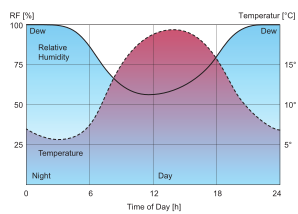
Figure 27. In a cloudless 24-hour period in summer, the temperature often varies from 20 °C in the daytime to 5 °C at night. Within the same 24-hour period, air humidity can be close to 100 % RH at night whereas it might drop to 50 % at around noon. The great variation in relative humidity is because the absolute water vapour content of air remains almost constant around the clock. Furthermore, the moisture content, which at the high daytime temperature corresponds to 50 % RH, will be almost 100 % at the lower night-time temperature.
3.3.2 Indoor Climate
Variations in relative humidity occur differently in indoor and outdoor air. This is not only due to fresh-air supply via ventilation, but also the fact that activities in the building generate moisture.
Cold outdoor air entering the building in winter will be heated. This results in a sharp drop in the relative humidity (see Figure 4). However, water vapour from people, animals, and plants as well as activities in the building such as cooking, bathing, and washing will infiltrate the indoor air.
Thus, the moisture content of indoor air can be characterised as an interplay between:
- Outdoor air moisture content
- Moisture generation inside the building
- Ventilation rate
- Building volume
Therefore, during the winter months the indoor air will reach a condition where the relative humidity in dwellings will be between 30 % and 50 %. During cold periods or in buildings with a high temperature and/or low moisture generation (such as offices), the relative humidity can be considerably lower.
Due to moisture input, the air in a heated occupied room will inevitably contain more water vapour than will outdoor air. This situation is crucial to gain an understanding of how to construct building constructions. It also means that airing will always remove water vapour from the room. Water vapour will be removed, even in rainy weather, provided that the indoor temperature is just a few degrees higher than the outdoor temperature.
Figure 28 shows average variations in air humidity outside and inside over a year.
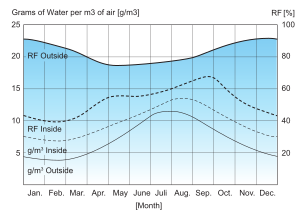
Figure 28. Typical variation in relative humidity outside and inside over a year. The relative humidity inside is highest from August to October and lowest from December to March. It assumes that the moisture generation inside results in a water vapour content which, in winter, is 3 g per m3 higher than outside. No humidification is included for the summer months because airing is more common at this time than during the rest of the year. The indoor temperature is calculated as 23 °C in July and August, 22 °C in June and September, and 20 °C during the rest of the year. There can be significant variations in the relative outdoor humidity, depending on whether the building is located close to, or far away from, the coast. The curves apply to dwellings, not offices and other buildings which generate little moisture.
As mentioned above, moisture generation in buildings is due to evaporation from people, animals, and plants, as well as activities within a building.
In dwellings, there is a considerable variation in moisture generation from one household to the next, depending on the number of people as well as their behaviour relative to airing, bathing, and drying of clothes.
According to Swedish studies (Tolstoy, 1993), moisture generation in single-family dwellings averages approx. 10 kg/24-hour period whereas it is approx. 6 kg/24-hour period in flats in multistorey buildings. Danish studies (Koch et al., 1986) show the distribution of humidification from various sources in a dwelling.
Table 2. Daily moisture generation from various sources in an average household with two adults and two children (Koch et al., 1986).
Source of Moisture | Moisture Generation (kg/day) |
|---|---|
People (breathing, sweating) | 3.5 |
Drying clothes (indoors) | 1.8 |
Personal hygiene | 1.3 |
Cooking | 0.9 |
Washing up | 0.4 |
House cleaning | 0.2 |
Plants | 0.2 |
Miscellaneous | 0.2 |
Offices, warehouses, and similar buildings, usually generate very little moisture. The temperature in office buildings is usually high. This along with low moisture generation, result in a very low moisture content in winter (RH can dip below 20 % for lengthy periods).
In swimming pools and other buildings with open water surfaces or humidification systems, considerable amounts of moisture can be added, and the relative humidity may therefore be very high. In such buildings, special attention must be given to the design of the building parts to ensure that they do not suffer moisture damage (see Section 3.3.3, Humidity Exposure Classes).
Ventilation rate is usually characterised by the air exchange rate, which states how many times the air in the building is exchanged within a specified unit of time (typically one hour).
The air exchange rate can be expressed as:
where
According to BR10 (Danish Business Authority, 2010) a fresh-air supply of at least 0.3 l/s m2 is required in dwellings which, with a room height of 2.5 m, equals an air exchange rate of at least 0.5 times per hour.
Assuming a constant moisture generation, the indoor air moisture content can be calculated as:
where
Since the long-term conditions are likely to be the most interesting (i.e., high values of t), the expression can be approximated as:
The second element in the equation is often designated as humidification:
Swedish studies indicate that the humidification in dwellings over a 24-hour period varies between 1.5 and 7 g/m3, averaging roughly 3 g/m3. The values for single-family dwellings are slightly lower than for flats in multistorey buildings, which is likely because single-family dwellings tend to have higher air exchange rates.
Impact on Moisture Content by Ventilation
In a close, shut-off room, the air will quickly be saturated with water vapour due to the moisture generated by the occupants. To keep the relative humidity at acceptable levels, therefore, a certain rate of air exchange is necessary. An air exchange rate of around 0.5 times per hour will normally be adequate in dwellings (see Figure 29). Only in special cases, when ventilation/airing out might be impaired, will there be moisture issues.
If the air exchange rate is high and the addition of moisture slight, the relative humidity may be low (in frosty periods it could fall below 20 %).
Applying equation (30), the relative humidity can be expressed as shown in Figure 30.
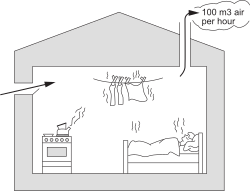
Figure 29. Humidification and required air exchange rate. If the indoor air is 20 °C with an RH of 50 %, it will contain approx. 9 g water per m3. If the outside air contains 5 g water per m3, 4 g water will be removed for every m3 of indoor air replaced by outside air. A family of four will add approx. 10 l (= 10,000 g) of water to the indoor air per 24-hour period. To remove this, the air exchange rate needs to be 10000:4 = 2500 m3 per 24-hour period or approx. 100 m3 per hour. The air in a dwelling of 80 m2 with a room height of 2.5 m (totalling 200 m3), will have to be exchanged over two hours. In other words, the air exchange rate must be 0.5 per hour, in accordance with Building Regulation requirements.
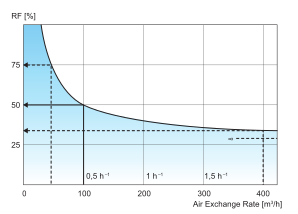
Figure 30. Relative humidity as a function of the air exchange rate. The curve is calculated for an ordinary dwelling of 200 m3 with outside air supply and humidification identical to that in Figure 29. If the air exchange rate is reduced to below 0.5 times (volume) per hour, air humidity will rise steeply, and condensate will quickly form on windows and exterior walls with the risk of mould growth. An air exchange rate of 0.25 will achieve approx. 75 % RH (= 13 g water per m3 indoor air at 20 °C), which is unacceptable. A twice-hourly air exchange rate will achieve a humidity of approx. 34 % and if the rate is further increased, the relative humidity will be close to 29 % (the lower punctured line). This is practically the same as zero humidification, meaning that outside air with a water vapour content of 5 g per m3 is heated to 20 °C.
3.3.3 Humidity Exposure Classes
When dimensioning moisture load, humidity exposure classes can be used to calculate the moisture load from indoor air that a structural element is exposed to. Humidity exposure classes are a simplified means to describe how indoor moisture generation and air exchange rate affect water vapour concentrations in indoor air.
Humidity exposure classes cannot be used for skating rinks, refrigerated rooms and cold stores, and similar buildings where moisture conditions deviate significantly from those of heated buildings. In such buildings, special attention should be given to the amount and direction of the moisture transport and the position of the vapour barrier, if applicable.
In heated buildings, humidity exposure classes can be applied when assessing the risk of condensation from thermal bridges and the risk of mould growth and wood-decaying fungus attacks.
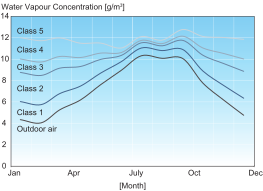
Figure 31. Water vapour concentrations in humidity exposure classes 1–5 and in outside air over the year. The figure is based on DS/EN ISO 13788:2013 (Danish Standards, 2013) and the reference year TRY.
DS/EN ISO 13788 applies 5 humidity exposure classes, designated humidity exposure classes 1-5.
Table 3 shows examples of which rooms would typically land in each of the 5 humidity exposure classes according to the standard. In Denmark, dwellings with ventilation are interpreted as dwellings meeting Building Regulation requirements for ventilation (0.3 l/s per m2 heated floor space, approximating an air exchange rate of 0.5 times per hour). These are typically single-family dwellings with natural ventilation or high-rise flats with balanced mechanical ventilation. Dwellings of unknown habitation density could be interpreted as rental accommodation.
Figure 31 shows calculated moisture content in indoor air for the various humidity exposure classes in accordance with the standard DS/EN ISO 13788 (Danish Standards, 2013) and based on the Danish reference year TRY (Andersen et al., 1982).
The humidity exposure classes in DS/EN ISO 13788 (Danish Standards, 2013) should not be confused with the indoor-climate classes 1-3 formerly used and described in SBI Guidelines 178, Bygningers fugtisolering (Moisture Insulation of Buildings) (Andersen, Christensen & Nielsen, 1993) or with the application classes in Eurocode 5: Design of timber structures – Parts 1-2 (Danish Standards, 2007b).
Table 3. Examples of rooms categorised by the humidity exposure classes in accordance with DS/EN ISO 13788 (Danish Standards, 2013) Modified in compliance with Danish Data.
Humidity Exposure Class | |
|---|---|
1 | Unused buildings, dry warehouses, sports halls without spectators, industrial buildings without moisture generation |
2 | Offices, shops, dwellings with normal occupational density and ventilation In Denmark, a dwelling is considered to have normal ventilation if Building Regulation requirements for ventilation are met. |
3 | Dwellings with unknown occupational density, Occupational density may be unknown in rented accommodation. In Denmark, sports halls with many spectators are categorised in humidity exposure class 3 |
4 | Catering kitchens, canteens, bathing and changing rooms |
5 | Special buildings (e.g., launderettes, breweries, swimming pools). |
- In Denmark, a dwelling is considered to have normal ventilation if Building Regulation requirements for ventilation are met.
- Occupational density may be unknown in rented accommodation.
- In Denmark, sports halls with many spectators are categorised in humidity exposure class 3.
The humidity exposure classes in Figure 32 are calculated with a humidification of the indoor air relative to the chosen humidity exposure class and the mean monthly outdoor air temperature as described in DS/EN ISO 13788 (Danish Standards, 2013). Figure 32 shows how the humidification is expected to decrease proportionally to the outdoor mean monthly temperature. The decrease in humidification is due to an increased air exchange rate resulting from increased natural ventilation (e.g., by frequently airing via open windows).
The added moisture is assumed to be zero when the mean monthly temperature is 20 °C or above.
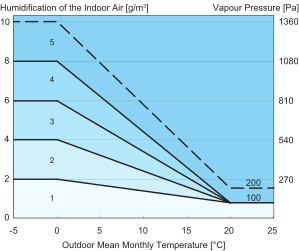
Figure 32. Humidification or an increased vapour pressure is expected in humidity exposure classes 1–5, depending on the mean monthly outdoor air temperature according to DS/EN ISO 13788 (Danish Standards, 2013)
In humidity exposure class 5, measuring data should be used. If unavailable, the punctured line can be used. The curves shown are limiting curves separating the humidity exposure classes. There is a significant difference in the expected humidification in cold periods of the year whereas no humidification to speak of is expected during the warm periods in any of the classes.
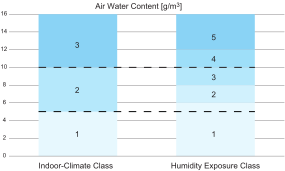
Figure 33. Comparison between the indoor-climate classes used previously and the new humidity exposure classes during wintry conditions (i.e., when humidification is at its highest).
Table values for the limiting curves between the humidity exposure classes in Figure 32 are shown in Table 4. Unless measurement results or alternative knowledge about actual conditions call for other measures, it is advisable to use the upper limits for the individual humidity curves (see Table 4).
Table 4. Humidity exposure class limits (% RH) according to DS/EN ISO 13788, (Danish Standards, 2013) Based on monthly averages for outdoor temperatures and relative humidity with reference to the reference year TRY.
°C | % | °C | 1→2 | 2→3 | 3→4 | 4→5 | |
|---|---|---|---|---|---|---|---|
January | - 0.6 | 94 | 20 | 35 | 46 | 58 | 69 |
February | - 1.1 | 91 | 20 | 35 | 46 | 58 | 69 |
March | 2.6 | 91 | 20 | 39 | 49 | 58 | 69 |
April | 6.6 | 82 | 20 | 45 | 53 | 58 | 69 |
May | 10.6 | 78 | 20 | 50 | 56 | 60 | 69 |
June | 15.7 | 67 | 22 | 55 | 59 | 64 | 69 |
July | 16.4 | 74 | 23 | 59 | 62 | 66 | 69 |
August | 16.7 | 71 | 23 | 61 | 64 | 66 | 69 |
September | 13.7 | 85 | 22 | 58 | 62 | 65 | 69 |
October | 9.2 | 87 | 20 | 51 | 57 | 63 | 69 |
November | 5.0 | 91 | 20 | 45 | 53 | 61 | 69 |
December | 1.6 | 88 | 20 | 38 | 49 | 59 | 69 |
3.3.4 Summer Condensation
Summer condensation is the term used for condensation occurring on the outside of the vapour barrier (facing the insulation) in strong solar heating. Summer condensation can e.g. be experienced as dripping from ceilings due to the infiltration of condensed moisture via joints and connections in the vapour barrier.
The humidification of a structure from driving rain will result in high water pressure in the peripheral parts of the construction if it is subsequently heated by strong solar radiation. The high vapour pressure will be able to drive the moisture into the construction where there is a risk that it will condense on the outside of the vapour barrier (if installed) on the inside of the construction. Notably constructions with great moisture-retention capacity and moderate heating capacity such as exposed brick walls or massive cellular concrete walls, can hold considerable amounts of water which can be driven into the construction. The same can occur in a roof construction where heating will drive out moisture (e.g., from beams or plywood) after which condensation will occur on the upper side of the vapour barrier. In unfortunate cases, it may lead to condensate dripping through nail holes and other perforations.
The risk of summer condensation is greatest in unheated buildings such as holiday homes, as there is no outward heat flow to drive the moisture out again. Therefore, in theory, in unheated buildings it will be best to omit the vapour barrier. Nevertheless, it is advisable to use vapour barriers in holiday homes, as most of these are now used throughout the year or will be later. It is advisable to protect the facade with a generous projecting overhang and to give the facade cladding a hydrophobic surface treatment. Both measures prevent needless humidification, reducing subsequent moisture transport to underlying materials via solar heating.