5 Critical Moisture Conditions
Excessive moisture content in materials and constructions may lead to damage in subsequent work processes (e.g., floors swelling or paint not adhering properly). In the finished building, too, an excessive moisture content can cause problems, including mould growth on damp surfaces.
To avoid issues, the moisture content must be kept below a certain critical value depending on the specific construction. The 2008 Building Regulations stipulate that measures be implemented to ensure sound workmanship in the planning and design phases, in invitations to tender, as well as in the execution of building constructions.
The provision is intended to ensure that no materials are used that are either so wet that they can cause mould growth (e.g., wet moisture-sensitive materials, or materials which have already been attacked by mould). If moist materials such as concrete are used, steps should be taken to ensure that they will not cause humidification in moisture-sensitive materials (e.g., by installing a moisture barrier). Furthermore, constructions should be designed to prevent humidification in the usage phase.
Examples of critical moisture content for several mechanisms/materials of destruction are shown below.
5.1 Corrosion
Corrosion of untreated metal occurs when humidity and oxygen in the air react with a metal surface. The critical moisture level for metals is expressed as the relative humidity where corrosion may occur. Based on practical experience, corrosion of steel can be avoided if the relative humidity on the surface is kept below 60 % RH. Under normal circumstances, it is usually impossible to achieve a relative humidity this low both indoors and outdoors.
Note that pollution/chemicals, applied voltage, and reactions between different materials (due to differing preciousness) can substantially change corrosion conditions.
Further information on corrosion is available from SBi Guidelines 104 (Danish Building Research Institute, 1976).
Untreated steel should be protected against corrosion (unless the relative humidity can be kept below 60 %).
The corrosion resistance of cast iron is identical to that of ordinary steel. However, due to its graphite content, it may form a protective membrane which reduces the corrosion rate by approx. half. Moreover, cast iron corrodes evenly across the whole surface and as such can be used for a variety of purposes without corrosive protection.
Certain steel alloys (including weathered steel known as cor-ten) will form a corrosion membrane on the surface, which protects the underlying parts against further corrosion.
Stainless steel is durable because of its ability to form a thin protective oxide membrane on the surface. Stainless steel is less suited in marine environments and environments with accumulated dirt, as both these conditions may prevent the formation of this protective membrane.
Aluminium and its alloys are normally resistant to the atmosphere but these materials do not tolerate alkaline conditions.
Copper will corrode in the atmosphere, but the corrosion is evenly distributed and so slow that it is not usually considered a problem.
Zinc and zinc plating is characterised by slow and even corrosion. Zinc is often used as corrosion protection (zinc plating or galvanisation). The lifespan of zinc platings or protective layers is roughly proportional with the thickness of the layer.
5.2 Laying a Floor
Before laying a floor/floor finish, the substrate must have dehumidified to form equilibrium with a suitably low relative humidity. Moreover, care should be taken to ensure that no humidification will recur (from below).
Table 6 shows the maximum permissible moisture content in the substrate for several different types of flooring. Here, moisture content is expressed as the relative humidity (residual pore moisture), with which a concrete or aerated concrete substrate should be in equilibrium.
Table 6. Maximum permissible equilibrium moisture content in aerated concrete and concrete floors prior to laying (without a moisture barrier).
Flooring | % RH | Source |
|---|---|---|
Ceramic tiles with cement-based adhesive | 100 | (Byggforsk, 1997) |
Quartz vinyl tiles, needle felt, carpets | 90 | (Gulvbranchen, 1999) |
Linoleum, PVC, polyolefin, cork, rubber | 85 | (Gulvbranchen, 1999) |
Wood – boards, rods | min. 35 max. 65 | (Gulvbranchen, 1999) (Gulvbranchen, 1999) |
When laying floors on a moisture barrier, the requirements set out in Table 6 are reduced relative to the moisture barrier type (the degree of vapour permeability).
Floor work must be done in closed, heated, and dry rooms.
Wooden floors are subject to further requirements stipulating that the relative humidity in indoor air should be in the interval 35–65 % (cf. Brandt, Slott, & Johansen (2010a)).
Furthermore, there are requirements for moisture content in in boards/rods, and in stickers and joists (see Table 7).
Table 7. Requirements for moisture content in boards/rods for floor-laying (cf. Brandt, Slott & Johansen (2010a)).
Material | Requirements for Wood Moisture Content in % |
|---|---|
Wooden flooring (boards, rods, blocks) | 8 ± 2 %, 2/3 of consignment between |
Stickers | 7 and 9 % max. 12 %, single measurement max.14 % max. |
Joists | 13 %, single measurement max. 15 % |
Prior to laying tiles on concrete floors, concrete and screed must be sufficiently hardened to ensure the required strength and the majority of shrinkage has run to completion. This also applies to concrete or aerated concrete walls with tiles (Gulvbranchens Samarbejds- og Oplysningsråd, 1999) (Brandt, 2001) (Brandt, 2006) (Dansk Byggeri, 2007a, 2007b).
5.3 Painting
Table 8 shows examples of recommended maximum moisture content for paintwork (Dansk Byggeri, 2007c). Interior paintwork must be done in closed, heated, and dry rooms.
Table 8. Examples of recommended maximum moisture content for paintwork (Dansk Byggeri, 2007d).
Material | Recommended Max. Moisture Content Weight-% |
|---|---|
Lightweight aggregate concrete | |
- 1000 kg/m3 | 8.0 |
- 1800 kg/m3 | 4.0 |
Wood for exterior work | |
- structures, exterior facing, windows | 18 ± 2 |
- Laminated wood, plywood | 12 ± 3 |
Wood for interior work | |
- doors, windows, and joinery work | 12 ± 3 |
- interior facing, joinery and floor work | 8 ± 2 |
5.4 Decay and Wood-Decaying Fungi
If organic building materials (such as wood) are very damp, they are prone to decay of attacks by wood-decaying fungi. The critical moisture content for wood is normally set at:
- 20 % for new fungus attacks (corresponding to an air equilibrium of approx. 87 % RH)
- 15 % in for wood previously attacked (corresponding to an air equilibrium of approx. 73 % RH).
5.5 Mould Growth
Assessing mould growth is difficult because it is dependent on several factors (see Figure 51).
Mould growth is dependent on sufficient nutrients, moisture, and the temperature. Although the conditions for growth are ideal, some time will elapse before the mould growth begins. At worst, the latency (i.e., the time elapsed from when the growth conditions are present until the point when the actual mould growth begins) is 2–3 days. Generally, there is no growth below the critical moisture conditions (known as the relative surface humidity or the water activity). Above the critical moisture content, the growth rate increases proportionally with the relative humidity on the surface/water activity. The characteristics of fungus species vary relative to moisture requirements and the environmental access to nutrients.
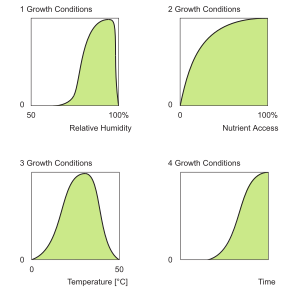
Figure 51. Mould growth depends on several factors (Sedlbauer, 2001):
- Growth only occurs at relatively high RH but will abate at relative moisture levels close to 100 %.
- There must be access to nutrients. Even tiny amounts (e.g., pollution/dirt) are sufficient for rapid growth.
- Mould growth can occur within a greater temperature interval. The growth is most prolific at a temperature of around 20–30 °C while it is negligible at both high and low temperatures. The growth rate abates when the temperature rises above approx. 50 °C.
- Mould growth requires a certain length of time which can vary from days to months relative to the growth conditions.
The optimal growth rate for most fungus species occurs at 25–30 °C. In temperatures outside this interval, the growth slows down and will normally stop completely above approx. 50 °C and below approx. 0 °C.
Mould growth happens over time. The level (strength) of mould and the extent (area size) of growth depends on the duration of optimal growth conditions.
Mould occurrence is not usually considered harmful until a certain level (strength) and extent (area size) has been reached. There are no hard and fast rules for judging how 'harmful' an instance of mould growth is.
In practice, mould growth often occurs during short periods of high RH followed by periods with adverse growth conditions. No general methods exist to convert long-term growth to conditions where growth occurs for a series of short periods (according to studies).
The best way to avoid mould growth is to make sure that the RH on the surface of the material is always kept below the critical level. As mentioned above, the critical moisture level depends on the material.
Table 9 shows examples of critical relative humidity levels for mould growth on different materials (Johansson et al., 2005).
Table 9. Examples of empirically determined critical relative humidity for mould growth on the surface of building materials (Johansson et al., 2005). The values describe long-term exposure at 20 °C.
Material | Critical RH for mould growth, % |
|---|---|
Wood and wood-based materials | 75-80 |
Carton on plasterboard | 80-85 |
Mineral wool | 90-95 |
Expanded polystyrene (EPS) | 90-95 |
Concrete | 90-95 |
Soiled materials (e.g., polluted by soil or dust) | 75 |
The top 5 values in Table 9 apply to clean materials. For materials soiled on the building site or by airborne dirt particles for example, the critical moisture content may be much lower.
Under normal conditions, the critical moisture level will be 75 % RH, meaning that mould growth can be avoided if the relative humidity on the surface of the material (the water activity) is kept below 75 % RH.
The critical moisture level is dependent on temperature (Gravesen, Nielsen & Valbjørn, 2002), (Hukka & Viitanen, 1999). Assessments should therefore consider that mould growth is reduced or stopped at low temperatures.
According to Gravesen, Nielsen & Valbjørn (2002) the critical moisture level for wood and wood-based materials can be approximated as:
where
In Hukka & Viitanen (1999), a so-called fungus index is defined.
The model is shaped by fact that the time taken by a fungus growth to establish itself and start growing is dependent on moisture and temperature conditions. At temperatures below 0 °C and above 50 °C, there is no growth, nor is there any growth below an RH of 80 %, according to the model. At temperatures between 0 °C and 50 °C, the growth rate will rise proportionally with the temperature and the RH.
5.5.1 Assessing the Risk of Mould Growth
The critical moisture content for mould growth on free surfaces is an RH of 75 %.
Note that the critical RH to prevent mould growth on the surface of building materials is lower than the corresponding critical RH for preventing attacks from wood-decaying fungi.
In practice, an excessive RH may occur on the surface of materials either due to dampness in the material, such as construction-related moisture or rising damp, or resulting from an excessive RH relative to existing surface temperatures.
The lowest permissible surface temperature in elements of the structure where excessive water activity levels can be avoided can be determined by a method described in DS/EN ISO 13788:2013 (Danish Standards, 2013). However, this method is based on a critical value of 80 % RH. This value must not be exceeded for long periods. The method assumes a constant indoor temperature of 20 ºC all year round and a monthly mean temperature is used for the outdoor temperature. Hence, a stationary temperature profile is calculated for one month at a time.
This method is not particularly suitable to assess whether surface temperatures (e.g., those measured via thermography), are critical. This is because surface temperatures usually vary because conditions rarely remain stationary, and measurements only provide discontinuous snapshots of data in time.
Critical moisture conditions depend on outdoor temperatures and humidity exposure classes. By means of DS/EN ISO 13788:2013 (Danish Standards, 2013), critical surface temperatures can be determined for the values shown in Table 10.
Table 10. Critical inside surface temperatures for the humidity exposure classes 1–4. Calculated according to DS/EN ISO 13788:2013 (Danish Standards, 2013) for risk of condensation (100 % RH) and risk of mould growth (75 % RH), respectively. The indoor-air temperature is 20 °C; in June and September 22 °C, and in July and August 23 °C. The outdoor-air temperature is based on monthly mean values from the reference year TRY
Humidity Exposure Class | Month | Outside Temperature | Inside Temperature | Critical Surface Temperature | Critical Surface Temperature |
|---|---|---|---|---|---|
°C | °C | 100 % RH, °C | 75 % RH, °C | ||
1 | January | -0.6 | 20 | 4.1 | 14.1 |
2 | January | -0.6 | 20 | 9.5 | 13.8 |
3 | January | -0.6 | 20 | 11.5 | 15.9 |
4 | January | -0.6 | 20 | 14.3 | 18.8 |
Determining critical moisture content as described in DS/EN ISO 13788:2013 (Danish Standards, 2013) is discussed further in Section 6.3.6.
Simple Assessment of Critical Moisture Conditions
A description of how to assess the risk of mould growth based on measuring the material (material surface) and measuring the relative humidity in the indoor air is provided below. Both methods rely on moisture conditions being determined when moisture content is expected to be highest, and the temperature measurements being made when the temperature is expected to be lowest.
Procedure for Measuring Moisture in the Material
A close-fitting box is secured to the surface to be examined. A data logger is placed inside this and registers temperature and RH over the course of a few days.
A temperature correction must be made as the box has an insulating effect and the temperature measured (e.g., on an exterior wall), is therefore likely to deviate from the correct temperature. The surface temperature will thus have to be determined in a different way (e.g., using thermography equipment).
If only a single measurement is made, the temperature of the structure must be constant.
Example
In a basement where the critical moisture content must be determined, moisture conditions are assumed to be most critical during summer. After a few days (using a data logger placed in a box with the opening facing the surface of the wall construction in the basement) a mean RH of 80 % and a temperature of 16 °C were measured. The temperature measured by the data logger is slightly low due to the thermal insulance factor of the box. Therefore, the correct surface temperature is measured using thermography equipment. The surface temperature is measured at 18 °C (measured in the early morning). The measurement is corrected with use of the water vapour chart (see Figure 1). Moving horizontally from 16 °C and 80 % RH, one can find a temperature reading of 18 °C. The intersection point will be approx. 70 % RH (i.e., below the critical level).
Measuring Indoor Humidity Levels
The procedure for measuring indoor humidity levels is as follows: Leave a data logger at a representative spot in the room for a few days. This can be used to determine the mean temperature and RH during the period. Furthermore, the surface temperature can be determined at critical spots (such as thermal bridges) at the time when the temperature is expected to be lowest. Using the temperature logged by the data logger, it is now possible to determine the surface RH by converting RH at room temperature to RH at the actual surface temperature.
Example
Using the data logger, the average indoor climate is determined to be 22 °C and 60 % RH. Using thermography equipment, the surface temperature measurement is 17 °C.
The water activity (RH on the surface) can be determined by looking at the water vapour chart (see inside cover). Moving horizontally from 22 °C and 60 % RF to 17 °C, the intersection point is approx. 83 % RH (i.e. above the critical level).