13 Dampness Surveys – Measuring
Dampness surveys are used partly to prevent moisture damage in constructions and partly to assess the conditions in existing constructions in connection with a building survey or damage investigation.
Dampness surveys may occur in the following situations:
- Acceptance check of materials (checking whether moisture content is acceptable)
- Checking for dryness, including construction-related moisture
- Checking underlay prior to further covering or coating (e.g., laying a floor or applying a coat of paint)
- Localising moisture sources (in cases of moisture-induced damage)
- Checking moisture conditions in existing constructions
In many cases, a visual inspection will reveal whether moisture-induced damage has occurred. Typical tell-tale signs of damp are discoloured patches on brickwork, walls and ceilings, wet woodwork, mould growth, or shrunken wood.
Thus, moisture damage does not always warrant measurements. Furthermore, in many cases, damage such as deterioration of adhesive or mould growth will not disappear by solving the moisture problem.
In the case of moisture damage, the source of dampness should be located and eliminated to avoid further damage.
13.1 Visual Examination of Building Parts
The following is a short introduction to the most common causes of damage in several building parts. For specific building parts, attention will be drawn to typical areas worth inspecting because they may either show signs of humidification or themselves be exposed to damage.
13.1.1 Roofs
A frequent cause of damage is water infiltrating from the outside through leakage paths in roofs. Inspection from the outside should therefore primarily focus on damp firewall parapets and chimneys, outlets on flat roofs, leakages in roof coverings, including defect valleys and flashings around chimneys, dormers, and skylights.
Dampness in roof constructions can also occur due to humid indoor air from below infiltrating the roof construction where it condenses. This is usually caused by leakages around penetrations or a defective vapour barrier.
Typical signs of moisture include damp/discoloured patches on sloping walls or dormers, rafters (especially gable-end rafters), bricked-in jamb-wall structures, beam ends supported by wall crests, and the undersides of wall plates.
13.1.2 Facades
Facades usually become damp from the outside due to defects in the facade, such as leaking joints or cracks in the brickwork. Inspection from the outside should therefore primarily focus on cracks and disintegrated bedding mortar in brick facades (especially in the upper storeys with decreased wall thickness) as well as defects like faulty joints or missing two-stage rainscreen sealant in light-weight facades. Finally, there is potential risk of damp near balconies, and where the facade is penetrated.
Leakages in the facade can lead to damp in the storey partition inside.
13.1.3 Storey Partitions
In storey partitions, damp will usually occur near wet rooms and below kitchen sinks. Furthermore, damp may occur at the level of leaking rainwater downpipes and near balconies where back-fall has been able to convey water into the construction. Inspection should focus particularly on discoloured damp patches.
13.1.4 Basements
There are often dampness problems in basements because the outer walls and floors are exposed to moisture from both inside and outside.
Building traditions and the materials used in old basements (especially brick-built constructions direct on grade without any form of moisture barrier) will often cause dampness, including rising damp.
In moisture surveys, focus should be directed in particular at discoloured patches, mould growth, mouldy smells, and other signs of dampness. Extra care should be taken if interior re-insulation or wooden sheets have been fitted to the basement walls, as this will prevent evaporation to the inside and may result in an increased capillary rise of soil moisture. If possible, moisture content should be measured in bricked-in joist ends and similar areas.
On the outside, the substructure should be examined for cracks, and checks should be made to see whether the surrounding ground slopes away from the exterior wall. Dampness problems in basements can deteriorate further when outlet and drainage pipes are defective. If this is suspected, the outlet pipework should be checked.
13.1.5 Ground Floor Slabs and Crawl Spaces
Damp in crawl spaces and ground floor slabs can be caused by rising damp from the soil or an incorrectly positioned vapour barrier. In crawl spaces, damp can also be caused by inadequate ventilation resulting from too few vent openings or covered vent openings.
This is often due to structural faults such as the absence of a capillary break, the formation of condensate (due to insulation layers that are too thick), or uninsulated heating pipes.
In a building survey, checks are made from the inside to see whether there is subsidence in the floor resulting from deterioration or shrinkage of the joisting. Checks are made in crawl spaces for signs of dampness (e.g., a high moisture content in the joisting, discoloured patches, visible mould or dry rot, and mouldy smells).
13.1.6 Gutters, Downpipes, and Floor Drains
Defect gutters and leaking downpipes may increase water load on the building and cause serious damage to roofs and facades. Checks are made for leakages and to see whether gutters and downpipes are clean and functioning correctly.
Checks are made to see whether floor drains are installed correctly (e.g., that they finish level with the floor surface and are centred relative to the grate frame).
13.1.7 Stairs
Checks are made to see whether panels or stringboards adjacent to a damp wall have become damp, as this may result in mould attack.
13.1.8 Bathrooms
Bathroom checks focus on details with the greatest risk of leakages and water infiltration such as floor drain connections, transitions between floors and walls, and pipe intersections.
Special problems will exist when an existing bathroom floor has been raised during renovation and continuing to use the old floor drain without replacing it. This poses a risk of dammed water infiltrating the floor construction between the old and the new flooring. Furthermore, checks are made for cracks (in both terrazzo and tiled floors) or for burst welding joints in PVC-facings.
13.2 Measuring and Investigation Methods
Two different categories of investigation methods can be used for dampness surveys. One category comprises methods for visual inspection in places not normally visible.
The other comprises actual methods for measuring dampness (i.e., to determine moisture content or equilibrium moisture content).
Instruments for visual inspection include:
- Endoscopes or borescopes which are used to inspect enclosed cavities through a small hole (e.g., in sheeting). Instruments of this type are highly suited to examining stud walls, storey partitions, or roofing slabs.
- Thermography equipment which is used to locate thermal bridging which could subsequently lead to surface condensation. It can also be used in conjunction with a so-called blower-door to locate leakages in vapour barriers and determine the risk of moisture convection. A blower-door is used to put the building under pressure (positive or negative pressure) to increase airflow through leakages.
- Drain cameras which are used to inspect sewer lines for leakages.
13.2.1 Moisture Content in Materials
Moisture content in materials depends on the relative humidity (cf. Section 2.2.2) and temperature. The equilibrium state may take a long period of time to stabilize, especially within large cross sections or extensive volumes of material. For example, an ordinary floorboard may take a few weeks to reach equilibrium when the relative humidity changes and a surface treatment (such as varnishing) will prolong the time taken to reach equilibrium. In many heavier (timber) constructions, equilibrium is only achieved after several months.
If moisture content in the materials (or on their surface) becomes too high, damage (such a decay or dry rot, destructive dimensional changes, or deterioration of adhesive) may occur. This is particularly true when organic materials (such as wood) are exposed to damp. Inorganic materials such as concrete and brick are rarely damaged by moisture. For these materials, moisture measurements are primarily used to assess whether there is a risk of damage to other adjacent materials (e.g., to discover whether a concrete deck is sufficiently dry for a wooden floor to be installed).
In the case of concrete, brickwork, and similar inorganic materials, the rise in moisture content proportional with a rise in RH is relatively small while it is great for wood.
In wood, moisture content can be accurately determined using various ‘electrical’ methods and the moisture content can quite easily be converted into equilibrium moisture (i.e., the relative humidity at which wood with the measured moisture content reaches equilibrium). In the cases of concrete and brickwork however, there is considerable uncertainty in converting measured moisture in the material to relative humidity (equilibrium moisture) (cf. Figure 12, sorption isotherms).
13.2.2 Measuring Assumptions
Measuring moisture content in building materials with traditional hand-held meters is associated with considerable uncertainty and a correct assessment of the results requires knowledge of the limitations of the equipment as well as possible sources of error. To gain reliable results, the user must:
- Be familiar with the specific instrument used, how it works and how to operate it, how to calibrate it, and its level of accuracy
- Be sufficiently versant with building physics to interpret the results. The user needs to know how the moisture conditions in the constructions vary in a year and based on this, be able to assess whether moisture conditions can be expected to be worse or better in other seasons
- Make several measurements to gain sufficient knowledge about the actual conditions, which can vary significantly from one area to the next in the construction.
- Keep measuring until equilibrium has been reached
- Be aware of any matters likely to interfere with the measurements (e.g., salt content in the material being examined).
13.3 Moisture Measurement Methods
In the following, mention will be made of:
- The loss-on-drying method
- Electric resistance meters (pinned meters)
- Built-in moisture sensors
- Moisture sensors in bore holes
- Capacitive moisture meters
- Neutron moisture detectors
- High-frequency meters
- Psychrometers
- Thermo-hygrographs
- Data loggers
13.3.1 The Loss-on-Drying Method
The method is based on the definition of moisture content in materials. It is performed by weighing a sample, drying it in a heating chamber (normally) at 103 ± 2 °C until the weight stops changing and then weighing it again. This method is considered the most accurate.
For inorganic materials, the method usually requires a sample to be cut or bored out. Sampling by boring is not particularly advisable, as the boring process will expose the sample to heating and drying.
The dry weight is considered reached when weighing performed at 1-hour intervals shows a max. difference of 0.1 %. Thereafter the moisture content can be calculated based on the weight of the moist and dry materials. Scales with a high accuracy are used (e.g., of min. 0.01 gramme for a 10-gramme sample). If a high degree of accuracy is required, the sample should be cooled in a desiccator after heating/drying before being weighed.
The moisture content is defined as the weight of the water contained in the sample relative to the weight of the dry material.
Moisture content is usually expressed as a percentage:
(Weight of moist material – weight of dry material) · 100
Weight of dry material
Determining the moisture content takes 1–3 days. Consequently, the method is not very common in usual practice.
13.3.2 Electric Resistance Meters/Pinned Meters
Electrical resistance meters work because electric resistance in wood is dependent on its moisture content. Therefore, one can calibrate resistance readings to moisture contents. Resistance is measured between two electrodes (pins) pressed or hammered into the wood under examination. Most meters show the moisture content in % for ordinary coniferous wood (spruce and fir). Calibration curves for other wood species can normally be obtained from the supplier.
Note that pinned meters cannot be used to measure the moisture content of concrete or brickwork.
Pinned meters are used to obtain a fast result. The measuring range is approx. 7–25 % moisture content. The accuracy of a carefully performed measurement depends on the make of the meter and is typically approx. 10 % of the measured value, which is satisfactory for most purposes.
The moisture content in wood can vary significantly (e.g., the surface of outdoor woodwork may be wet from rain or dew but dry further in).
Conversely, when the ambient relative humidity drops, the wood will be drier on the surface than further in. Measurements made using uninsulated electrodes will indicate the smallest resistance between the pins, which is where the moisture content is highest.
If the wood is moist on or below the surface, the meter will indicate a high moisture content, even though the moisture content further inside the sample is relatively low.
If there is considerable difference between the moisture content in the surface and further in, reliable results will only be obtained using insulated electrodes where measurements only occur between the pin tips. Moisture content can thus be determined at different depths.
It is possible to measure through thin facings such as wallpaper and linoleum if the holes made by the electrodes are acceptable.
Beyond moisture content, the electrical resistance of wood depends on the different densities of wood species (volumetric weight), their oil and resin content, and other species-specific factors. Moisture values should thus be adjusted relative to specific wood species and density. Moisture meters are normally calibrated for use in fir or Norway spruce and the readings here can therefore be used directly whereas they must be adjusted for other wood species.
The electrical resistance in wood is altered along with temperature and the moisture values measured should, in theory, be adjusted for any such influence. However, measurements are usually made within a narrow range (around 15–20 °C) where the impact of temperature is of no practical significance. To adjust for temperature, the adjustment can be estimated as 0.1–0.15 % units/°C (Forsén & Tarvainen, 2000). The resistance drops (i.e., the shown moisture content rises) proportional with a rise in temperature, meaning that, at a higher temperature, the moisture content shown will be too high whereas at lower temperatures, the moisture content shown will be too low.
The electrodes should normally be positioned to measure along the fibres. Measuring in a transverse direction may result in slightly lower values and the measurement may also be disrupted by cracks in the wood. However, deviations are usually of no practical significance. Measurements made in end wood and knots will give misleading results.
Measurements in pressure-impregnated wood (especially fireproofed wood) may show misleading results because the impregnating agent affects the resistance. Vacuum impregnation using turpentine-based agents (typical for windows, doors, and facades) does not affect measurements.
Moreover, pinned meters can be used for chipboard, plywood, wood-fibre sheets, and other wood-based sheeting, but the results need adjusting relative to type of sheeting as indicated in the meter’s instructions for use.
To achieve reliable and representative results, it will often be necessary to measure in several locations.
Meters must be checked regularly (e.g., by measuring a series of fixed electrical resistances spread across the measuring area). In this way, it is possible to check whether meter indications remain unchanged. Meters can also be calibrated by comparing results from a recently calibrated meter or by comparing results from a loss-on-drying sample.
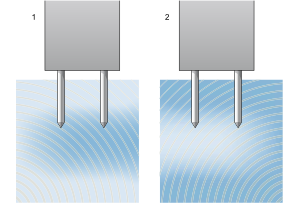
Figure 113. When using insulated electrodes, the moisture content between the pin tips is measured. When using uninsulated electrodes, the highest moisture content is measured – irrespective of whether it occurs inside the wood (left) or on the outside (right). The blue areas indicate the highest moisture content.

Figure 114. Pinned meters with uninsulated electrodes for measuring moisture content in wood and wood-based materials. Note that pinned meters cannot be used for measuring moisture content in other materials such as plaster and brickwork.
13.3.3 Built-In Moisture Sensors
For continuous surveys of moisture conditions in a construction for an extended period, moisture sensors can be used in the shape of a sensor pad or dowel.
These sensors are based on the same principle as electrical wood-moisture meters (i.e., the resistance between the electrodes is relative to the moisture content of the wood).
The sensor comprises a piece of plywood or wood with drilled-in electrodes. Dimensions are approx. Ø 50 mm × 12–16 mm for plywood pads and Ø 10 mm × 10–25 mm for the dowel-shaped device, normally made of beechwood.
The sensor is inserted into the construction whose moisture content will be monitored and the electrode wires are positioned in a spot where it is possible to perform the measurement. The resistance measurement is performed with an ohmmeter after which the moisture content is determined by means of a calibration curve, expressing the interrelationship between the resistance and moisture content in the sensor. The moisture content is determined by converting the measured resistance into a moisture percentage by means of an ancillary calibration curve specifying the interrelationship between the resistance and moisture content in the sensor. Using this method, the moisture content of the wood can be determined with an uncertainty of ± 1 %.
To check whether dampness occurs over time, electrodes can also be mounted directly into the wood being measured. Moisture can be measured using an ohmmeter or a pinned meter connected to the electrodes with wires.

Figure 115. Dowel-shaped measuring device (left) and sensor pad (right) for incorporation into wooden structures to monitor the moisture situation over an extended period. Both have electrodes for measuring moisture by means of resistance measurements as well as a thermo element unit.
13.3.4 Capacitive Moisture Meters
Capacitive moisture meters cannot be used for measuring absolute moisture content (expressed in %) but they can be used for examining the moisture content distribution (i.e., where the moisture content in a structure is highest).
Capacitive work by utilizing the fact that moist building materials have a greater electrical capacitance than dry ones. The measuring depth is only 10–20 mm depending on the material, meaning that only the outermost parts of the construction form part of the measurement.
Measurements can be performed through - and without damaging - facings (such as paint, wallpaper, and flooring).
Note that salts, conductive materials, and electrical wiring may disrupt this measurement and surface moisture may produce a non-representative high moisture content.
If a capacitive meter reading only fluctuates slightly, it is safe to assume that there is no moisture. If meter readings fluctuate considerably, this could be due to moisture, but could equally be due to the presence of salt in the structure, joints in the substrate for a facing, etc. Measurements made by capacitive sensors should therefore frequently be verified via other methods (e.g., opening the construction or investigating to see whether the structure contains salt).
The meter has a conductive sensor (sheet, stirrup, or metal ball) pressed against the surface of the material to be examined.
The meter is pre-calibrated by placing it on a conductive surface (e.g., metal) where the reading needle is adjusted to max. fluctuation. Thereafter, the ‘scanning' of a floor or wall can begin. The surface is often divided into a grid where measurements are taken in all intersections. An actual moisture measurement can then be made. Measurements are usually limited to those places where the moisture content is highest.
Large-scale devices with wheels are commercially available for scanning extensive surfaces such as flat roofs or concrete decks. The measuring depth of these devices is greater. However, as with other devices, it is also dependent on the construction of the substrate/materials.
On roofs, capacitive meters are often used for making actual moisture measurements.
However, this requires that the given structure is uniform and that samples are collected and used to calibrate the meter reading with moisture content determined by alternative methods (e.g., the loss-on-drying method). Measurements cannot be made on facings with aluminium insets or with a considerable content of active carbon. Measurements also cannot be made above cavities.

Figure 116. Examples of capacitive moisture meters

Figure 117. Example of large-scale capacitive moisture meter for scanning extensive roof areas or concrete decks.
13.3.5 Moisture Sensors in Bore Holes
A commonly used moisture measurement method for inorganic materials such as concrete is placing a moisture sensor in a tightly sealed bore hole in the construction. The moisture sensor measures the relative humidity in the bore hole at equilibrium between the relative humidity in the bore hole air and the surrounding material.
The depth of the hole is optional, depending on the specific task. By boring several holes, the moisture content distribution in the structure can be determined. Normally, the bore depth should equal half of the structural thickness (see Figure 118).
It is important that the dust in the bore hole is carefully removed (e.g., using compressed air (spray can) or a vacuum cleaner with a special nozzle) before placing the sensor in the hole which is then closed and sealed. Alternatively, the hole can be closed using a cork until the measurement is taken. Several days will usually pass from sealing the hole until equilibrium has been achieved.
The moisture content in the construction can also be determined by inserting a piece of 'isolated' wood, kept clear of the wall, in the bored-out hole. When the wood has finally achieved equilibrium with the surroundings after a few days, its moisture content can be determined (e.g., using the loss-on-drying method).
Alternatively, samples from the structure can be collected and kept in sealed plastic containers until the moisture measurement has been made. Samples should preferably be cut out, as the heat or cooling water from an electric drill may give misleading readings.
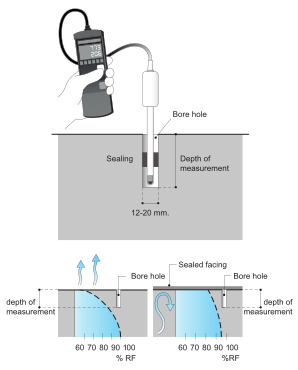
Figure 118. Moisture measurement in concrete and similar materials can be made by measuring the relative humidity in a hole bored in the concrete. Measurements are usually made at a depth equalling 0.4–0.5 times the thickness of the concrete. For measurements made when laying floors, this corresponds to the measured moisture content approx. equalling the moisture content below the flooring at equilibrium (see the two bottom figures).

Figure 119. Different meter models for measuring moisture in bore holes. Right, a new device which includes several different sensors. The model shown has sensors for bore holes (blue) and insulated pins (far right). For bore-hole measurements, several sensor heads can be used and left in situ until equilibrium moisture content has been reached. In the meantime, the device can be used elsewhere.

Figure 120. When measuring equilibrium moisture content in a bore hole in a concrete wall. The hole must be thoroughly cleaned out followed by a waiting period of several days before equilibrium between the air in the bore hole and the surrounding material is reached. Only when equilibrium has been reached can a correct measurement be made.
13.3.6 Neutron Moisture Detectors
Measuring using neutron moisture meters (such as Troxler) is a safe method to find the distribution of moisture content. The measuring depth is 100–150 mm and measurements are not disrupted by the presence of impurities (such as salts) in the structure.
The measurement must be performed by specially trained staff, as this device uses a radioactive source. The device emits neutrons into the structure where they are deflected by the material. The amount of deflection is directly related to the moisture content in the structure.
An actual moisture measurement is performed on the assumption that the structure being measured is uniform and that samples are collected and used to calibrate the meter reading (with moisture content determined with alternative methods, e.g., the loss-on-drying method).

Figure 121. Measuring the distribution of moisture content in a concrete wall with a neutron moisture detector.

Figure 122. The principles upon which neutron moisture detectors function. The neutrons are deflected by hydrogen atoms in the target material. The amount of deflection is directly related to the moisture content.
13.3.7 High-Frequency Meters
High-frequency meters use the polarity of water molecules and the fact that they can be made to oscillate within a high-frequency field to measure moisture levels. The effect is expressed by the dielectric constant. In water, this is very large (compared to building materials). At high frequencies, there will be energy loss in the oscillations due to the mutual relationship between the water molecules themselves and other materials. By selecting a suitable frequency, the dielectric loss expressing the water content can be measured. Measurements require uniform materials and temperatures above 0 °C.
Due to the large dielectric constant of water compared to other materials, the method is not sensitive to salt content in the material being examined.
The measurement depth, relative to sensor head, is set at up to 800 mm.

Figure 123. High-frequency meter used for measuring moisture content in a concrete structure.
13.3.8 Psychrometers
Momentary air humidity measurements can be made with a psychrometer. Two precision thermometers are used, of which one is covered with a wet cotton sock. The air is made to flow past the thermometers, causing moisture from the sock to evaporate, which in turn results in cooling.
The amount of cooling (i.e., the difference between the temperature measured by the wet and the dry thermometer) expresses the relative humidity. The method is fairly accurate and is often used to calibrate other measuring devices (e.g., a thermo-hygrograph).
If a higher degree of accuracy for calibration purposes is required, a mirror dew point hygrometer can be used.

Figure 124. The aspiration psychrometer on the left is used for determining relative air humidity. When the difference between the dry and the wet temperature has been measured on the two thermometers, the appropriate RH is found in a table. The spring ventilator at the top ensures that air will pass the sensors at a specific velocity.
The sling psychrometer on the right is used according to the same principle used to determine relative air humidity, but the passage of air past the sensors occurs by swinging the whole psychrometer like a ratchet around the axis of the handle.
The sling psychrometer on the right is used according to the same principle used to determine relative air humidity, but the passage of air past the sensors occurs by swinging the whole psychrometer like a ratchet around the axis of the handle.
13.3.9 Thermo-Hygrographs
A thermo-hygrograph consists of a bimetallic thermometer and a mechanical hair hygrometer. Both are connected to a pen drawing the measured values on a slowly rotating drum with measuring paper mounted to it.
The drum rotates once during a set period (typically a week). This provides a registration of the variation of air humidity and temperature.
The mechanical hair hygrometer requires regenerating and calibrating at relatively short intervals for results to be reliable (cf. SBi Guidelines 170, Målemetoder til bygningsundersøgelser (Building Survey Measuring Methods) (Brandt, 1990)).

Figure 125.The thermo-hygrograph registers both air temperature and humidity. RH is registered with a hair hygrograph whose length fluctuates proportionally to the fluctuations in RH. Temperature is registered with a bimetallic thermometer. Both measuring devices are linked to a pen, marking the measurements on a slowly rotating drum. Measurements are immediately readable.
13.3.10 Data Loggers
Data loggers are used to register temperatures and moisture measurements over extended periods. Data loggers are well-suited where there is a need to monitor the effect of seasonal variations or user behaviour relative to the moisture conditions in dwellings, offices, or inside constructions. Data loggers have largely replaced thermo-hygrographs which were formerly very common.
Data loggers contain moisture and temperature sensors. Therefore, no wires are required for data logging or making measurements.
Data loggers are operated via a PC, and they can be programmed to measure at set intervals (from a few seconds to several months). The sensor outputs measuring data to a PC where further results processing occurs.
Recent studies show that good results can be achieved by using data loggers to measure moisture in materials, provided that the data logger is placed close to the structure under examination. The most reliable results are achieved when the data logger is screened from the humidity of the ambient air.

Figure 126. Examples of data loggers (approximately the size of large USB flash drives) which are capable of registering ambient moisture and temperature levels over an extended period. The loggers can be programmed to measure for extended or short time intervals. Data loggers of this type are also available with a display for taking direct readings.
Data from moisture and temperature measurements can also be collected via a modem connected to a PC and the telephone network. The advantage of this solution is that data can be collected on an ongoing basis and that it is possible to change or regulate certain sensor types. A disadvantage is that it needs to be wired up, which is time-consuming and expensive.
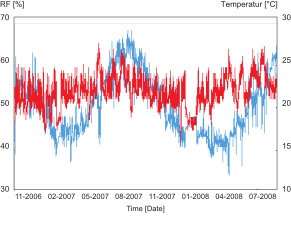
Figure 127. Example of moisture variations in a dwelling registered by a temperature and moisture logger over a period of almost 2 years.
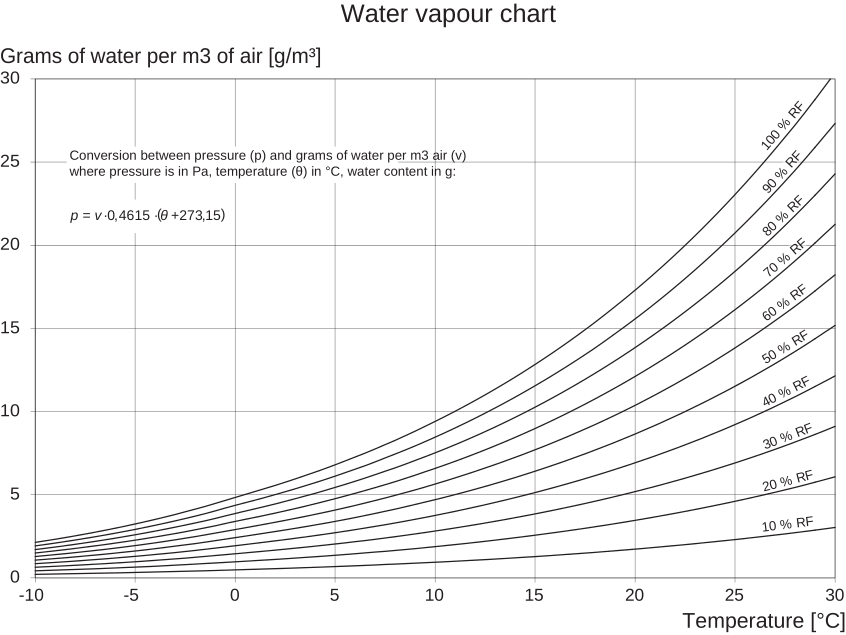
Figure 128. Water vapour chart
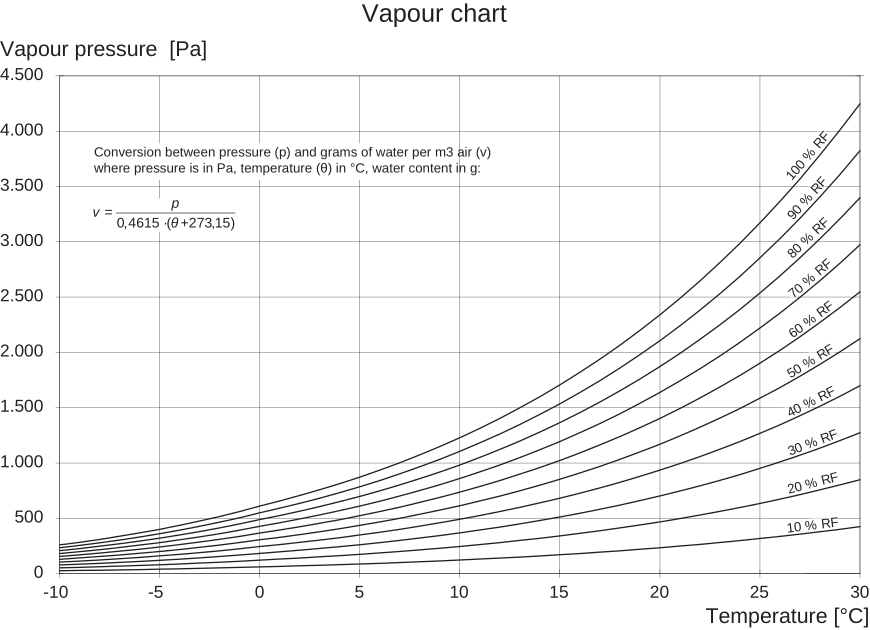
Figure 129. Vapour chart