11 Moisture – Windows and Doors
This section discusses windows in facades and windows installed in the roof surface. Moisture problems relative to doors are also covered in this section. Primary focus will be given to windows, but the information is also generally applicable to doors.
Todays’ windows and doors are designed as traditional wooden constructions as well as plastic, aluminium, or hybrid solutions (e.g., with wood on the inside and an aluminium rainscreen on the outside).
Applicable requirements for U-values for windows and doors mean that some of the problems commonly encountered earlier no longer exist in new constructions. Dew on the inside of modern panes with U-values of 1.2 W/m2K or less tends to be an extremely rare occurrence. However, condensation may occur on the outside (see Section 11.6, Outside Condensation).
Moisture problems associated with windows and doors are not only restricted to the window itself, but also to the inside fittings in the wall or roof, including junctions with vapour barriers, joints, and thermal bridges.
11.1 Moisture Exposure
Exposure to moisture in windows and doors may derive from:
- Precipitation, (driving) rain, and (driving) snow entering the construction from the outside
- Humidity from outside air
- Condensation of humidity from indoor air due to thermal bridging or leakages in window or door constructions.
Exposure to moisture derives primarily from precipitation striking the window or door.
The impact is greatest in areas with heavy rainfall and/or wind load. This is especially the case for driving rain or snow. Wind load (and hence the impact of driving rain) is greater for tall buildings than for short buildings. Driving rain and snow sometimes move in an upward direction and may intrude via leakage paths in windows or doors in unfortunate circumstances (e.g., via fresh-air vents).
In old windows, condensate may appear on the inside of the windowpane when its temperature becomes lower than the indoor-air dew point temperature.
In constructions with secondary glazing or double-frame constructions, condensate may appear on the inside of the outer pane. This is because humidity in the indoor air infiltrating the two glass layers will condense due to the strong cooling on the cold, exterior pane (see Figure 96).
11.2 General Measures to Prevent Humidification
11.2.1 Precipitation
Windows or doors must be capable of resisting expected impact from rainfall (including driving rain) without water infiltration into, or through, the construction. As far as possible, products should be selected for which the tightness is documented. Windows with proven airtightness will normally also keep out driving rain.
Often, even minor issues can prove very significant for the tightness of a window, and it is therefore important to maintain and adjust the window regularly and to prevent it from 'drooping'.
11.2.2 Deterioration of Materials
Deterioration of materials in windows resulting from moisture is usually only a concern which applies to wood. The wooden dimensions in contemporary window constructions are often larger than in the past. The increased dimensions mean that the wood takes longer to dry out when the weather changes from rain to sunshine and the wood is more prone to cracking. Both increase the risk of long-term water impact. Older wooden windows would rarely decay because dimensions were smaller, and the windows dried out quickly. If they did decay, it was usually due to condensate forming on the inside of single-glazing.
Modern window constructions (especially inward-opening windows) will often have wide upturned wooden surfaces on the outside. These are especially vulnerable to rain, particularly at corner joints. All exterior upturned wooden surfaces should therefore have an outward slope of at least 1:8, to ensure that rainwater can be drained off quickly.
An efficient preventative measure is to reduce the amount of water which will impact the window. This may for example be achieved using a roof with a sizeable overhang, or by setting the window back from the level of the facade or installing a canting strip above the window to deflect the water from the area of the façade above.
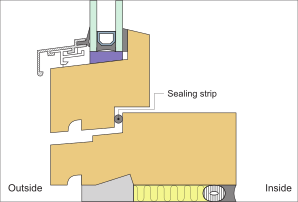
Figure 90. An example of a wooden window with double-glazing in an outward-opening casement. The window has an aluminium bottom glazing bead. When installing insulating glazing, the manufacturer's installation instructions must be followed. There must be min. 5 mm free space between the sill and frame at the bottom to prevent driving rain from infiltrating the cavity. The slope on free surfaces (including the horizontal glazing recess) should be min. 1:8.
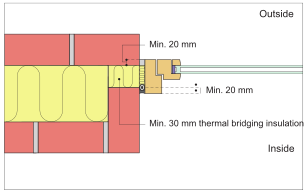
Figure 91. To minimise thermal bridging (and to meet Building Regulation requirements for a linear thermal transmittance of max. 0.03 W/mK), the window should be positioned so that the frame overlaps both the inner and outer walls by min. 20 mm. Alternatively, special seamed solutions can be designed to reduce thermal bridging.
Bottom glazing beads should be made of aluminium or another moisture resistant material, as wooden bottom glazing beads are particularly prone to damage from water infiltration.
To prevent water intrusion from driving rain, the side joint between the casement and frame should be max. 3 mm and there should be an air latch preventing water from infiltrating the window’s enclosure (see Figure 92).
11.3 Joints
The joint around the window must be tight. The joint is best constructed as a two-stage joint where the outer part functions as a rainscreen whereas the inner part functions as a wind barrier (see Figure 92). In theory, the rainscreen should be vapour-permeable and the inner part (the wind barrier at the back of the joint) should be sealed (e.g., with caulking compound). Water infiltrating the outer part of the joint must be deflected to the outside of the wall (e.g., via drain holes and a sill).
The bottom joint in the rainscreen should be set back from the two siding joints and the top joint, regardless of whether this joint is made of mortar or other materials. Setting back the bottom joint sufficiently relative to the other joints will allow drainage and pressure equalisation at the bottom of the siding joints. The bottom joint must not obstruct a drip hole installed in the lower part of the frame.
Under normal circumstances, caulking compound should not be used for rainscreens, especially not in concrete walls with wooden windows, as the compound will stop moisture diffusion from the inside, and moisture may then be sorbed by the wooden frame with the risk of decay and dry rot.
For joints around windows in timber walls, a wooden strip in front of a cavity of min. 10 mm depth can be used as a rainscreen

Figure 92. An example of an old wooden window with a double-frame construction. The sealing strip is placed on the inside of the window, which prevents indoor air from infiltrating the space between the frames and forming condensate. The space between the frames is vented to the open.
The joint between the frame and the wall is constructed as a two-stage rainscreen sealant system. On the outer side, a mortar joint is used as a rainscreen and on the inner side (warm side) caulking compound is used as a windproof layer.
The joint between the frame and the wall is constructed as a two-stage rainscreen sealant system. On the outer side, a mortar joint is used as a rainscreen and on the inner side (warm side) caulking compound is used as a windproof layer.
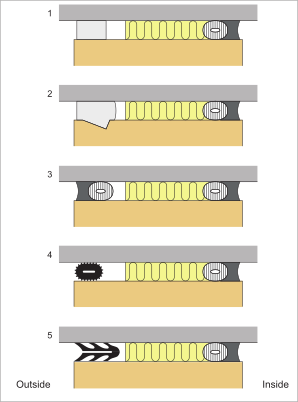
Figure 93. Examples of two-stage sealant joints between window frames and window rabbets. In all five examples, the inside is rendered air-tight and vapour-impermeable with caulking compound (and a bottom stop). In the first example, the outside is sealed with a vapour-permeable sealant strip (1), the second is sealed with mortar (2), the third is sealed with caulking compound (3), and the fourth and fifth are sealed with profiles (4 and 5). Behind the outside joint, there is a cavity or drain hole to provide pressure equalisation with the side joints. Furthermore, any rainwater which passes the rainscreen will be drained away at the bottom where it is drained to the outside of the exterior wall (see Figure 94).
When jointing old windows, it is often difficult to manoeuvre the caulking compound into the rear part of the joint around the window. A structural operation around the window is usually required to do this (e.g., removing the side casings). In such cases, jointing from the outside will usually be the only realistic option to make the window adequately windproof. Jointing with caulking compound at the front edge of the window always carries a risk of the frame absorbing moisture that may lead to decay and dry rot.
In brickwork, on the other hand, it is safe to assume that any moisture behind the caulking compound will be transported away through the brickwork by capillary action. Concrete does not possess this capillarity and exterior caulking compound should therefore not be used for concrete facades: In this case, caulking compound must be applied at the rear part of the window; if necessary, from the outside. To ensure a safe rainscreen, vapour-permeable sealant strips or profiles should be used.
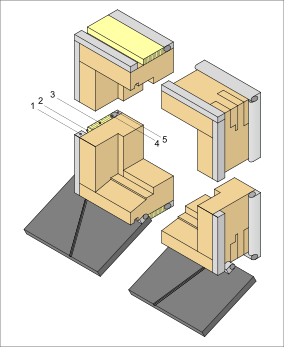
Figure 94. A two-stage sealant joint between window frame and window rabbets:
- Rainscreen in the outer part of the joint, such as sealant strips or mortar,
- Pressure equalisation chamber with drainage to the open at the sill,
- Mineral wool filling,
- Bottom stop profile,
- Windproof caulked joint (wind screen).
The joint should be constructed in such a way as to prevent moisture-sensitive materials from absorbing moisture. Consequently, there must be no open access from the joint to moisture-sensitive constructions.
11.4 Sills
Water striking the window will not be absorbed and may therefore exert considerable moisture load on the facade below the window. Water run-off from the window is normally drained away by a sill. The sill must be designed to prevent the water from infiltrating the adjacent facade parts at the ends of the sill (see Figure 95).
Furthermore, the sill should project out at least 30 mm from the facade and finish with a drip bar/drip edge to effectively drain water away from the facade.
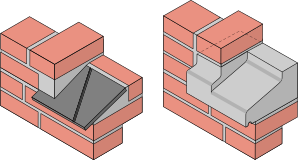
Figure 95. Sills should have end stops preventing wind-driven water along the sill from entering the facade. Furthermore, sills should be finished with a drip bar/drip edge and should project out at least 30 mm from the facade, so that water can drip off without striking the facade. Concrete sills are placed on a sliding layer, allowing any movement between concrete and brickwork to be absorbed without cracking (see Byg-Erfa info sheet, Sålbænke i murværk (Sills in Brickwork) (Byg-Erfa, 2012)). The sliding layer is not shown in the figure.
11.5 Mounting the Glass
Moisture problems are seen when mounting glass in both single-glazed and insulating glazing units.
Single-glazing is traditionally mounted using glazing points and glazing compound. The glazing compound is painted over, and the paint is continued 1–2 mm onto the glass to prevent the compound from deteriorating and water from intruding into the glazing recesses.
Insulating glazing is mounted in compliance with the directions issued by the glass trade association Glasindustrien, which forms the basis for the guaranteed scheme for insulating glazing. These are some of the requirements:
- Bottom glazing profiles must be sloped, vented, and drained
- Bottom glazing beads must be through-going, project out, and have a drip bar
- The insulating glazing unit must be raised min. 4 mm above the bottom glazing profile
- Frame packers as well as setting and location blocks must be positioned and fixed correctly
- Test documentation for caulking and mounting materials must be available.
11.5.1 Inside Condensate
Condensate or dew on the inside of window panes and doors is primarily a sign that the relative humidity is high and is often associated with poor ventilation.
Condensation occurs when the temperature on the glass surface is lower than the indoor air dew point temperature. Apart from indoor-air humidity content, the risk of condensation thus depends on the window's U-value, the outdoor temperature and room temperature. Dew occurs primarily when there is a sudden change to cold weather. The panes cool down quickly while the humidity content of the indoor air is still high (corresponding to equilibrium at the former higher temperature). In such cases, thorough airing is needed to remove often large amounts of moisture accumulated in the materials throughout a house. Every autumn, a house should be dried out by ventilation beginning at the start of the heating season.
Surface condensation often begins as dampness and dark discoloration (mould growth) in the interface between glass and casement. At worst, condensate on the glass can damage the wooden casement when water runs down and is sorbed by the wood. Condensation problems are virtually non-existent in new windows with energy-efficient glazing which meet applicable U-value requirements. However, condensation sometimes occurs at the rim of energy-efficient glazing with traditional aluminium spacer bars. Warm edges may help mitigate condensation at the rim of the pane.
For double-frame windows or windows with secondary glazing, condensate/dew may also occur on the inside of the exterior glass. This is because indoor air has infiltrated the two glass layers and water vapour has condensed on the cold exterior pane (see Figure 96).
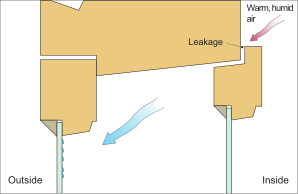
Figure 96. Traditional wooden window with secondary glazing. If the secondary glazing does not fit tightly, warm, and humid indoor air can infiltrate the cavity between the frames. If the outside temperature is significantly lower than the indoor temperature, the inner side of the glass will become sufficiently cold for condensate or dew to form on the inside of the exterior pane.
To avoid condensation, the interior window must be sufficiently tight to prevent indoor air from infiltrating the cavity. If used, weather strips should always be placed on the interior window frame.
However, there should be some open ventilation from the space between the glass panes, which significantly reduces the thermal insulating capacity.
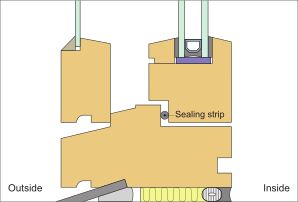
Figure 97. An example of a wooden window with triple-glazing. The exterior frame contains a single-glazing pane protecting the insulating glazing unit in the interior frame. The sealing strip must always be placed on the interior frame, preventing warm air from entering the cavity between the frames. There should be mild ventilation of the space to the open.
If both sets of frames in a window with a double-frame construction or in a window with secondary glazing are leaking, in windy weather, cold outdoor air will infiltrate from the windward side. This will not result in condensation. In the leeward side, on the other hand, indoor air will flow into the cavity. This will be intensified by the pressure difference resulting from negative pressure outside. Warm air condensing on the outer glass pane may result in heavy dew formation on cold days. This is a typical example of condensation resulting from convective vapour transport (airflow).

Figure 98. Doors are protected against condensation by insulation combined with a vapour barrier. The figure shows an insulated exterior door with a vapour barrier immediately beneath its interior cladding. The vapour barrier prevents moisture diffusion and hence condensation on the reverse side of the external cladding. Joints around exterior doors are weatherproofed using a two-stage sealant system in the same way as for windows.
11.6 Outside Condensate
Condensate may form on the outside of modern energy-efficient glazing with U-values of or below 1.2 W/m2K. The heat loss for this type of glazing is negligible which means that, at times, the surface temperature of the exterior glazing may be lower than the dew point temperature of the outside air.
Condensation will primarily occur at a high relative humidity (above 85 % RH) and clear weather when emissions to the atmosphere are high and hence temperatures low. Skylights are more exposed to condensation than facade windows. Overhangs can help mitigate the extent of this problem.
11.7 Surface Treatment
Wooden windows should always be painted or given wood preservation treatment. Plastic and aluminium windows (including the exterior side of windows with an aluminium rainscreen) do not usually require any surface treatment.
When painting wooden windows, the inside coat should be relatively vapour-impermeable while it should be more vapour-permeable on the outside. This will ensure that water vapour that diffuses into the wood from the inside is able to evaporate to the outside. If the coat is not vapour-permeable, water vapour from the inside might accumulate behind the outside coat of paint which, in turn, will begin to peel. If the window has not been thoroughly impregnated, the woodwork might be prone to decay and dry rot.
When coating the surface, care should be taken to ensure that no water can infiltrate cracks or gaps, including joints between wooden parts.
The risk of the wood cracking will increase in tandem with temperature rises. Treating the surface by applying light-coloured coats is therefore advantageous, as it reduces the amount of radiation absorbed and therefore the temperature of the wooden parts of the window.
It is advisable to install ready-painted windows because these are normally painted under controlled, favourable conditions. Moreover, they are usually painted on all sides, including those that remain invisible after installation.
Windows supplied without surface treatment should be treated swiftly. The glazing channel should be given treatment before mounting the glass.
11.8 Skylights and Roof Lights
Skylights and roof lights, inclusive of installation fittings, are subjected to more water exposure than facade windows and they should therefore be installed with extra care to ensure that they are weatherproof.
In theory, skylights are installed in the same way as other penetrations in the roof surface. If underlay is used, it should be fitted tightly to the window and water should be diverted around it. Weatherproofing is often supplemented by a trench above the skylight diverting the water from the overlying roof surface away from the window. This reduces the moisture load.
The connection to the roof covering should be designed to ensure a watertight joint and to divert water from the overlying roof surface around the window.
For flat roofs, the flashing height around skylights should be min. 150 mm to avoid water infiltration. This includes meltwater, which may ‘pond’ on the roof surface and exert water pressure on the flashing.
One should always follow the manufacturer’s installation instructions when fitting roof lights.
To avoid condensation, side casings should be designed to allow indoor air to circulate freely along the glazing. Side casings should also be adequately insulated to avoid the formation of condensation on the inside.