6 Measuring Moisture Content
To assess the structural soundness of a construction in terms of moisture, the moisture conditions in this construction may require measurement. However, such measurements should always be supplemented by an assessment of the actual conditions based on practical experience.
The measurement methods available range from coarse initial assessments to manual measurements for use in stationary conditions, to computer simulations of non-stationary conditions (moisture conditions allowing for variation over time).
Knowledge about the parameters underlying the model is necessary before taking measurements. Typically, these would include the exterior and interior climate impact (such as temperature, relative humidity, and solar radiation) as well as material parameters. Generally, moisture calculations are relatively unreliable, particularly because those climate and material parameters which form part of the calculations are unreliable or unknown.
Material data are typically found in tables and, in some cases, may be obtained from the manufacturer.
6.1 Climatic Parameters
The optimal basis for climatic parameters is achieved with sustained measurements over a relevant extended period in the building in question. Usually, however, it will be necessary to use empirical figures for temperature conditions given the application of the building.
6.1.1 Indoor Climate
The moisture content can be determined by allowing the indoor water vapour content to follow that of the outdoors and adding an amount corresponding to the expected humidification (which will typically be 3–5 g/m3 for dwellings). In other cases, the humidification may be subject to assessment relative to the application.
For buildings using humidifiers or other forms of climate regulation, the available sizing data of the system should be used.
If none of these options are available, the values for the building’s humidification class can be used.
For refrigerated rooms, skating rinks, and cold stores, the available sizing data of the climate system should be used.
It will usually be sufficient to describe the parameters relative to the indoor climate with monthly values.
6.1.2 Outdoor Conditions
Outdoor conditions are more difficult to measure because they vary much more. One should decide whether to include solar heating. It is generally alright to ignore solar heating of exterior surfaces. The potential of drying out during summer or the risk of summer condensation cannot be assessed with any degree of accuracy.
On a calm sunny day, the temperature of a dark roof may reach 60–70 °C. Conversely, emissions to the cold atmosphere during calm clear periods can lower the exterior surface temperature to several degrees below that of the air.
Due to the very sharp and non-linear rise of the vapour pressure with temperature, even the briefest periods with intense solar impact and the resulting high outside surface temperatures can be very significant to the drying of a construction. Therefore, it is not entirely correct to apply seasonal mean values of the outside temperature, as this would not consider the effect of a surface warmed by solar heating.
In a coarse initial assessment, data on the outdoor climate can be limited to conditions in the coldest month. In Denmark, this is February and the temperature is typically –1.1 °C with an RH of 90 %.
6.1.3 Danish Design Reference Year
For calculations, notably computer simulations, far more data are required than for rough estimates. This is typically where the Danish Design Reference Year (DRY) is used. In addition to hourly values for a typical year with average conditions, it also contains extreme periods (Jensen & Lund, 1995). DRY was developed for the purpose of calculating the thermal conditions of buildings and it contains data on solar radiation, wind, and precipitation, which can be relevant for moisture content calculations.
When determining parameters for the outdoor climate, one can make configurations to the following parameters (in increasing order of realism):
- The balance of humidification and dehumidification
- Whether to take solar impact and emissions into account
- The duration of outdoor temperature intervals
Humidification/Dehumidification Balance
Six-month or twelve-month mean values are used for outdoor air temperature and humidity.
Sun and Radiation
Monthly mean values are used for the outdoor surface temperature where solar irradiation and solar radiation are considered. The solar irradiation absorbed on an exterior surface with the relevant solar absorptance, tilt, and orientation must be determined. Furthermore, longwave emissions to the atmosphere and other visible surroundings should be assessed. This is achieved using the mean air vapour pressure.
Table 11 shows the mean air temperature and the calculated outdoor temperature of a dark horizontal building surface for each month in the Danish Design Reference Year (DRY). Furthermore, the mean outdoor vapour pressure for each month is shown.
Table 11. Monthly and annual average outdoor temperatures, outside temperatures of a dark horizontal building surface, and the outdoor vapour pressure (Rode, 1996)
Month | θoutdoor air | θdark horizontal surface | poutdoor air |
°C | °C | Pa | |
January | -0.6 | -0.6 | 563 |
February | -1.1 | -0.4 | 532 |
March | 2.6 | 4.0 | 685 |
April | 6.6 | 9.9 | 805 |
May | 10.6 | 15.3 | 988 |
June | 15.7 | 22.5 | 1159 |
July | 16.4 | 22.6 | 1374 |
August | 16.7 | 20.0 | 1325 |
September | 13.7 | 15.7 | 1337 |
October | 9.2 | 10.0 | 1029 |
November | 5.0 | 4.7 | 805 |
December | 1.7 | 1.0 | 635 |
For the year | 8.1 | 10.5 | 939 |
Duration Intervals for Outdoor Temperatures
The hours of a year are subdivided into several temperature intervals according to outdoor temperatures (e.g., intervals of 5 degrees). Thus, each temperature interval is represented by several hours corresponding to the total duration over the year. The method is applicable based on both air temperature and interior surface temperature.
The temperature groups are used as calculation intervals and condensation and dehumidification amounts are determined based on the number of hours in each interval.
This means that the few hours with very high temperatures are represented. Much moisture is moved during these brief periods and the calculated climatic impact results will be very realistic. Consequently, no safety factor has been incorporated into the calculation method. It is a disadvantage that the intervals cannot be linked to the time of year when they occur.
This method of describing the outdoor climate requires a detailed method for determining outside surface temperatures.
Table 12 shows the duration of the outdoor air temperature and of the temperature of a dark horizontal building surface (based on the Danish Design Reference Year (DRY)).
Table 12. Total annual length of periods with specific temperatures of outdoor air and a dark horizontal building surface in intervals of 5 degrees (Rode, 1998).
No. of Hours | ||
|---|---|---|
Temperature (Interval of ± 2,5 °C of the Stated Temperature) | Outdoor Air | Dark Horizontal Surface |
-20 | 0 | 10 |
-15 | 4 | 59 |
-10 | 99 | 106 |
-5 | 435 | 459 |
0 | 1567 | 1514 |
5 | 2153 | 1972 |
10 | 1785 | 1588 |
15 | 1851 | 1126 |
20 | 726 | 699 |
25 | 133 | 468 |
30 | 7 | 306 |
35 | 0 | 185 |
40 | 0 | 139 |
45 | 0 | 71 |
50 | 0 | 32 |
55 | 0 | 21 |
60 | 0 | 3 |
65 | 0 | 2 |
6.2 Dew Point Method
In the dew point method, the dew point temperature of the air surrounding or within a construction with temperature conditions which may occur in the moisture-sensitive layers of the construction. If temperatures lower than dew point temperature are expected, the construction should be upgraded. This is illustrated by the example below.
6.2.1 Example of Dew Point Calculation
From the outside, a roof construction comprises a roofing membrane, plywood, vapour barrier, and ceiling cladding. If there is doubt as to the vapour barrier's tightness and performance, the assumption should be made that there may be equilibrium between the inside of the roof and the indoor air.
In wintry conditions, if the indoor is 20 °C with a 40 % RH, indoor air vapour pressure will be 0.4 · 2338 Pa = 935 Pa. The temperature on the plywood can be calculated as approx. 2 °C. To avoid mould growth on the plywood, relative humidity on the surface must be kept below 75 % (i.e., the vapour pressure on the plywood should not exceed 0.75 · pm (2 °C) = 0.75 · 706 Pa = 530 Pa).
Consequently, the expected vapour pressure of the indoor air exceeds the permissible level and there will be a risk of mould growing on the plywood.
If the improvement involves insulating the roof externally to raise the temperature of the plywood, sufficient insulation must be added to make the indoor air vapour pressure equal 75 % of the saturation vapour pressure at the new temperature.
pm at plywood = pindoor air/RHcritical = 935/0.75 = 1247 Pa (33)
This saturation vapour pressure exists at approx. 10.3 °C.
6.3 The Glaser Method
The Glaser calculation method for water vapour diffusion is a stationary calculation method applying the constant conditions on both sides of the construction. However, it is possible to calculate several periods with different constant conditions (such as monthly intervals). One can thus gain an overview of humidification and dehumidification. The method is described in DS/EN ISO 13788, Hygrothermal performance of building components and building elements - Internal surface temperature to avoid critical surface humidity and interstitial condensation – Calculation methods (Danish Standards, 2013). The description in this section is consistent with this norm.
To assess the moisture conditions over a whole year, calculations are made for each month.
It is advisable to transfer the Glaser method to a spread sheet, thereby facilitating calculations under various climatic conditions or construction types (see www.sbi.dk/fugt for further information).
6.3.1 Temperature Distribution
Temperature plays a vital role for the moisture conditions in a construction and all calculations are thus preceded by determining the temperatures in the construction.
Peripheral Conditions
- The outdoor temperature is set to the monthly mean value for the relevant month.
- The indoor temperature is set according to the expected level relative to building usage.
- The soil temperature near structures facing grade level is set to the annual mean value for the outdoor temperature.
Determining the Temperature
The temperature throughout the construction is determined by making proportionality calculations. The drop in temperature above a layer of material is relative to the thermal insulance factor of that layer. The proportional drop in temperature above a layer of the overall drop in temperature above the structure is therefore identical to the layer’s thermal insulance factor (Rm) relative to the total thermal insulance of the construction (∑R).
The drop in temperature (Δθm) above a layer m, is therefore calculated using the following formula:
Determining the Insulance Factor
The insulance factor of each separate layer is calculated as its thickness divided by its thermal conductivity. For several materials, the design thermal conductivity, which can be used for practical calculations, is found in Table 25 in Annex A.
For other materials and further information (e.g. on thermal conductivity and U-values), please see the website of the Varmeisoleringsforeningen (Thermal insulation Association) www.vif-isolering.dk.
Determining the Thermal Resistance
There is a slight temperature difference between the inside and outside surfaces of the structure because the thermal contact between the surface and the ambient air is not ideal. A thermal resistance is therefore calculated on either side of the construction.
According to DS 418 (Danish Standards, 2011), the thermal resistance is set to:
- 0.04 m²K/W on the outside of a construction facing the atmosphere
- 0.13 m²K/W for interior surfaces with a max. deviation from the vertical of 30° (e.g., exterior walls)
- 0.10 m²K/W for interior surfaces if the heat flow travels upwards (e.g., ceilings)
- 0.17 m²K/W for interior surfaces if the heat flow travels downwards (e.g., floors)
The method underlying this is described in DS/EN ISO 13788 (Danish Standards, 2013). Note that the method only operates with these thermal surface insulance factors when calculating interstitial condensation inside a construction and surface condensation of doors and windows. When assessing surface condensation and risk of mould on non-transparent constructions, the thermal resistance is set at 0.25 m2K/W. This is done to be conservative, even at the riskiest spots, such as corners.
For soil-facing structures, the soil is included with an insulance factor as stated in DS 418.
Determining the Thermal Insulance Factor for Cavities
The thermal insulance factor for unvented airspaces inside a construction can be read directly from tables, which state the thermal insulance factor relative to the thickness of the airspace and the direction of the heat flow. If a cavity is vented to the outside via small openings, this slightly vented airspace is included with a thermal insulance factor corresponding to half of that for a similar non-vented airspace. For vertical cavities, a slightly vented airspace is defined as a cavity where the openings to the outside are between 5 and 15 cm² per metre of horizontal length (e.g., those evident in raked out perpends in an outer brickwall). For horizontal cavities, openings are spaced between 5 and 15 cm² per m² of surface area. If the openings are smaller than this, the cavity is considered unvented. The insulance factor of facings on the outside of slightly vented airspaces can be included up to a value of 0.15 m² K/W.
If the openings are bigger than the limits for a slightly vented cavity, the space is considered vented. In this case, the thermal insulance factor of the cavity and all the layers on the outward-facing side of the cavity (facing the outside surface) is given the same value as the inside thermal resistance for the construction in question.
Example Temperature Distribution Calculation
From the outside, an exterior wall consists of a 110 mm brick facing, 200 mm mineral wool (with a design thermal conductivity of 0,036 W/m·K), 100 mm cellular concrete, and 20 mm of rendering.
The temperatures come from the values in Table 4. The example shows the conditions in the month of October.
The calculation is performed using Table 13. It is filled in with available data on material thickness, thermal conductivity, known thermal insulance factors, and air temperatures on either side of the structure (marked in bold on the chart). The remaining insulance factors and then the drops in temperature above each separate layer can then be calculated. Finally, the temperatures in the boundary layers can be determined. The separate material layers are not subdivided. Regardless, DS/EN ISO 13788:2013 (Danish Standards, 2013) stipulates that each layer must have a max. insulance factor of 0.25 m2K/W.
The temperature distribution is outlined in Figure 52.
The heat loss through the construction [W/m²] can be calculated as the total drop in temperature divided by the total thermal insulance factor.
Table 13. Example calculation of the distribution of temperature through an exterior wall in October.
Material | Thickness d m | Thermal Conductivity λ W/m·K | Insulance Factor R=s/λ m2K/W | Drop in Temperature Δθ °C | Temperature θ °C |
|---|---|---|---|---|---|
Outdoor conditions | 9.20 | ||||
Exterior transition | 0.04 | 0.07 | 9.27 | ||
Brick facing | 0.11 | 0.75 | 0.15 | 0.24 | 9.50 |
Insulation | 0.2 | 0.036 | 5.56 | 9.08 | 18.58 |
Cellular concrete | 0.1 | 0.14 | 0.71 | 1.17 | 19.75 |
Rendering | 0.02 | 0.8 | 0.03 | 0.04 | 19.79 |
Interior transition | 0.13 | ||||
Indoor conditions | 20 | ||||
∑R | 6.61 | θinside-θoutside | 10.8 | ||
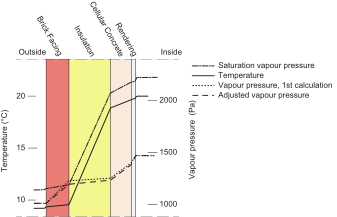
Figure 52. An example graphic representation of calculated temperatures, saturation vapour pressure, and existing vapour pressure through a construction. The materials are reproduced with their actual thickness to scale.
6.3.2 Vapour Pressure Distribution
A calculation of vapour pressure conditions in the construction is performed according to the same method as calculating the temperature distribution. However, check to ensure that the calculated vapour pressure in the boundary layers is not higher than the accompanying saturation vapour pressure.
Peripheral Conditions
- Outdoor moisture conditions: Vapour pressure calculations are determined based on mean monthly values (temperature, θoutside and relative humidity, RH) for the outdoor climate where poutside is determined by calculation (poutside= RH · pm,θoutside). In light constructions where the reaction time for changes in temperature is much less than one day, the outdoor relative humidity is set at 95 %.
- Indoor moisture conditions are calculated with the following formula: pinside = poutside + Δp, where Δp is determined based on the expected usage of the building (i.e., expected humidification often expressed in terms of humidity exposure class). If the indoor moisture conditions are kept constant, this value can be selected.
- Moisture conditions in soil are set at the saturated vapour pressure (RH = 100 %).
Determining Saturation Vapour Pressure
Which saturation vapour pressures correspond to the previously calculated temperatures in the boundary layers can be determined using tables. If a calculation is performed, the following formulae can be used:
Determining Diffusion Resistance
For membranes, surface coatings, etc., diffusion resistance values (Z-values) can normally be obtained from the supplier. Alternatively, recommended values are stated in Table 29 in Annex A. For airspaces, the Z-value is set to 0.05 · 109 Pa · m2 · s/kg, regardless of the thickness or orientation of the airspace.
For materials whose diffusion resistance (Z-value) is not known directly, this can be calculated as the thickness of the material divided by its water vapour permeability. Table 28 in Annex A includes instructive examples of the vapour permeability of several different building materials.
Determining Vapour Pressure
As a rule, the transition resistance of moisture is so slight as to be disregarded. These are set at 0 in the table. The vapour pressure on the two sides of the construction is determined using the proven/assumed relative humidity and ambient saturation vapour pressure. The drop in vapour pressure above a layer (m) represents the same share of the total drop in vapour pressure as represented by the layer’s Z-value (Zm) of the construction’s total Z-value (∑Z).
Therefore, the difference in vapour pressure above a material layer can be determined as:
The chart from the temperature calculation is extended with new columns or continued in a new chart. The calculation for the vapour pressure distribution is shown in Table 14 where the indoor moisture conditions correspond to humidity exposure class 2.
The relative humidity is calculated in the last column and is the ratio between the calculated vapour pressure for each boundary layer and the saturation vapour pressure at this place. If the RH everywhere is below 100 %, there will be no condensation in the construction under the conditions applied. Checks should be made to make sure that the calculated relative humidity factors will not cause material deterioration.
The permeability of some materials (e.g., metal sheeting) is so slight that they will effectively stop water vapour. To complete the calculations, in this case the vapour permeability may be set at 2 · 10-15 kg/(m s Pa).
Table 14. Example calculation of the vapour pressure distribution. The chart is a continuation of the calculation chart for temperature distribution. Material constants and climatic values are printed in bold; the rest are calculated values. Yellow areas in the chart indicate the occurrence of condensation.
Material | Thickness | Thermal Conductivity | Insulance Factor | Drop in Temperature | Tempera ture | Saturation Vapour Pressure | Vapour Permeability | Diffusion Resistance | Drop in Vapour Pressure | Vapour Pressure | Relative Humidity | |||||
d | λ | R=d/λ | Δθ | θ | pm | δ | Z=d/ δ | Δp | p | RH | ||||||
m | W/m·K | m2K/W | °C | °C | Pa | kg/m·s·Pa | Pa·m2·s/kg | Pa | Pa | % | ||||||
9.2 | 1163 | 1012 | 87 % | |||||||||||||
External transition | 0.04 | 0.07 | ||||||||||||||
9.27 | 1,168 | 1,012 | 87 % | |||||||||||||
Brick facing | 0.11 | 0.75 | 0.15 | 0.24 | 2.00E-11 | 5.50E+09 | 206.90 | |||||||||
9.50 | 1,187 | 1,219 | > 100 % | |||||||||||||
Insulation | 0.2 | 0.036 | 5.56 | 9.08 | 2.00E-10 | 1.00E+09 | 37.62 | |||||||||
18.58 | 2,139 | 1,256 | 59 % | |||||||||||||
Cellular concrete | 0.1 | 0.14 | 0.71 | 1.17 | 6.70E-11 | 1,49E+09 | 56.15 | |||||||||
19.75 | 2,301 | 1,313 | 57 % | |||||||||||||
Rendering | 0.02 | 0.8 | 0.03 | 0.04 | 1,00E-11 | 2.00E+09 | 75.24 | |||||||||
19.79 | 2,306 | 1,388 | 60 % | |||||||||||||
Internal transition | 0.13 | |||||||||||||||
20 | 2,337 | 1,402 % | 60 | |||||||||||||
∑R | 6.61 | θinside -θoutside | 10.8 | ∑Z | 9.99E+10 | pinside -poutside | 390 | |||||||||
6.3.3 Adjusted Vapour Pressure Distribution
If there are boundary layers where the calculated vapour pressure exceeds the saturation vapour pressure, the calculation must be adjusted, as this is not physically possible. Therefore, it is necessary to repeat the calculation with a changed assumption, namely the occurrence of condensation. This means that RF = 100 % in the boundary layer where the vapour pressure was too high in the first calculation. Vapour pressure in the critical boundary layer should, therefore, be set to equal the saturation vapour pressure at the location in question. There may be interstitial condensation in more than one boundary layer. In this case, the vapour pressure is set to equal the saturation vapour pressure in both boundary layers.
A new calculation of the vapour pressure distribution is performed on either side of the boundary layer where interstitial condensation is present (condensation point). From the condensation point, the difference in vapour pressure is distributed to each side of the construction as before (i.e., proportional with the diffusion resistance factors of the layers on either side of the condensation point). The calculation is shown in Table 15. Areas with condensation are marked in yellow whereas areas to be recalculated are marked in green. The bold lines between brick facing and insulation mark the boundary layer with interstitial condensation. The auxiliary factors ∑Zu and ∑Zi denote the total diffusion resistance factors from the condensation point to the outside and inside of the construction, respectively. Similarly, the auxiliary factors Δpu and Δpi denote the differences in vapour pressure between the condensation point and the outside and inside of the construction, respectively.
Table 15. An example of vapour pressure distribution calculation after adjustment for saturation. The condensation point is located between the brick facing and the insulation. Where there is condensation (marked in yellow), the vapour pressure is set to equal the saturation vapour pressure. Relative to Table 14, two new calculations are made of the areas marked in green. The two green colours indicate the two specific calculations in question. The yellow section also forms part of both calculations.
Material | Thickness | Thermal Conductivity | Insulance Factor | Drop in Temperature | Temperature | Saturation Vapour Pressure | Vapour Permeability | Diffusion Resistance | Drop in Vapour Pressure | Vapour Pressure | Relative Humidity |
|---|---|---|---|---|---|---|---|---|---|---|---|
d | λ | R=d/λ | Δθ | θ | pm | δ | Z=d/δ | Δp | p | RH | |
m | W/m·K | m2K/W | °C | °C | Pa | kg/m·s·Pa | Pa·m2·s/kg | Pa | Pa | % | |
9.2 | 1,163 | 1,012 | 87 % | ||||||||
Extern. transition | 0.04 | 0.07 | |||||||||
9.27 | 1,168 | 1,012 | 87 % | ||||||||
Brick facing | 0.11 | 0.75 | 0.15 | 0.24 | 9.50 | 2.00E-11 | 5.50E+09 | 214.83 | |||
1,187 | 1,187 | 100 % | |||||||||
Insulation | 0.2 | 0.036 | 5.56 | 9.08 | 18.58 | 2,139 | 2.00E-10 | 1.00E+09 | 39.06 | ||
1,226 | 57 % | ||||||||||
Cellular concrete | 0.1 | 0.14 | 0.71 | 1.17 | 19.75 | 2,301 | 6.70E-11 | 1.49E+09 | 58.30 | ||
1,285 | 56 % | ||||||||||
Rendering | 0.02 | 0.8 | 0.03 | 0.04 | 1.00E-11 | 2.00E+09 | 78.12 | ||||
19.79 | 2,306 | 1,363 | 59 % | ||||||||
Intern .transition | 0.13 | ||||||||||
20 | 2,337 | 1,402 | 60 % | ||||||||
ΣR | 6.61 | θinside - θoutside | 10.8 | ∑Z | 9.99E+09 | pinside-poutside | 390 | ||||
∑Zu | 5.50E+09 | Δpu | 175 | ||||||||
∑Zi | 4.49E+09 | Δpi | 215 | ||||||||
In the example shown, the calculation on the outside becomes quite simple because only the boundary layer on the outside of the brick facing must be calculated and the vapour pressure here is the same as that for the outdoor air. From the condensation point moving inwards, the vapour pressure distribution is found via calculation.
The vapour pressure distributions calculated before and after adjustments are reproduced in Figure 52.
The moisture flow into the construction can be calculated as the difference in vapour pressure between the indoor climate and the condensation point divided by ∑Zi. The moisture flow out of the construction can be calculated as the difference in vapour pressure between the condensation point and the outdoor climate divided by ∑Zu.
In the example shown, there will be a vapour flow through the back wall and the insulation of 4.8·10-8 kg/m² s = 128 g/m² per month.
The vapour flow out through the brick facing will be 3.2·10-8 kg/m² s = 85 g/m² per month. This means that approx. 43 g/m² per month will condense inside the construction.
By making calculating the conditions each month, one can assess whether the amount of condensed water will have time to dry out. This is discussed in Section 6.3.6 Application of the Calculation Method.
6.3.4 Glaser – Graphic Solution
The calculation can be performed in a simpler way by a graphic representation as shown in Figure 53. The construction is entered into a grid where the diffusion resistance factors are expressed as ‘layer thicknesses’.
Hence, layers with a great diffusion resistance will appear thick although, in truth, they may be quite thin (such as membranes). Conversely, thick diffusion-permeable layers (such as mineral wool) will appear thin because their diffusion resistance factors are small.
First, the curve for the saturation vapour pressure is entered. Then, the points for the actual indoor and outdoor vapour pressure are joined with a straight line (the first calculation). The straight line shows the vapour pressure distribution if there is no condensation. However, that is not the case in this example because the vapour pressure curve (the straight line) is above the saturation curve for part of the construction. Instead, the correct solution is the shortest possible kinked flowline between the inside and outside vapour pressure which, at most, borders without intersecting the saturation curve (the ‘adjusted vapour pressure’).
With the diffusion resistance expressed along the x-axis and the vapour pressure on the y-axis, the incline of the vapour pressure curve equals the density of the vapour flow. Thus, a steep curve represents a relatively large moisture flow whereas a flat curve represents a small moisture flow. At the point where the curve kinks from steep to flat, more moisture is flowing in than out. Consequently, the kink indicates that condensation occurs.
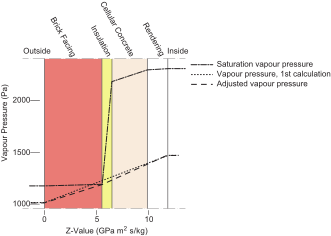
Figure 53. A temperature and vapour pressure chart for the same example as in Figure 52. Here, the materials are expressed by their Z-values. In this representation, the actual vapour pressure distribution can be determined geometrically rather than by calculation.
6.3.5 Calculating the Drying-Out Process
When moisture has accumulated in a boundary layer following humidification in winter, the feasibility of drying out this moisture can be examined by applying a calculation method very similar to the one described for moisture absorption. The relative humidity of the wet layer is set to 100 % with climatic conditions set for typical summer conditions outside.
With these assumptions, a drop in vapour pressure will normally occur from the wet layer towards the air on both sides of the construction, indicating a drying process. Naturally, it is impossible to dry out more moisture than is present at the start of the drying-out period. The calculation result should therefore be regarded as a potential option.
6.3.6 Calculation Method Applications
Despite several limitations inherent in this method (which will be covered in greater depth later in this section) the Glaser calculation method will give an idea of the state of fitness of a construction. It is especially good for assessing the effect of changes to the construction. The method assumes that construction-related moisture has dried out and is therefore not suited to calculate the drying out of construction-related moisture.
The method is particularly suited for two purposes:
- Calculations to prevent critical levels of surface moisture
- Calculations of condensation inside the construction.
In theory, the calculation should be performed for each month in both cases. Calculating the level of surface moisture indicates a permissible indoor temperature at a given moisture load, whereas condensation calculations are used to assess a construction under given outdoor and indoor climate factors.
Critical Level of Surface Moisture (φcrit)
When calculating critical levels of surface moisture, focus is directed at the inside surface of the construction, typically to prevent mould growth. A critical level should be selected (e.g., 75 % RH), for which one wishes to test the construction.
The remainder of the procedure is illustrated by way of an example. The description refers to the columns in Table 16.
- Enter the outdoor temperature and outdoor moisture levels for each month (columns 1 and 2).
- The outside vapour pressure (pu in column 3, is determined either by looking it up in a table (such as Table 23 in Annex A), or by approximate calculations (equation (35), (36), and (7)).
- The humidification expressed by the partial pressure (Δp in column 4), is stated. The partial pressure can be determined based on humidity exposure classes (stated in Figure 32).
- The indoor vapour pressure (pi) is calculated as pi = pu + 1.1Δp (column 5).
- Based on selected critical levels of surface moisture (ϕcrit) (e.g., 75 % RH), the level of saturation vapour pressure this corresponds to is calculated with the following formula:
p_m\left(\theta_{crit}\right)=p_i/\phi_{crit} (column 6). - The critical indoor surface temperature (θcrit in column 7) can now be determined via the following equations:
\theta=\frac{237,3in\left(\frac{p_m}{610,5}\right)}{17,269-in\left(\frac{p_m}{610,5}\right)} (38) \theta=\frac{265,5ln\left(\frac{p_m}{610,5}\right)}{21,875-\ln\left(\frac{p_m}{610,5}\right)} (39) - By comparing the critical surface temperature (θcrit) with the expected indoor temperature (θi) an assessment can now be made as to which month is the most critical, since the temperature factor (fRi in column 8), is an expression of this. The critical month is that where fRi is highest.
f_{Ri}=\frac{\theta_{krit}-\theta_u}{\theta_i-\theta_u} (40) By using the outdoor climate in Denmark as shown in Table 11, this calculation can be done for a critical moisture level (e.g., 75 % RH for buildings landing between humidity exposure classes 3 and 4, such as dwellings). The calculation indicates that January is the most critical month.The method can be used to assess whether the total U-value of a construction is adequate to protect against moisture problems. Unless the temperature drops below the critical surface temperature in the critical month, the construction can be considered safe from reaching the critical level of surface moisture.
Table 16. An example of critical surface temperature calculation for buildings categorised as bordering on humidity exposure classes 3 and 4 when the critical moisture level is set at 75 % RH (based on the outdoor climate in Denmark).
1 | 2 | 3 | 4 | 5 | 6 | 7 | 8 | 9 | |
|---|---|---|---|---|---|---|---|---|---|
Month | θu °C | ϕu | pu Pa | Δp Pa | pi Pa | pm(θcrit) Pa | θcrit °C | θi °C | fRi |
January | -0.6 | 0.94 | 546 | 810 | 1356 | 1808 | 15.9 | 20 | 0.802 |
February | -1.1 | 0.91 | 507 | 810 | 1317 | 1756 | 15.5 | 20 | 0.785 |
March | 2.6 | 0.91 | 670 | 718 | 1388 | 1850 | 16.3 | 20 | 0.786 |
April | 6.6 | 0.82 | 799 | 576 | 1375 | 1833 | 16.1 | 20 | 0.711 |
May | 10.6 | 0.78 | 996 | 434 | 1430 | 1907 | 16.8 | 20 | 0.655 |
June | 15.7 | 0.67 | 1194 | 253 | 1447 | 1929 | 16.9 | 22 | 0.197 |
July | 16.4 | 0.74 | 1380 | 228 | 1607 | 2143 | 18.6 | 23 | 0.335 |
August | 16.7 | 0.71 | 1349 | 217 | 1566 | 2088 | 18.2 | 23 | 0.237 |
September | 13.7 | 0.85 | 1332 | 324 | 1656 | 2207 | 19.1 | 22 | 0.648 |
October | 9.2 | 0.87 | 1012 | 483 | 1495 | 1994 | 17.5 | 20 | 0.765 |
November | 5 | 0.91 | 793 | 633 | 1426 | 1901 | 16.7 | 20 | 0.781 |
December | 1.6 | 0.88 | 603 | 753 | 1356 | 1808 | 15.9 | 20 | 0.778 |
Condensation at the Core of the Construction
Moisture conditions on the inside surface are not always sufficient to assess a specific construction as condensation may occur inside the construction. The above describes how to determine the vapour pressure distribution inside a construction. The fact that condensation occurs inside a construction does not necessarily mean that it is not a viable construction. If conditions at other times of the year cause the accumulated water to dry out and the materials are insensitive to moisture, the construction can be perfectly viable.
The following method can be used to assess a construction:
- Calculate temperature and moisture conditions as described above. Begin with the first month of condensation. Outside tropical areas (i.e., localities with seasonal changes) this will typically be two or three months prior to the coldest period.
- Next, calculate the conditions for the following month where the amount of condensed moisture (g) is calculated based on the following equation if the condensation is limited to one spot:
g=\frac{p_{inde}-pc}{Z_i}-\frac{p_c-p_{ude}}{Z_u}=\left(\frac{\Delta p_i}{Z_i}-\frac{\Delta p_u}{Z_u}_{}\right) (41) The vapour pressure in this spot is designated pc. If there is condensation in two spots, c1 and c2, with the vapour pressure factors pc1 and pc2, the diffusion resistance should be subdivided into three lengths: Z1 from the outside of the construction to c1, Z2 from c1 to c2, and Z3 from c2 to the inside of the construction. The condensation in the two spots can now be calculated as:For c1:g=\left(\frac{p_{c2}-p_{c1}}{Z_2}-\frac{p_{c1}-p_{ude}}{Z_1}\right) (42)
For c2:$$ g=\left(\frac{p_{c2}-p_{c1}}{Z_2}-\frac{p_{c1}-p_{ude}}{Z_1}\right) $$ (43)
- Now calculate the conditions for the following month. For spots with condensation in the previous month, the vapour pressure should be set to equal the saturation vapour pressure before calculating as before, applying the required adjustments. Now calculate the condensation at this spot. If the condensation value is negative, this means that the area is drying out.
- The following months are calculated in a similar fashion. The accumulated moisture in condensation spots is calculated on an ongoing basis to assess when the condensed moisture has dried out. Only one month after the accumulated moisture has been removed by evaporation should the vapour pressure in the former condensation spot no longer be set at saturation vapour pressure.
The results of these calculations could be that:
- No condensation will occur during any month anywhere in the construction. Thus, the construction can be regarded as condensation proof. Consideration should be given to the fact that there may be spots in the construction where moisture levels could be high enough to cause other problems (e.g., mould).
- Condensation occurs in one or more spots in the construction but dries out over the course of the year. In that case, consideration should be given to the length of time in which the construction is wet and whether surrounding materials are sensitive to moisture. An assessment can be made regarding the risk of the construction being seriously weakened or damaged due to moisture content.
- Condensation occurs which will not dry out during the year. Such constructions should be considered risky and should not be implemented unless more detailed calculations prove that the Glaser method overestimates the risk.
An example of a condensation calculation over a year is shown in Table 17. This is the continuation of the example of an exterior wall comprising brick facing, insulation, cellular concrete, and rendering on the inside. The calculations show that the first month of condensation is October. Therefore, this is where the calculations begin. In every month from October up to and including April, condensation occurs between the brick facing and insulation. Thereafter, a drying process sets in that will not have dried out the moisture until the end of August. This means that, during the months of May up to and including August, the vapour pressure between brick facing and insulation is set at saturation vapour pressure. Not until September can the calculation be made without adjustments.
Therefore, the construction has approximately enough time to dry out, thereby avoiding moisture accumulation over the years. Since the materials are insensitive to moisture, the construction is considered safe in terms of moisture.
Table 17. This example shows a calculation of interstitial condensation and evaporation between brick facing and insulation for the same wall shown in the examples in Figures 52 and 53.
Condensation Between Brick Facing and Insulation kg/m² month | Accumulated Moisture in the Condensation Boundary kg/m² | |
October | 0.0428 | 0.0428 |
November | 0.1877 | 0.2305 |
December | 0.2338 | 0.4642 |
January | 0.3162 | 0.7805 |
February | 0.2668 | 1.0473 |
March | 0.2390 | 1.2862 |
April | 0.0565 | 1.3427 |
May | -0.1151 | 1.2276 |
June | -0.5192 | 0.7084 |
July | -0.4341 | 0.2743 |
August | -0.5039 | |
September |
6.3.7 Limitations of the Calculation Method
The Glaser method has several limitations, which means that the results are associated with a significant degree of uncertainty. The most important are listed here:
- The method is stationary. Thus, the assumption is that the climatic conditions have remained constant for long enough to secure equilibrium moisture content in the construction layers. In practice, this will not usually be the case, as it will take a long time to reach equilibrium moisture content, especially for heavy and dense materials. The climatic conditions should therefore be selected as qualified mean values for suitable periods.
- The material parameters are assumed to be constant. The thermal conductivity and diffusion resistance of a material can be affected (e.g., by the moisture content) and can vary significantly in both temperature and moisture conditions.
- Vaporisation and condensation, which are significant factors influencing temperature, are not included in the calculations.
- Conditions such as driving rain, solar irradiation, and longwave radiation are not considered.
- Many building materials are hygroscopic and are thus capable of absorbing a certain amount of water vapour.
- The calculation method exclusively addresses water vapour diffusion. Moisture transport in liquid form (capillary transport) or by convection is not considered.
- The method is one-dimensional even though most constructions are two-dimensional or three-dimensional. It is therefore a matter of judgment which cross section of the construction it would make most sense to examine.
As such, the method is best suited to provide an approximate assessment of the conditions, bearing the limitations of the method in mind.
6.4 Detailed Moisture Calculations
A more detailed calculation of moisture conditions results in a higher level of certainty by taking material parameters and variations in climatic impact into account, both outside and inside the construction. The calculations could include moisture capacity of constituent materials, changes in the permeability of the materials at a given air humidity, convection, capillary suction, and more calculation intervals (e.g., each with a duration of 1 hour).
However, it is worth noting that quite a few of these programs have difficulty in handling anything but water vapour diffusion in a convincing fashion.
The programs currently on the market typically apply one-dimensional or two-dimensional calculation methods to determine hygrothermal conditions (a coupling of moisture and heat transport). The programs incorporate detailed weather data, such as those from the Danish reference year, DRY. Material data usually derive from extensive material libraries incorporated into the programs. It is often necessary to obtain supplementary data from suppliers or elsewhere.
The Danish calculators BSim and MATCH apply the same computing model. The model for moisture transport in constructions apply vapour diffusion as a form of transport. Moisture transport inside constructions is determined in a stationary manner, as sorption isotherms for the materials are used to factor their moisture-buffering effect. The layers in a composite building construction are divided into several control volumes. For each control volume, a balance is defined between how much moisture is added or released by diffusion and the extent to which the moisture content is changed between the time intervals. The sorption isotherm is used to convert the changed moisture content into relative humidity as well as the associated vapour pressure driving the diffusion. In the case of the sorption isotherm, it is possible to take the hysteresis prevalent in such isotherms into account, meaning that the changed humidification properties occurring in materials depend on whether they are in a process of dehumidification or humidification.
According to suppliers, the calculators can perform the following calculations:
- Condensation risk
- Drying-out time for constructions
- Impact of changes to constructions
- Water absorption resulting from driving rain
- The influence of moisture conditions on insulation capacity
- Moisture conditions near thermal bridges.
Three-dimensional moisture calculations are undergoing research and are only used to a very limited extent for practical assessment of constructions.
Figures 54 and 55 are examples of a detailed simulation of moisture conditions over time for the separate layers in a vented wooden construction in a dwelling.
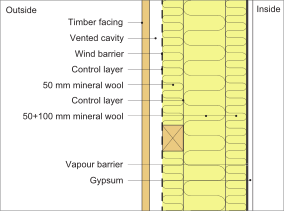
Figure 54. Example of a stud wall construction where moisture conditions in the separate layers (including the control layers shown) have been calculated (see Figure 55).
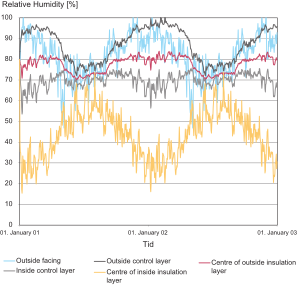
Figure 55. The result of the moisture calculation shows that significant humidification in the exterior facing, and the outside control layer (just behind the wind barrier) may occur, but that only minimal humidification occurs in the remaining parts of the construction.