4 Constructive Moisture Control
Buildings and constructions should be protected against humidification constructively. This will ensure that materials or constructions are not damaged (e.g., due to decay and dry rot) and that no adverse health issues will occur due to mould growth.
Constructive control should:
- reduce the exposure to moisture on buildings and constructions as far as possible
- ensure that any moisture that inevitably finds its way in is effectively removed by drainage and ventilation
- ensure that suitable materials and constructions are used, capable of tolerating the anticipated exposure to moisture
When designing details, it is essential to consider that high winds will move rain and snow in a horizontal direction and, in special cases, even upwards at roof edges and corners. Precipitation (and notably driving snow) will then be able to penetrate even tiny gaps.
4.1 Water Should be Diverted
All buildings should be designed according to the following maxim: water should be diverted because water causes issues. The expression refers to the fact that rainwater and surface water should be diverted from the building as fast as possible, so that it does not cause undue humidification.
The weather screen should therefore be designed so that the least possible outside water can infiltrate the constructions. Moreover, water which has entered the building structure must be led out again. Examples of measures to ensure this are:
- Overhangs to reduce the amount of driving rain striking the facade
- A waterproof substructure (at least 150 mm high), to prevent water intrusion and splashback from affecting moisture-sensitive surfaces such as timber cladding
- Perimeter drains removing percolating water to avoid water pressure on the foundations or basement walls
- Drip bars on windows, external windowsills, etc., to ensure that water will run off away from the facade
- Two-stage climate screens with outer rainscreen sealant systems and a windproof layer behind, to prevent water from being pressed into the actual construction and draining it off if some of it manages to get behind the rainscreen (cf. two-stage rainscreen sealant system mentioned below).
4.2 Overhangs and Flashings
As far as possible, outdoor constructions should be covered to protect them against precipitation. Based on experience, a roof overhang projecting out approx. 600 mm will provide adequate protection for small buildings (i.e., up to a height of about 4 m). Overhangs will also protect higher buildings but are primarily effective on the upper part of the facade (which is the surface most exposed to water).
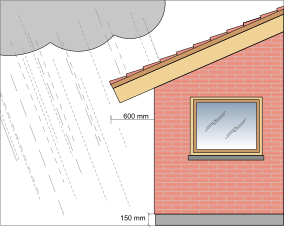
Figure 34. Projecting overhangs protect the upper parts of the facade. For smaller buildings, an overhang projecting out only 600 mm is adequate protection for the whole facade (up to a height of approx. 4 m). A weatherproof substructure is constructed measuring at least 150 mm and can withstand splashback from rainwater.
Coverings include external sills, canting strips above windows, and flashing around barge boards. Flashing is fitted to divert water away from facades, beam ends, etc., allowing it to drain off without causing humidification.
To deflect water, the upper sides of projecting overhangs must have a well-defined slope. The slope should match the construction and materials used, but should be at least 1:10 (10 mm per 100 mm).
Flashings should finish with a drip edge/drip bar. The drip edge should project 30–45 mm beyond the surrounding facade to ensure that the water will drain off away from the facade.
To avoid water remaining in slits due to capillary action, there should be a min. 5 mm gap under the drip edge (e.g., between window casings and moving frames). For the same reason, abutting joints in wood should be avoided (wood draws the highest amount of moisture through cross-cut ends). Detailed information on constructive wood protection is available in Jensen (2001).
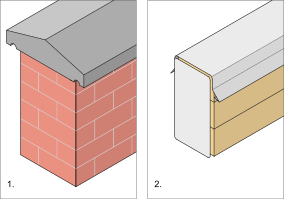
Figure 35. Examples of constructive protection by flashing.
- Brickwork is protected against humidification by means of flashing with effective slopes finished off by a water deflector. Joints between flashing units are waterproofed using suitable caulking compound.
- Upper sides and ends of beams are protected against humidification by flashing them with metal profiles, allowing ventilation between wood and flashing.
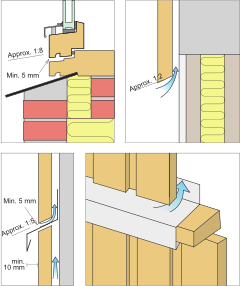
Figure 36. Examples of constructive measures to prevent humidification.
Surfaces on windows, doors, and other exposed parts (especially wooden parts) should slope to ensure that water can drain off quickly.
The size of slits must be adequate (min. 5 mm) to prevent water droplets from ‘bridging’ openings.
Joints are flashed as required to ensure that water is diverted to the surface. Finishes are made with drip edge/chamfered edges, or water deflectors, ensuring that water is diverted to drain off away from the structure. If possible, flashings are extended to the back of the slit to overlap with the wind barrier, if fitted.
Surfaces on windows, doors, and other exposed parts (especially wooden parts) should slope to ensure that water can drain off quickly.
The size of slits must be adequate (min. 5 mm) to prevent water droplets from ‘bridging’ openings.
Joints are flashed as required to ensure that water is diverted to the surface. Finishes are made with drip edge/chamfered edges, or water deflectors, ensuring that water is diverted to drain off away from the structure. If possible, flashings are extended to the back of the slit to overlap with the wind barrier, if fitted.
4.3 Moisture-Related Movement
Many (especially wood-based) materials will sustain significant dimensional changes due to changes in relative humidity. Such movement should be absorbed without damaging the construction or making it leaky and open to precipitation.
When considering moisture movement, it is worth noting that dimensional changes can vary in different directions within the same material, thus the longitudinal expansion in wood is only around 1/10 of the average transverse expansion.
Different materials respond, differently to moisture expansion and thus differences in movement between abutting materials should be considered (e.g., brickwork joined to concrete).
Finally, a varying moisture content at the top and bottom within the same material in a structure may result in warping. Examples of this include the so-called ‘washboard’ effect in floorboards sustaining one-sided humidification from below as well as the upward warping of roofing slabs in wintry conditions where the underside of the ribs is dry (hence short) whereas the upper side is damp (hence long).
4.4 Ventilation
The most common method to remove moisture from air and materials is by venting the cavities in the constructions providing fresh air. Although ventilation is a proven method, it cannot be applied uncritically. Ventilation only works if the ventilation air contains less moisture than the cavities being vented. Special care is needed where there may be a risk of cooling the ventilation air, such as in basements and crawl spaces. In these constructions, the cooling of ventilation air during summer can cause a sharp rise in the relative humidity with a risk of mould growth.
Ventilation of heated rooms should be performed by extraction or balanced ventilation, producing negative pressure in the building in relation to the constructions. Pressure ventilation is not advised, as it involves the risk of moist air being forced into constructions.
4.5 One-Stage and Two-Stage Rainscreen Sealant Systems
4.5.1 One-Stage Rainscreen Sealant System
A one-stage rainscreen sealant system is used in all homogeneous walls, such as solid brickwork and sometimes also in joints where elastic caulking compound is used in the outer part of the joint. When a layer is required to provide simultaneous weatherproofing against rainwater and wind, the latter will produce a pressure difference between the two sides, pressing rainwater through even the smallest leak. Hence, as far as possible one-stage solutions should be avoided.
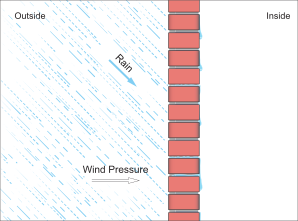
Figure 37. In one-stage rainscreen sealant systems, joints are exposed to the simultaneous impact of water and wind pressure. Normally, a full-brick wall is considered weatherproof against continuous driving rain whereas it is well-known that water can penetrate a half-brick wall.
4.5.2 Two-Stage Rainscreen Sealant System
The effect of simultaneous exposure to wind and precipitation can be avoided using the so-called two-stage rainscreen sealant system where the function of the exterior facing is performed in two layers:
- An outside rainscreen, to make the structure rainproof
- An inside wind-breaking layer, to make the structure airtight.
The two layers are separated by a fresh-air vented cavity via vent openings in the rainscreen. The principle of two-stage rainscreen sealant systems is illustrated in Figure 38.
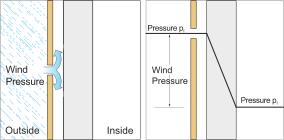
Figure 38. Two-stage construction where the function is performed by a rainscreen on the outside and a windproof part on the inside. Due to the openings, the pressure on both sides of the rainscreen is largely identical and there will be no appreciable pressure difference capable of pressing water through the rainscreen and across the cavity. The drop in pressure occurs across the rear parts of the wall or joint.
The first step in a two-stage rainscreen sealant system is the exterior facing (the rainscreen), which repels most of the rainwater. The rainscreen is not airtight, and has vent openings for the cavity between the rainscreen and wind barrier. Hence, the air space is connected to the outside air, meaning that the wind pressure will propagate into the cavity.
This will achieve a practically uniform pressure either side of the rainscreen. Since there is no pressure difference worth speaking of, only small amounts of water will be pressed through the openings in the rainscreen. The bottom of the cavity is drained so that the small amounts of water that inevitably find their way in are effectively drained away.
The inner part of the construction (the inner wall or the back part of the joint), needs to absorb the wind load (or perform the wind proofing function).
In the case of a two-stage rainscreen sealant system, it is advantageous if the rainscreen is made of very durable materials, which might be vapour-impermeable (e.g., glass or metal) since water vapour can be vented away via the openings in the rainscreen. By contrast, a wind-breaking layer covering the insulation behind the rainscreen should always be vapour-permeable.
4.6 Vapour Barriers
To prevent the infiltration of water vapour from indoor air into surrounding constructions and resultant moisture damage, a vapour barrier is often installed on the warm side of the insulation. Besides preventing humidification, the vapour barrier is also instrumental in ensuring that the building is airtight.
The role of the vapour barrier is to prevent humidification resulting from both diffusion and
convection.
convection.
To prevent humidification resulting from diffusion, the vapour barrier must be relatively vapour-impermeable. The most important feature is that the vapour barrier must be more vapour-impermeable than the layers installed on the cold side of the insulation.
A useful heuristic is that the vapour barrier should be at least 10 times as vapour-impermeable as the layers on the cold side of the insulation.
Normally, the vapour barrier should have a Z-value of at least 50 GPa s m2/kg. Lower values should only be used in consultation with the supplier of the vapour barrier (e.g., in connection with ‘systems solutions’ where vapour and wind barriers are adapted for joint use). Due to the high air humidity in bathrooms, the vapour diffusion resistance of wet-room coatings should be at least 100 GPa s m2/kg.
In practice, it is usually more important that joints, penetrations, etc., are airtight rather than that the materials are extremely vapour-impermeable. This is because moisture transport is usually far greater in the case of convection than diffusion (see the first and third example in Section 2.4.1).
In new builds, Building Regulations requirements stipulate that the air exchange rate through evenly distributed leakages in the weather screen must not exceed 1.5 l/s per m2 of heated floor space when tested with a pressure difference of 50 Pa above the weather screen. When this requirement is fulfilled, it is realistic to expect that the building is protected against problems resulting from convection (the requirement is expected to be amended to 1.0 l/s per m2 in 2015).
Vapour barrier materials must be CE-marked according to DS/EN 13984, Flexible sheets for waterproofing (Danish Standards, 2005) and DS/EN 13859-1, Flexible sheets for waterproofing (Danish Standards, 2010).
Since moisture conditions in the building will often be heavily dependent on the functioning of the vapour barrier, the durability of vapour barriers and accessories such as tape and caulking compound should be documented.
Vapour Barrier – Vapour Control Layer
The term vapour barrier is normally used for products that prevent moisture transport in vapour form. In some cases, the term vapour control layer is also used, especially for products allowing slightly more water vapour to pass through.
Nevertheless, the term vapour barrier is the preferred term and is used throughout this publication.
4.6.1 Materials
Materials marketed as vapour barriers are usually roll material, but other types are also relevant (e.g., sheeting or membranes applied in liquid form).
In many buildings, the function of the vapour barrier is a precondition for correct moisture performance in buildings. The vapour barrier must therefore possess the required properties, and these must be documented with a CE marking. The lifespan is especially important because the construction must be able to function for many years. The lifespan applies to both the actual vapour barrier and the accessories used to install it (such as tape, sleeves, and caulking compound). The best solution is achieved by using ‘vapour barrier systems’ (i.e., where the manufacturer supplies accessories to match the chosen vapour barrier).
4.6.2 Plastic Vapour Barriers
Almost all traditional plastic vapour barriers are made from polyethylene (PE).
Plastic vapour barriers are available in varying thickness with or without reinforcement, depending on the applicable requirements for diffusion resistance and robustness. Most plastic vapour barriers are usually able to meet the requirements for diffusion resistance.
Vapour barriers must be sufficiently robust to withstand handling and mounting on the building site. For example, loosely fitted vapour barrier overlaps at vapour barrier joints in wooden elements are liable to be exposed to great mechanical impact. Vapour barriers with great tensile strength, elongation at fracture, and impact tensile strength (e.g., corresponding to 0.2 mm PE foil) should be used. Alternatively, the manufacturer should be able to document that the given properties are adequate (e.g., corresponding to an ordinary 0.2 mm PE vapour barrier).
When plastic foils are used as vapour barriers in floors, they will often be walked on after having been fitted. In such cases, plastic foil with a documented resistance to perforation by small sharp objects should be selected.
4.6.3 Aluminium-based Vapour Barriers
Aluminium-based vapour barriers are structured with a thin layer of aluminium foil as a diffusion-control layer. The thickness of the aluminium layer is usually 7–30 µm (1 µm = 10-6 m).
This type of vapour barrier is available in various designs, but all are based on aluminium foil glued to a substrate. In its simplest design, the substrate is merely a layer of strong paper. In more sophisticated products, reinforcement fibres are used to augment robustness or plastic lamination to enhance resistance to chemical (alkaline) impact from the surroundings.
Unprotected aluminium is degradable in an alkaline environment (such as stables), or by contact with wetted cement-based materials. Condensate in damp environments with chloride present (such as swimming pools) may lead to pitting corrosion.
Note that in practice, the reflective effect of aluminium foil is largely irrelevant to heat transport. Consequently, it is irrelevant which way the aluminium foil is facing.
4.6.4 Bitumen-based Membranes
For special applications or considerable moisture loads, bituminous felt can be used as a vapour barrier. However, to install this type of vapour barrier requires a firm substrate.
Bituminous felt can be made completely airtight by welding or bonding the joints. Bituminous felt with aluminium inserts can be used where a very large diffusion resistance is required.
4.6.5 Moisture-adaptive Vapour Barriers
A moisture-adaptive vapour barrier is the term used for special foils where the diffusion resistance is relative to the RH of the surroundings.
The diffusion resistance of the products presently on the market is highest at a low RH where they function as actual vapour barriers. For a high RH, their diffusion resistance is low, meaning that they no longer function as vapour barriers and instead allow the passage of moisture.
In certain contexts, moisture-adaptive vapour barriers can contribute to removing moisture from roof constructions. In summer, if used in roofing slabs, they will allow the passage of moisture driven down to the upper side of the vapour barrier by solar heating. The reason for this is that the vapour barrier (now in damp surroundings) cause the diffusion resistance to be altered or reduced, enabling moisture to penetrate to the bottom of the roofing slab.
Moisture-adaptive vapour barriers cannot generally be used to keep out construction-related moisture.
Note that the conditions of use and application of all products are subject to limitations, which must be specified and clearly stated by the manufacturer of the product in question.
Plastered Ceilings
Earlier, plastered ceilings were considered a suitable replacement for an actual vapour barrier in vented constructions. If they remain intact, plastered ceilings possess the most important quality, namely an airtight ceiling surface. In this way, moisture transport by airflow (convection) from the indoor climate into the constructions is prevented.
Earlier traditional ventilation in constructions ensured that water vapour from diffusion through the loft construction was removed by ventilation air. Furthermore, any cavities in the construction were partly heated by the heat loss through the sparsely insulated constructions.
In modern buildings, the airtightness of plaster can no longer be exploited to ensure required airtightness. Constructions have become colder and it can no longer be assumed that enough moisture is removed by the infiltration of heat from underlying rooms and from natural ventilation to meet applicable requirements. For this reason, vapour barriers should be used in new builds and renovations to ensure that harmful volumes of condensate will not form in the constructions due to diffusion.
When re-insulating roof constructions where the thermal insulation thickness exceeds 150 mm, an actual vapour barrier should be installed (see SBi Guidelines 240, Efterisolering af småhuse – byggetekniske løsninger (Re-Insulating One Family Houses and Similar Small Houses – Construction Solutions, 3.4.3, Roof Constructions)).
4.6.6 Execution
To protect against convection of moist indoor air, the vapour barrier must be installed completely tight, which requires that:
- details are carefully designed to be buildable, including correct penetrations and suitable materials.
- the vapour barrier is correctly installed, especially when constructing details to ensure airtightness.
- electrical installations are planned in such a way as to require the least possible penetration of the vapour barrier.
- any damage is repaired satisfactorily as instructed by the manufacturer/supplier (e.g., using special tape).
The vapour barrier should always be installed before the heating is switched on, as construction-related moisture might otherwise penetrate the construction and cause condensation.
4.6.7 Position
The vapour barrier should be placed on the warm side of the insulation (within dwellings, as closely as possible to the heated rooms).
However, experience shows that the best position for the vapour barrier is slightly up into the insulation, from the inside (the warm side). Thus, the vapour barrier is well protected against both deterioration caused by UV light and unintentional piercing.
When placing the vapour barrier slightly higher up in the construction, electrical cables and junction boxes can be mounted in the construction below the vapour barrier to avoid penetrating it. However, the vapour barrier should be placed no more than 1/3 inside the insulation layer seen from the warm side (see Figure 39).
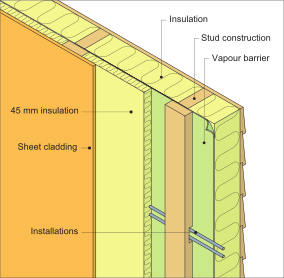
Figure 39. Example of the positioning of a vapour barrier in an external wall. The vapour barrier is placed on the warm side, but in this example, it is pulled 45 mm inside the insulation layer (it can be placed as far as a third way into the insulation layer). This location protects the vapour barrier and allows electric cables, and other features inside the wall, to be run below the vapour barrier to avoid penetrating it.
Alternatively, the planned position of electric installations (such as lamp outlets), should be in areas of the construction that do not contain the vapour barrier. For example, lamp outlets could be placed at the top of interior walls rather than in the ceiling (cf. SBi Guidelines 214 (Rasmussen & Nicolajsen, 2007) and Byg-Erfa info sheets on vapour barriers (Byg-Erfa, 2007b; Byg-Erfa, 2008a)). Note that, when installing insulation, work procedures above head height should be avoided as far as possible, alternatively, insulation with a surface lining can be used (cf. executive order 344 from the Danish Working Environment Authority (Danish WEA, 1988)).
4.6.8 Installing a Vapour Barrier
Joints, penetrations, and connections must be executed on a firm substrate (e.g., 15 mm plywood sheeting).
Joints or connections must be executed with at least 50 mm overlap. To be sufficiently airtight, all joints, connections, and penetrations must also be secured by bonding (cf. SBi Guidelines 214 (Rasmussen & Nicolajsen, 2007) and Byg-Erfa info sheets (39) 08 30 06 (Byg-Erfa, 2008a) and (39) 07 10 29 (Byg-Erfa, 2007a) on vapour barriers).
‘Bonded’ is used here as a common term for solutions involving tape, adhesive, or sealant tape (e.g., butyl). If using caulking compounds (e.g., synthetic sealant) this must be able to bond with both substrate and vapour barrier. Adhesives and caulking compounds must be compatible with the vapour barrier used – preferably documented by neutral testing. Joints executed using butyl sealant tape or tape must be pinched after mounting (e.g., with a nylon roller). Joints between two lengths not installed on a firm support cannot be assumed to be airtight.
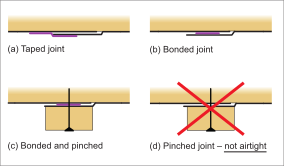
Figure 40. Vapour barrier joints must be executed with at least 50 mm overlap, joined with sealant tape (a), or by bonding using sealant tape or adhesive (b). An airtight construction can only be secured when joined on a firm substrate. The best joint (c) is achieved by using a taped or bonded joint, which is also pinched. Pinched joints (d) without sealant tape or bonding (which was formerly common practice) cannot be assumed to be airtight.
On wood and other nailable materials, the vapour barrier is mounted using corrosion-proof clamps. The clamps should be spaced out approx. 100 mm and in line (see Figure 41), to protect against damage when the vapour barrier is exposed to wind load, including being tested for airtightness. On a steel frame, the vapour barrier is mounted with bi-adhesive tape or bonded using adhesive according to manufacturer’s/supplier’s instructions.
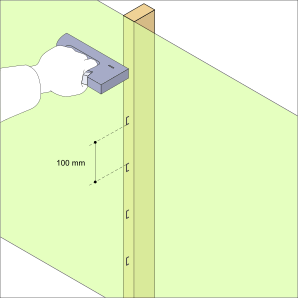
Figure 41. On timber frames, the vapour barrier is mounted in line with clamps spaced out at approx. 100 mm.
At penetrations, the penetrating object such as a pipe for a ventilation duct, should be secured to the substrate. This will prevent unwanted movement and ensure a good and durable joint. The area around the penetration is tightened (e.g., with a suitable sealant tape or synthetic sealant). For certain (especially small) penetrations such as cables or small pipe dimensions, special ancillary products are available (e.g., readymade sleeves) which provide optimal airtightness (see Figure 42).
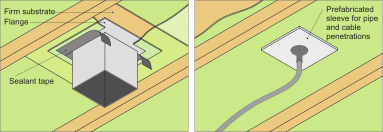
Figure 42. Examples of penetrations. Left: penetration of duct executed on a firm substrate. The vapour barrier is bonded to the flange with sealant tape. Right: an example of a sleeve suitable for a small pipe or cable penetrations.
For terminations against firm walls, etc., the vapour barrier should be mounted with a slight excess of length which should be extended in a soft arch (see Figure 43). This will ensure that minor movement/deformation can be absorbed without exposing the vapour barrier and joint to tension.
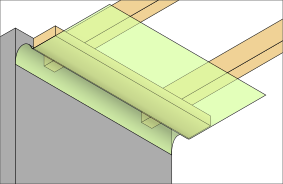
Figure 43. The vapour barrier is best terminated against firm structures such as walls with a ‘soft arch’, to prevent the joint from being exposed to tensile stress during any structural movement.
Should Vapour Barriers Be Used in Holiday Homes?
There is much uncertainty about using vapour barriers in holiday homes.
Currently, it is common for holiday homes to be occupied all year round, including the winter.
Stays range from a few weekends/holidays to permanent residence for pensioners. The usage pattern will often change over time (e.g., in connection with change of ownership or the transition to permanent residence for pensioners).
Vapour barriers are therefore installed in holiday homes in the same way as for permanent residences.
A correctly installed vapour barrier would not usually do any harm – whether the house is occupied during winter or not. Conditions could be further improved by using a moisture-adaptive vapour barrier, allowing vapour transport from the outside to the inside to occur without the risk of condensation in the form of ‘summer condensation’ (see section 3.3.4, Summer Condensation).
4.6.9 Special Constructions
Certain buildings such as cold stores and swimming pools are subject to particularly stringent requirements for constructions to be vapour-tight. Here, the requirements for both diffusion resistance and airtightness are extra tough.
In cold stores, the Z-value should be at least 500 GPa s m2/kg. The vapour barrier should be placed on the warm side of the insulation (i.e., outside for cold stores and inside for swimming pools).
Penetrations are not recommended and should, in any case, be restricted to those necessary only. It is advisable to bond the vapour barrier to a firm substrate or to place it between two sheets, so that it is well-protected against mechanical impact.
All details should be designed with the utmost care and be subject to strict supervision, as installation defects can have very serious consequences.
4.6.10 Vapour Barriers and Renovation
In renovation work, vapour barriers should be installed in constructions according to the same guidelines applying to similar new constructions. However, it is not to be expected that a vapour barrier installed during renovation will meet the same airtightness requirements applicable to a new build.
Joints between the existing and the new vapour barriers must be airtight. The installation must comply with the guidelines for new constructions, which means that they must be taped, bonded, or caulked joints.
In the case of unutilised loft spaces or sloping walls, the vapour barrier can sometimes be installed between the rafters according to the following steps: Remove the existing insulation and install lengths of vapour barrier between rafters. If there is a risk of damaging the vapour barrier due to projecting nails, etc., a thin layer of rigid insulation can be laid down as a substrate (the thickness of which must be max. one third of the total insulation thickness). Bend the lengths of vapour barrier up along the sides of the rafters and fasten carefully. Make the joint as airtight as possible (e.g., with sealant tape). The joint should be further secured by a wooden strip that will pinch the joint. The remaining insulation is placed on the outside of the vapour barrier.
Plaster ceilings can be considered airtight but can only be retained without a vapour barrier if they are intact (i.e., without cracks or holes, and provided that no changes are made to the construction, including re-insulation) (cf. the box on page 76). When joining a new vapour barrier with an old plaster construction, there should be plenty of overlap between the old construction and the new vapour barrier. The joint should be made tight using tape or sealant tape.
Further information on vapour barriers is available from the Byg-Erfa info sheets on vapour barriers (Byg-Erfa, 2007a; Byg-Erfa, 2008a).
4.7 Moisture Barriers
Moisture barrier is the term used for a layer of material which prevents moisture transport in liquid form. Moisture barriers are commonly used to prevent humidification by soil moisture or discharge of construction-related moisture (e.g., from concrete floors). However, they can also be used for other purposes such as preventing humidification of windows and doors in brickwork.
Moisture barriers are intended to prevent water from ‘wicking’ up (e.g., through a grade construction). When installing moisture barriers, it is important to ensure complete tightness everywhere, so that there will be no moisture infiltration outside the moisture barrier. In foundations, the plaster layer must be interrupted at the level of the bituminous foundation waterproofing (could also be a plastic membrane/wall membrane), as the plaster layer could otherwise act as a wick, drawing moisture up past the moisture barrier.
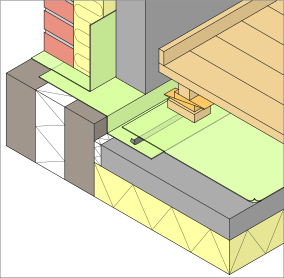
Figure 44. Example of moisture barrier installed on ground floor slab. The moisture barrier on the deck is sealed tightly with the bituminous foundation waterproofing (which could also be plastic membrane/wall membrane). The bituminous foundation waterproofing is continued on to the deck and bonded or welded to the concrete. The moisture barrier is laid out to overlap with the bituminous foundation waterproofing, which will prevent moisture from wicking up and will act as a radon shield.
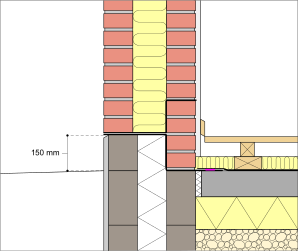
Figure 45. The position of a moisture barrier in a wall/foundation and on ground floor slab. The moisture barriers in the wall/foundations are continued to the outside. The moisture barrier is not plastered over as the plaster may act as a ‘wick’ and draw moisture upward. On the inside, the bituminous foundation waterproofing is continued on to the deck and bonded or welded to the concrete. The joint between the wall and deck moisture barriers is sealed tightly with a bonded overlap.
For renovations, a moisture barrier is sometimes used on an existing ground floor slab instead of a capillary break underneath the concrete deck. If this is the case, great care must be taken not to soil the concrete deck, as organic soiling and any humidification occurring when installing the moisture barrier could result in mould growth. The best solution in such cases would be to install a moisture barrier impermeable to oxygen (e.g., a bonded bituminous sheet or a vapour barrier applied in liquid form). The same is true of preventing moisture infiltration after water damage (e.g., resulting from a burst pipe or flooding).
Further information on moisture barriers is available in Fugtspærre i murværk (Moisture Barriers in Brickwork) (Bunch-Nielsen & Christensen, 2002) and in Vejledning om fugtspærre over vinduer og døre i murværk (Guidance to Moisture Barriers Above Windows and Doors in Brickwork) (Danish Technological Institute, 2011).
4.7.1 Radon
Radon is a radioactive soil gas. Radon will primarily enter buildings via leakage paths. This is undesirable because a high radon content in indoor air may increase the risk of lung cancer.
In new builds, moisture control in soil-facing wall and deck constructions will also act as radon shields. In deck constructions, radon entry can be prevented by incorporating a moisture barrier in the floor construction, for example.
In existing buildings, radon entry can normally be reduced by ensuring that ground floor slabs or basement floors are tight, paying special attention to cracks and gaps.
Radon can also be removed via ventilation, as radon will enter the building when air pressure in the building drops (creating positive pressure in the soil relative to the inside of the building). A ventilation solution could be to vent crawl spaces or capillary breaks via vent pipes above roof level.
The best solution is achieved by combining these two measures.
Further information on radon is available from the Byg-Erfa info sheet on radon (Byg-Erfa, 2002).
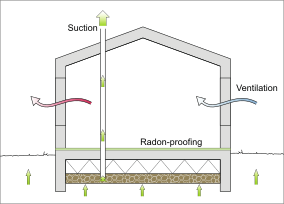
Figure 46. House ventilation and venting the capillary break via a vent pipe above roof level, combined with radon-proofing, will help to maintain a low indoor-air radon content.
4.8 Wind Barriers
It is sometimes necessary to use windproof flashing on top of the insulation in vented roof constructions or on the outside of the insulation in vented facade constructions. This is to avoid airflow in the insulation material resulting in a reduced thermal insulance factor. Wind barriers can normally be omitted in low buildings where the underlying construction can be regarded as tight. Some insulation materials can withstand a level of wind load without needing a wind barrier. It is important that the windproof layer has a suitably small diffusion resistance compared to that of a vapour barrier (if used), and other layers on the warm side of the windproof roof.
Experience shows that the diffusion resistance of the windproof layer should be 10 times less than the diffusion resistance of the materials on the warm side of the windproof layer. However, buildings with an indoor climate corresponding to humidity exposure class 1 or 2 can (subject to a moisture-performance assessment of the specific construction) sometimes be executed with just a factor-5 difference between the diffusion coefficients.
In addition to the primary performance requirements (which prevent moisture accumulation and air passage in the thermal insulation material) the windproof layer should also meet potential fire performance requirements.
Examples of commonly used wind barriers are shown in Table 5, which also indicates the typical fire classification of the products.
The windproof layer must be durable and, importantly, resistant to the impacts it will be exposed to while in use.
Table 5. Examples of wind barrier materials with a typical Z-value and fire classification. (Note that, for a specific building project, the value applicable to the specific product in question should be used.)
Material Typical Z- Value | GPa s m2/kg | Typical Fire Classification |
Light bituminous sheet (wind sheet) | 3-8 | Not classifiable |
3 mm wood-fibre sheet | 1-3 | Not classifiable |
12 mm bitumen-impregnated wood-fibre sheet | 1-3 | Not classifiable |
9 mm carton-coated wind barrier plasterboard | 0.5-1 | B-s1,d0 |
6 mm fibre cement board | 1-4 | A2-s1,d0 |
10 mm cement particle board | 1-3 | A2-s1,d0 |
Synthetic foils of various types | 0.3-2 | Depending on the material |
4.9 Fresh-Air Ventilation
A basic measure to prevent moisture damage due to condensation is to ensure a suitably low water vapour content in indoor air via fresh-air ventilation. The necessary air exchange rate is relative to the actual rate of humidification.
The Building Regulations stipulate that, in dwellings, fresh air must be supplied at the rate of at least 0.3 l/s m2, which corresponds to an air exchange rate of at least 0.5 times per hour in a room with a height of 2.5 m.
For rooms in single-family dwellings, the ventilation requirement is considered met by natural ventilation if there is an openable window or opening facing the room as well as an adjustable valve in the window or exterior wall with a free opening totalling at least 60 cm2 per 25 m2 floor area. Furthermore, specific Building Regulations requirements apply to ventilation from bathrooms, toilets, utility rooms, and kitchens. In residential buildings other than single-family dwellings with natural ventilation, mechanical ventilation is a requirement (see Section 3.3.2, Indoor Climate).
4.10 Hydrophobic Coating
Impregnation is performed to reduce humidification of materials, especially in a weather screen.
Applying a coat of proofing compound to the outside the weather screen will achieve a hydrophobic effect in otherwise hydrophilic materials such as brick or concrete.
The materials used for hydrophobic coating should be vapour-permeable to allow water vapour to dissipate.
Hydrophobic coating should be applied with care, as there are both pros and cons associated with its use. Hydrophobic coating will usually only prevent water intrusion in small openings (pores) and cannot effectively close larger openings. This leads to a concentrated water load around large leakages such as cracks in mortar joints. Furthermore, in tall buildings, hydrophobic coating may result in increased water load sustained by the lower parts of the facade because water is no longer absorbed in the upper parts. Hydrophobic coating can also change the look or colour of the treated surface.
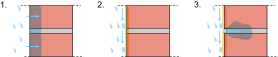
Figure 47. Hydrophobic coating.
- Water encountering an untreated surface of sorbent material (such as brick), will be wicked evenly and transported into the material in tandem with it being wetted.
- If a hydrophobic coating is applied to the surface, moisture will be repelled, and the water will run off instead.
- In areas with major leakages or untreated areas, the amount of water being drawn or pressed in by the wind will grow beyond normal levels because run-off from higher areas now add to the water load. Consequently, there is a certain risk of uneven and, in places, more intense humidification.
4.11 Surface Coatings and Treatments
The pore structure of certain materials means that they have good capillary transport properties. When the pores in the material are water-filled, there will be a liquid transport driven by the negative pressure created in the open pores. This quality can be exploited to remove condensate.
Certain calcium silicate sheets and surface treatments (including rendering) possess such qualities.
These materials can be used as interior surface cladding/treatment of damp basement walls.
Here, capillary forces will drive any moisture in the wall to the surface whence it can evaporate. Calcium silicate sheets are available in a version which, besides their capillarity also possess relatively good insulating properties, making them suited to interior re-insulation (breaking thermal bridges) on damp surfaces.
Ordinary rendering on a substrate with a high saline content (such as basement walls exposed to rising damp) will often peel and efflorescence may blemish the surface. In such cases, an option could be to try using special patching compounds, proportioned to contain the efflorescence inside the plaster layer without the plaster dropping off immediately. Patching compound will thus provide a more durable solution than ordinary rendering.
In the case of both rendering and sheeting, please remember that the final surface treatment should be vapour-permeable, like silicate paint.
4.12 Sloping Ground
To reduce water impact, the ground must slope away from the building for the first 3 m. Water is drained off to a gully or dry well.
The slope must be min. 1:40 but can be reduced to 1:50 for surface areas with a permanent compact finish (such as paving slabs). The fact that the ground may settle should be considered when constructing slopes, so that the required gradient will be achieved even after potential settling.
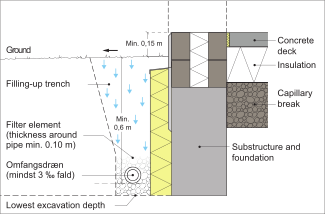
Figure 48. Moisture control measures at a building perimeter:
- Sloping ground, min. 1:40 for the first approx. 3 m from the building, and after potential settling. In areas with permanent compact finish, such as paving slabs on patios and walkways, the slope can be reduced to 1:50.
- Substructure height of min. 150 mm to avoid humidification in moisture-sensitive lower parts of the exterior wall.
- Perimeter drain to remove percolating surface water and avoid water pressure on foundations or basement walls.
4.13 Water Pressure and Drainage
The risk of humidification is especially great if water is allowed to stand along the building perimeter, as this may exert water pressure on the foundations and basement walls and floors. This water pressure will typically come from the surface through the backfill along the outer wall perimeter. It is important, therefore, that the water is drained away as quickly as it enters. This is normally done by placing a perimeter drain along the outside of the foundations. A draining layer, or so-called wall drainage system, is placed along basement walls to intercept surface water, conveying it down to the perimeter drain.
Only where the ground consists of self-draining material (such as coarse sand) can the perimeter drain be omitted. Drainage should be carried out according to DS 436, Code of Practice for the groundwater drainage of structures (Danish Standards, 1993).
For building work carried out in areas where the water table is high, or at great depth below the natural water table, special measures must be implemented to keep out the water.
4.13.1 Drainage Systems
Drainage systems can be subdivided into a filter medium (such as gravel) and a drainage element (drainage run).
The filter medium ensures collection and transport of inflowing water from the surroundings while preventing undesirable transport of solid particles into the medium and further into the drainage run. The filter medium should therefore be made of material with a grain size meeting the so-called filtration criteria, which are rules specifying the relationship between grain sizes in the filter and in the surrounding soil. When designing a filter medium, one should ensure that the size of pores and flow openings gradually increase towards the drainage run.
The drainage run will collect the drainage water and lead it away from the building (normally through a drainage system). Drainage pipes usually have slits or holes in the pipe wall, allowing water to flow into it.a
Drainage runs should be laid with a min. gradient of 3 ‰. Due to frost issues, the lower edge of the foundation for heated buildings should be at least 0.60 m below the level of the finished grade level. Furthermore, the lower edge of the drainage pipe should be at least 0.3 m below the specific structural element (e.g., the basement floor) to be protected against moisture. Excavations must not go deeper than to the lower edge of the substructure. The drainage run should be connected to a min. 300 mm gully with a grit trap and the connection should lie above the highest damming level. Alternatively, the drainage line can terminate in a sump. Here, the water can be pumped into the drainage system (cf. DS 436, Code of Practice for the groundwater drainage of structures (Danish Standards, 1993)). Figure 49 is an example of the positioning of a perimeter drain.
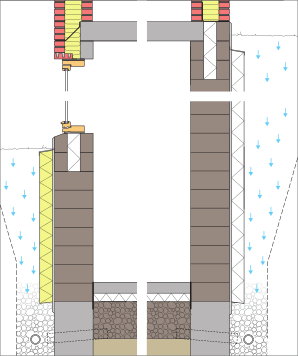
Figure 49. Profile of an exterior concrete basement wall, insulated on the outside, on low and high ground. The upper part of the exterior basement wall is built as an insulated cavity wall. The outside insulation must overlap the insulation in the upper part of the basement wall by at least 200 mm to eliminate thermal bridging, thus reducing energy loss and protecting against surface condensation. This also applies to a high-ground position. On the left side of the figure, the insulation consists of porous insulation while, on the right, polystyrene insulation with drainage grooves on the outside has been used. To protect against water pressure to the exterior basement wall, a perimeter drain has been installed to drain away percolating water. Transfer pipes drain water from the capillary break beneath the concrete floor to the perimeter drain. The ground slopes away from the building.
Pipe dimensions should be min. 70 mm to allow cleaning. Pipes and fittings should meet the requirements of DS 436, Code of Practice for the groundwater drainage of structures (Danish Standards, 1993). Pipes without sleeves should not be used.
To avoid the risk of blockage, the drainage pipe must be enclosed by a filter medium. This filter could be geotextile fabric whose permeability should be adjusted to the specific soil type. The pores in the geotextile fabric should be sufficiently large to ensure that the fabric will not clog.
The filter could also consist of course sand/gravel. If the surrounding soil consists of clay (solid cohesive soil). The filter medium could be a layer of coated, expanded clay aggregate pellets, small pebbles (2–8 mm), pea gravel (5–16 mm), or coarser materials, along with 80 mm perforated plastic piping, or similar. In sand and similar (non-cohesive soil), a filter medium of well-graded sand with d10 > 0.3 mm and 1.5 mm < d50 < 2.5 mm would be suitable. In this case, the slits in the drainpipes must be max. 1.5 mm wide.
The designations d10 and d50 indicate the mesh size of the screens allow 10 % and 50 % of the filter medium to pass through, respectively.
The thickness of a filter medium of coarse sand/gravel should be min. 0.10 m on all sides of a drainage run. When backfilling the excavation, the top layer finish should consist of a dense layer (e.g., min. 0.20 m sealing soil such as loam).
4.14 Transport, Storage, and Installation
To ensure a dry building, steps must be taken to avoid humidification during the entire construction process.
Materials arriving by transport to the building site must be packaged safely and robustly to allow handling and must be protected against moisture during transit.
During the entire construction process from factory to finished building materials should be stored in such a way as to keep them dry. Materials for outdoor use should be stored above ground level and protected against rain and potentially against frost and sun. Note that exposure to sunlight may drive moisture out of materials packaged in snug-fitting plastic such as shrink-wrap. When cooled, this moisture may result in condensation and the risk of mould growth. The covering should therefore be vented to enable such moisture to escape. If necessary, materials to be used indoors (especially wood-based materials) should be stored in conditions of similar humidity to where they will be installed.
Moisture-sensitive materials such as wood should not be installed until the construction-related moisture has dried to a level that is not harmful to the materials. Note that drying out construction-related moisture is a very time-consuming process – often lasting several months. To some extent, the drying-out process can be accelerated with dehumidifying, heating, and ventilation, or by installing dehumidifiers.
For critical work processes, it is advisable (and often economical) to totally cover the building site. One good reason for this is an improved working environment and a reduction in the number of days lost due to bad weather. More information on this topic can be found at the following resource: www.vinterkonsulenterne.dk.
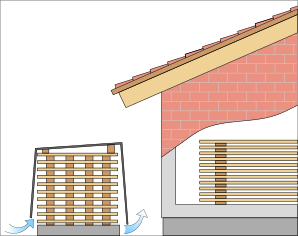
Figure 50. Building materials should be stored to protect them from humidification (e.g., as shown) in closed ventilated buildings or raised from the ground and covered by a tarpaulin. When storing materials, ensure that rainwater can drain off freely, that there is adequate ventilation to remove moist air, and that no humidification will occur via rising damp (e.g., by making sure that the ground slopes away from the storage place and by placing a moisture barrier under the stored materials). Wrapping materials in plastic foil is not enough to protect against humidification. Plastic is easily damaged and heating due to solar radiation can lead to moisture discharge. This, in turn, may form condensate on the inside of the plastic, causing moisture infiltration in the outermost parts of the materials and, ultimately, the possibility of mould growth.
Installing wooden elements should be performed as quickly as possible after their arrival on the building site to avoid lengthy on-site storage.